
Skip to content
The Encyclopedia of Horology

Pocket watch · Chiming, alarm and quarter-repeating coach watch

Wilhelm Köberle Coach Watch

Partially verified

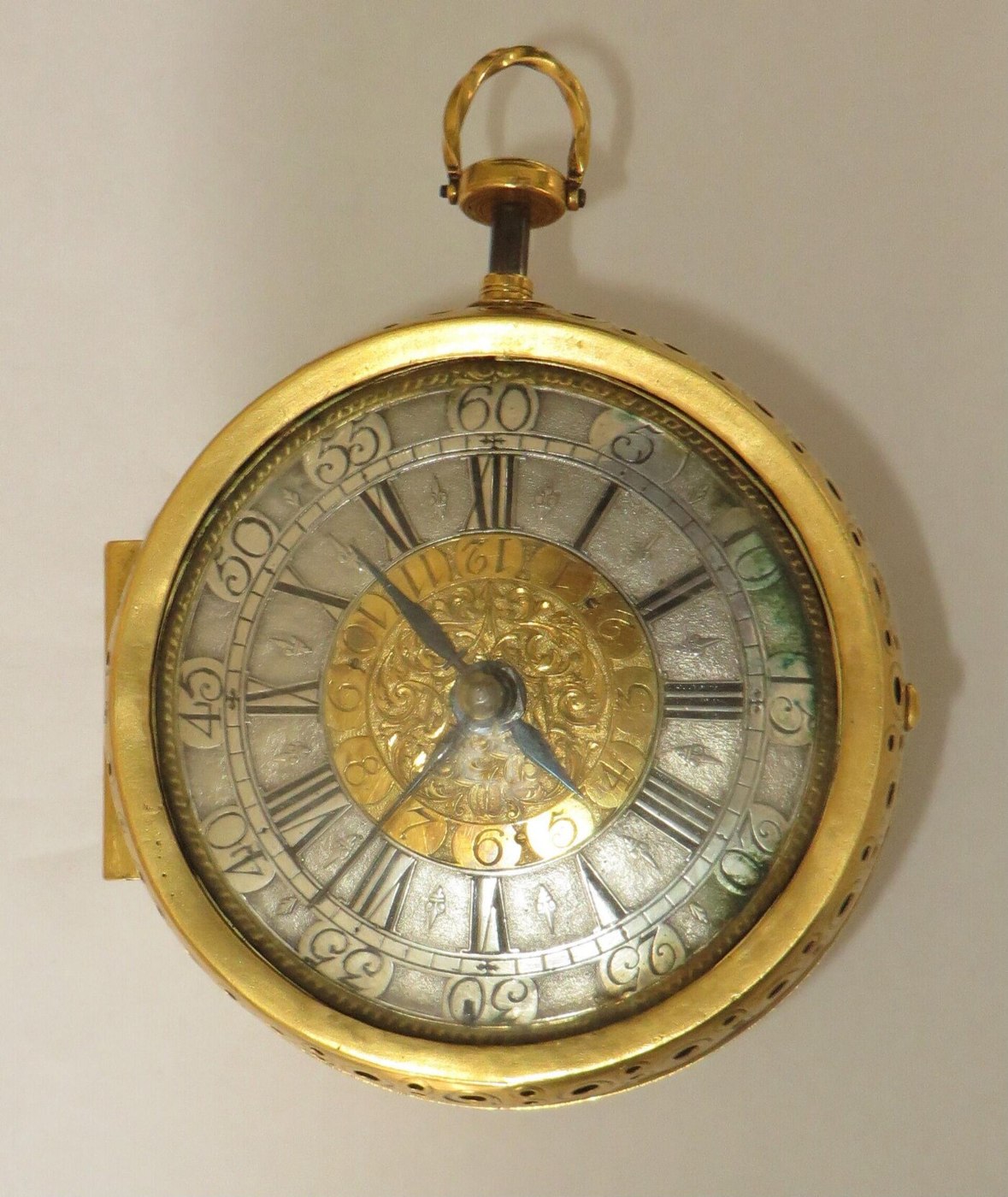
This coach watch is a chiming, alarm, and quarter-repeating timepiece created by the watchmaker Wilhelm Köberle of Eichstätt, Bavaria, around 1700. Constructed primarily of gilt brass with silver components, the watch features a pierced and engraved inner case decorated with foliage and strapwork. The dial is made of silver, featuring a central gilt brass alarm-dial engraved with foliage. The object utilizes a verge escapement and steel hands for timekeeping. It is accompanied by an outer case made of red, tooled leather decorated with gold, floral patterns, and a star-rosette. The watch was historically associated with Anselm II Schwab, Abbot of Salem, having been presented to him by the Cistercian nunnery of Rottenmünster in 1771. An inscription in the form of a chronogram, added at a later date, commemorates this historical event. The Victoria and Albert Museum acquired the watch in 1906.

Front view of the Wilhelm Köberle coach watch, showing the silver dial, alarm-dial, and pierced gilt-brass case.
Front view of the Wilhelm Köberle coach watch, showing the silver dial, alarm-dial, and pierced gilt-brass case. — Victoria and Albert Museum, London. Rights pending — permission not yet requested. Original source

Catalogue identity

Source
collections.vam.ac.uk
Category
Pocket watch · Chiming, alarm and quarter-repeating coach watch
Maker / attribution
Wilhelm Köberle
Reference
Not recorded
Catalogue / lot identifier
276-1906
Source-reported date
ca. 1700
Source-reported place
Germany

Source-reported attribution and specifications are not independent authentication. A listing does not establish present ownership, current display, availability or permission to reproduce.

Object description

Case and Dial Design

The watch is housed in a gilt-brass case that is both functional and decorative. The inner case is extensively pierced and engraved with intricate foliage and strapwork, a decorative motif that extends to the balance-cock. The dial is fashioned from silver and incorporates a central gilt-brass alarm-dial that is similarly engraved with foliage.

The outer protective case is made of red, tooled leather. This cover is decorated with gold-toned details including enriched borders, various floral motifs, and a star-rosette, providing both protection and aesthetic ornamentation. The watch features steel hands for timekeeping and is fitted with a matching brass key.

Evidence for this section
  • “The inner case is pierced and engraved with foliage and strapwork and the balance-cock is of similar work.”
  • “The face is of silver with gilt brass alarm-dial in the middle engraved with foliage.”
  • “The outer case is of red leather decorated with gold with enriched borders, flowers, and a star-rosette.”

Mechanism and Functionality

The movement is a complex design for the period, functioning as a clock-watch with alarm and quarter-repeating capabilities. The mechanism is designed to sound the time on a bell, providing both a visual and auditory experience for the user.

The watch includes an alarm mechanism centered on the dial, which is adjusted using the central gilt brass disc. The repeating work allows for the time to be struck on demand, facilitating usage in low-light conditions.

Evidence for this section
  • “Chiming, alarm and quarter-repeating coach watch”
  • “The inner case is pierced and engraved with foliage and strapwork and the balance-cock is of similar work.”
  • “Verge escapement.”

Provenance and Inscription

The object carries a specific historical record related to its ownership. In 1771, it was presented by the Cistercian nunnery of Rottenmünster to Anselm II Schwab, the Abbot of Salem, to recognize his role in settling a dispute between the town of Rottweil and the nunnery.

The case bears a later-added chronogram, which translates to a formal dedication to Abbot Anselm II Schwab, identifying him as a defender and arbiter of peace. This inscription provides a firm terminus ante quem for the association between the watch and the Abbot, specifically referencing the year 1771.

Evidence for this section
  • “The watch was given in 1771 by the Cistercian nunnery of Rottenmünster, near Rottweil, to the abbot of the monastery of Salem, Anselm II Schwab”
  • “Inscribed at a later date with a chronogram: ANSELMO II. ABBATI. IVRIS. RVBRI. PARTHENONIS. ASSERTORI. DEFENSORI. AC. PACIS. ARBITRO.”

Open research questions

  • What is the specific nature of the chiming mechanism's strike train (e.g., repeating work type)?
  • Are there other signed works by Wilhelm Köberle surviving in public collections for comparison?

Source evidence

Recorded claims and source quotations for Wilhelm Köberle Coach Watch
FieldSource-reported valueSource quotation
MakerWilhelm Köberle“Maker: Köberle, Wilhelm (watchmaker)”
Dateca. 1700“Date: ca. 1700”
Accession number276-1906“Accession number: 276-1906”
Place of originEichstätt, Germany“Place of origin: Eichstätt (made)”
Dimensions145 mm x 115 mm x 65 mm“Height: 145 mm; Width: 115 mm; Depth: 65 mm”
ChronogramAnselm II Schwab“Inscribed at a later date with a chronogram: ANSELMO II. ABBATI. IVRIS. RVBRI. PARTHENONIS. ASSERTORI. DEFENSORI. AC. PACIS. ARBITRO.”
ProvenanceRottenmünster nunnery“The watch was given in 1771 by the Cistercian nunnery of Rottenmünster, near Rottweil, to the abbot of the monastery of Salem, Anselm II Schwab”

Visible details

  • Silver dial with central gilt-brass alarm dial
  • Pierced and engraved gilt-brass casing with strapwork
  • Steel hands
  • Suspension bow at the top of the case

Research qualifications

  • The chronogram inscription is stated to be a later addition
  • Exact mechanical internal condition is not described

Photograph identity and source facts were screened before import; rights clearance remains pending.

Consulted source

Watch

Reviewed 2026-10-26 · Record eee536efa2

Terms in this record

Glossary explanations for terms named in this object’s record.