
Skip to content
The Encyclopedia of Horology

Pocket watch · Pendant watch

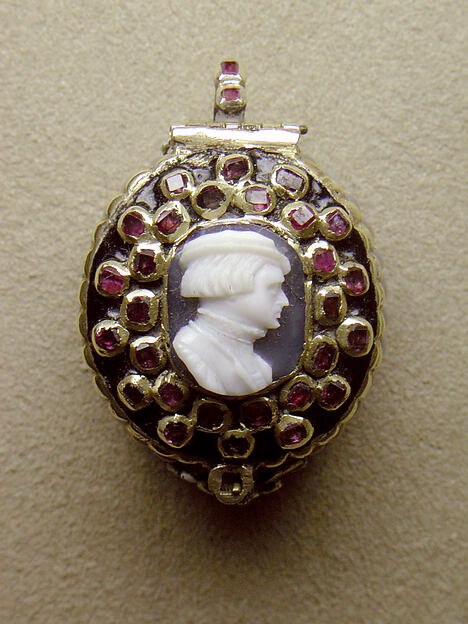
Watch with cameo cover by Wilhelm Peffenhauser

Partially verified

This watch, attributed to Wilhelm Peffenhauser (born 1618, master 1647, died before 1683), dates to circa 1650 and is of German, Augsburg origin. It is a small, ornate piece measuring approximately 3.8 by 2.7 by 1.9 cm. The case is constructed from agate and features an onyx cameo set into a cover of enameled gold, which is further decorated with rubies. The dial is executed in engraved gold and silver. The internal movement is crafted from gilded brass and steel, with components that are partly blued. The cameo component itself is historically distinct, attributed to the 16th–17th century. The watch is currently held in the collection of The Metropolitan Museum of Art as accession number 17.190.1517, representing an example of Augsburg watchmaking from the mid-17th century with integrated decorative lapidary work.

The watch is shown open, revealing the engraved gold and silver dial.
The watch is shown open, revealing the engraved gold and silver dial. — The Metropolitan Museum of Art, New York. Rights pending — permission not yet requested. Original source

Catalogue identity

Source
orbiscollectibles.com
Category
Pocket watch · Pendant watch
Maker / attribution
Wilhelm Peffenhauser
Reference
Not recorded
Catalogue / lot identifier
17.190.1517
Source-reported date
ca. 1650
Source-reported place
Germany, Augsburg

Source-reported attribution and specifications are not independent authentication. A listing does not establish present ownership, current display, availability or permission to reproduce.

Object description

Case and External Decoration

The external presentation of this watch centers on an intricate cover comprising an onyx cameo depicting a portrait profile. This cameo is inset into a gold frame, which is finished with enamel and decorated with a series of rubies.

The body of the case is fashioned from agate, featuring a distinct, radial fluted carving that creates a textured, fan-like appearance on the surface.

Evidence for this section
  • “Case: agate, onyx cameo, with cover of enameled gold set with gemstones (rubies)”
  • “Overall (visible cameo): 13.8 × 11 mm”

Dial and Movement

The interior dial is crafted from engraved gold and silver, presenting a decorative, patterned surface beneath the hands. The numerals are arranged within a ring on the dial face, contrasting with the central engraved work.

The internal mechanism is built using gilded brass and steel components. Some of the steel parts, including those within the escapement or motion work, are blued, a technique often used for both functional protection and decorative contrast in horological works of this era.

Evidence for this section
  • “Dial: engraved gold and silver”
  • “Movement: gilded brass and steel, partly blued”

Provenance and Documentation

The object is held in the collection of The Metropolitan Museum of Art under the accession number 17.190.1517. It was gifted to the museum by J. Pierpont Morgan in 1917.

The maker is attributed to Wilhelm Peffenhauser of Augsburg. While the watch is dated to approximately 1650, the cameo inset is dated more broadly to the 16th or 17th century, indicating it may have been an earlier decorative element incorporated into the watch assembly.

Evidence for this section
  • “The Metropolitan Museum of Art holds this object as 17.190.1517”
  • “Gift of J. Pierpont Morgan, 1917”
  • “watch ca. 1650, cameo 16th–17th century”

Open research questions

  • Does the 16th-century date of the cameo suggest it was repurposed from a piece of jewelry for this watch?
  • Can the internal movement be linked to specific Augsburg manufacturing techniques known from Peffenhauser's period?

Source evidence

Recorded claims and source quotations for Watch with cameo cover by Wilhelm Peffenhauser
FieldSource-reported valueSource quotation
MakerWilhelm Peffenhauser“Watch made by Wilhelm Peffenhauser (German, Augsburg, born 1618, master 1647, died before 1683)”
Dateca. 1650“watch ca. 1650, cameo 16th–17th century”
Case MaterialsAgate, onyx, gold, enamel, rubies“Case: agate, onyx cameo, with cover of enameled gold set with gemstones (rubies)”
Dial MaterialsEngraved gold and silver“Dial: engraved gold and silver”
Movement MaterialsGilded brass, steel“Movement: gilded brass and steel, partly blued”
Dimensions1 1/2 × 1 1/16 × 3/4 in.“Overall: 1 1/2 × 1 1/16 × 3/4 in. (3.8 × 2.7 × 1.9 cm)”
Accession Number17.190.1517“The Metropolitan Museum of Art holds this object as 17.190.1517”

Visible details

  • The watch features a central portrait profile on the outer cover.
  • The agate case body is carved with a radial fluted pattern.
  • The inner dial is surrounded by engraved gold and silver floral-style ornamentation.
  • A small suspension loop is mounted at the top of the case.

Research qualifications

  • The cameo component is described as 16th–17th century, potentially pre-dating the watch movement.
  • The watch is attributed to Wilhelm Peffenhauser, but the record notes research is required to confirm the maker and wider type.

Photograph identity and source facts were screened before import; rights clearance remains pending.

Terms in this record

Glossary explanations for terms named in this object’s record.