
Skip to content
The Encyclopedia of Horology

Pocket watch · Octagonal watch

Watch, ca. 1680

Partially verified

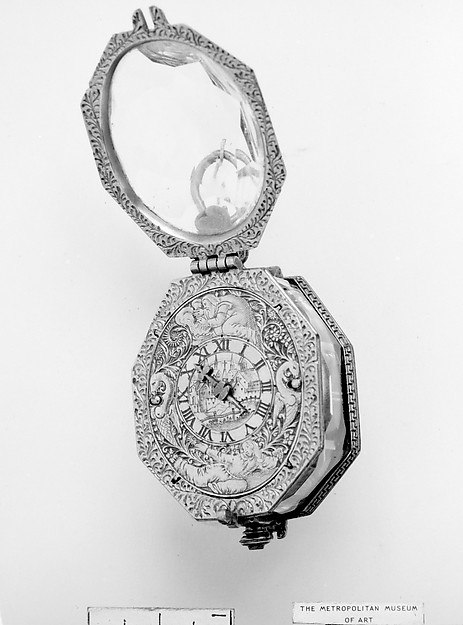
This watch, currently held in the collection of The Metropolitan Museum of Art (accession 17.190.1530), is attributed to approximately 1680. It represents a small-scale horological object featuring an octagonal construction. The case is manufactured from rock crystal combined with gilded and engraved brass. The watch measures 1 7/8 by 1 1/2 inches (4.8 by 3.8 cm). Internally, the movement is composed of gilded brass and iron components. As an item within a public museum collection, the watch has been catalogued by the European Sculpture and Decorative Arts department. The physical design integrates the rock crystal with decorative metalwork on the exterior. This object serves as an example of seventeenth-century watchmaking, preserved within the museum's permanent holdings. No specific maker or original geographic origin is provided in the source documentation, which notes that further research is required to verify the wider type, specific maker, and date through specialist reference materials.

A front view of the octagonal watch with its lid open, revealing the engraved dial and Roman numerals.
A front view of the octagonal watch with its lid open, revealing the engraved dial and Roman numerals. — The Metropolitan Museum of Art, New York. Rights pending — permission not yet requested. Original source

Catalogue identity

Source
orbiscollectibles.com
Category
Pocket watch · Octagonal watch
Maker / attribution
Not established
Reference
Not recorded
Catalogue / lot identifier
17.190.1530
Source-reported date
ca. 1680
Source-reported place
Not established

Source-reported attribution and specifications are not independent authentication. A listing does not establish present ownership, current display, availability or permission to reproduce.

Object description

Case Construction and Design

The watch is housed in an octagonal case that utilizes both natural and metallic materials. The primary structure incorporates rock crystal, which is paired with brass components that have been gilded and engraved. This material combination results in a visual contrast between the polished transparency of the crystal and the decorative metalwork.

The engraving on the brass portions of the watch suggests a decorative focus, with intricate patterns surrounding the dial. The construction includes a hinged cover that allows access to the dial, with the crystal framed by the engraved metal border. The dimensions are compact, measuring 4.8 cm by 3.8 cm, consistent with traditional pocket-carried timepieces of the era.

Evidence for this section
  • “Case: rock crystal, gilded and engraved brass”
  • “1 7/8 × 1 1/2 in. (4.8 × 3.8 cm)”

Movement and Internal Components

The internal mechanism is constructed primarily from gilded brass, with additional use of iron for specific components within the movement. The gilded finish on the brass elements is consistent with the external metalwork found on the case, suggesting a unified approach to the watch's assembly.

The source identifies the movement materials as part of the formal museum record.

Evidence for this section
  • “movement: gilded brass, iron”

Provenance and Documentation

This watch is part of the collection of The Metropolitan Museum of Art in New York. It is identified by the accession number 17.190.1530 and was catalogued by the institution’s European Sculpture and Decorative Arts department. The object has been documented in the museum's open-access records.

The museum assigns a date of approximately 1680 to the piece. While these details are derived from museum documentation, the source notes that the object's wider classification and attribution require further verification through independent specialist literature to confirm its precise historical and technical context.

Evidence for this section
  • “Watch in The Metropolitan Museum of Art, New York (accession 17.190.1530)”
  • “The museum dates it ca. 1680.”
  • “These details are transcribed from the museum's open-access record; how far this object represents a wider collectible type has not yet been independently verified.”

Open research questions

  • What is the specific movement configuration and escapement type used in this watch?
  • Can the engraving style be linked to a specific region or school of decorative arts?
  • Are there similar octagonal rock crystal watches in other public collections that share design features with this object?

Source evidence

Recorded claims and source quotations for Watch, ca. 1680
FieldSource-reported valueSource quotation
Accession number17.190.1530“17.190.1530”
Dateca. 1680“ca. 1680”
Case materialsRock crystal, gilded and engraved brass“Case: rock crystal, gilded and engraved brass”
Movement materialsGilded brass, iron“movement: gilded brass, iron”
Dimensions1 7/8 x 1 1/2 in. (4.8 x 3.8 cm)“1 7/8 × 1 1/2 in. (4.8 × 3.8 cm)”

Visible details

  • The watch has an octagonal case shape.
  • The dial plate is heavily engraved with scrollwork and figures.
  • The watch includes an opening lid containing a rock crystal panel.
  • The dial features Roman numerals for the hours.

Research qualifications

  • The exact maker of the movement and case is not identified in the museum records.
  • The geographic origin of the watch remains unconfirmed in the provided documentation.

Photograph identity and source facts were screened before import; rights clearance remains pending.

Consulted source

Watch, ca. 1680

Reviewed 2026-11-02 · Record 683d558d5e

Terms in this record

Glossary explanations for terms named in this object’s record.