
Skip to content
The Encyclopedia of Horology

Pocket watch · Pair-cased watch and chatelaine

Watch and chatelaine

Partially verified

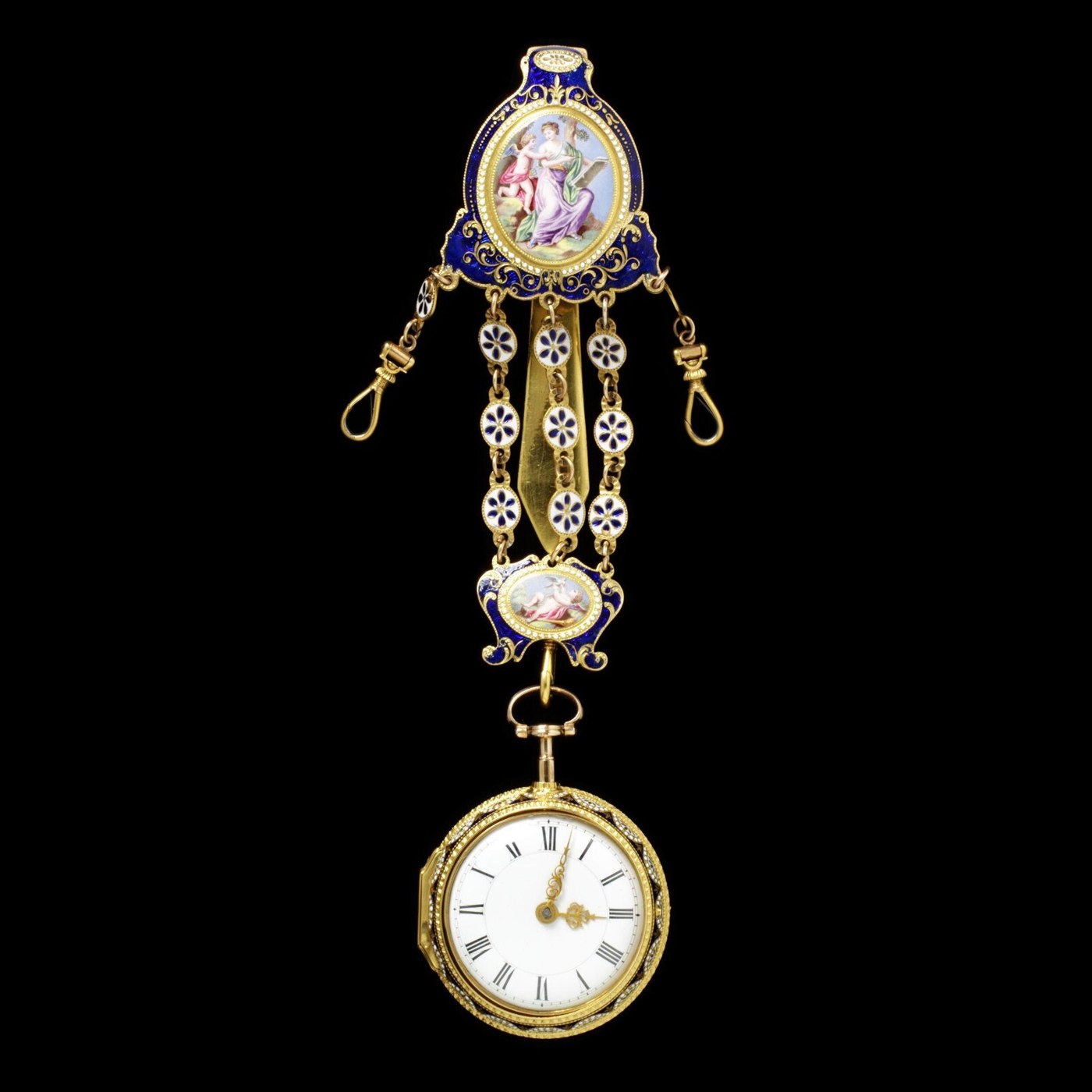
This pair-cased pocket watch is suspended from a matching chatelaine, together forming an integrated ensemble crafted from enamelled gold. The set was produced in London between 1779 and 1780 and bears the appropriate London hallmarks for this timeframe. The maker of the watch and chatelaine remains unidentified. The visual aesthetic of the set relies on a consistent application of blue enamel backgrounds, intricate gold filigree-style patterning, and finely executed painted enamel vignettes. The decorative motifs feature specific iconography, including depictions of Cupids engaged in various activities such as writing, interacting with a dove, and lighting a torch at an altar of love. The chatelaine is structured with chains composed of enameled floral links and terminating in swivel clasps. The round watch, suspended at the base of the chatelaine, displays a white dial featuring Roman numeral hour markers and ornate golden hands.

Pair-cased watch and matching chatelaine with enamel decoration.
Pair-cased watch and matching chatelaine with enamel decoration. — Victoria and Albert Museum. Rights pending — permission not yet requested. Original source

Catalogue identity

Source
orbiscollectibles.com
Category
Pocket watch · Pair-cased watch and chatelaine
Maker / attribution
Not established
Reference
M.294:1 to 3-1919
Catalogue / lot identifier
M.294:1 to 3-1919
Source-reported date
1779-1780
Source-reported place
London

Source-reported attribution and specifications are not independent authentication. A listing does not establish present ownership, current display, availability or permission to reproduce.

Object description

Construction and Decoration

The ensemble is constructed from enamelled gold, utilizing a palette centered on blue enamel backgrounds. The surface is adorned with gold filigree-style patterning that provides a textured contrast to the smooth enamel finishes. These technical elements are further enriched by the inclusion of painted enamel vignettes, which serve as the primary focus of the chatelaine’s decorative program.

The imagery presented within these vignettes centers on allegorical scenes featuring Cupids. These figures are shown in various domestic and mythological settings, such as writing, interacting with a dove, or performing symbolic actions like lighting a torch at an altar of love. The integration of these elements creates a cohesive aesthetic between the chatelaine structure and the suspended timepiece.

Evidence for this section
  • “crafted in enamelled gold”
  • “The chatelaine and watch are decorated with blue enamel backgrounds, gold filigree-style patterning, and painted enamel vignettes”
  • “The decorative iconography includes scenes depicting Cupids inspiring writing, playing with a dove, and lighting a torch at an altar of love”

Structure and Function

The chatelaine acts as the suspension mechanism for the watch, utilizing a series of chains comprised of individual enameled floral links. These chains are fitted with swivel clasps that allow for the attachment of the timepiece. The overall design results in an assembly where the round watch is positioned at the base of the supporting apparatus.

The watch itself follows a pair-cased construction. The face of the watch features a white dial characterized by the use of Roman numerals for the hour markers. This arrangement is consistent with the standard timekeeping displays found on watches of the late 18th century, emphasizing legibility within a decorative frame.

Evidence for this section
  • “Connected by chains with enameled floral links and swivel clasps”
  • “the ensemble carries the round watch at its base”
  • “features a white dial with Roman numeral hour markers”

Documentation and Attribution

The ensemble is preserved under the accession number M.294:1 to 3-1919 within the Victoria and Albert Museum. Records for this object indicate it was produced in London during the period of 1779 to 1780. The museum documentation confirms that the set bears the official London hallmarks corresponding to this specific date range.

Despite the level of documentation provided by the museum, the specific maker responsible for the creation of the watch and chatelaine is currently unknown. The attribution is limited to the date and location of production, leaving the identity of the individual craftsman or workshop unverified in the existing collection records.

Evidence for this section
  • “Museum object number M.294:1 to 3-1919”
  • “Produced in London between 1779 and 1780”
  • “the set bears London hallmarks for that period”

Open research questions

  • What is the specific nature of the watch movement hidden within the pair case?
  • Is there further archival evidence within the V&A records to suggest a specific workshop for the gold enamelling?

Source evidence

Recorded claims and source quotations for Watch and chatelaine
FieldSource-reported valueSource quotation
Object nameWatch and chatelaine“Watch and chatelaine”
Museum numberM.294:1 to 3-1919“M.294:1 to 3-1919”
Place of manufactureLondon“Produced in London”
Dating1779-1780“1779-1780”
MaterialsEnamelled gold“enamelled gold”
Decorative elementsCupid iconography“scenes depicting Cupids inspiring writing, playing with a dove, and lighting a torch at an altar of love”
Watch dialWhite with Roman numerals“white dial with Roman numeral hour markers”

Visible details

  • Blue enamel background
  • Gold filigree-style patterning
  • Painted enamel vignettes of Cupids
  • White dial with Roman numerals

Research qualifications

  • Maker is currently unknown
  • Exact nature of the internal movement is not specified

Photograph identity and source facts were screened before import; rights clearance remains pending.

Consulted source

Watch and chatelaine

Reviewed 2026-11-02 · Record 2e6035d926

Terms in this record

Glossary explanations for terms named in this object’s record.