
Skip to content
The Encyclopedia of Horology

Clock · Wall clock

Wall clock with bracket

Partially verified

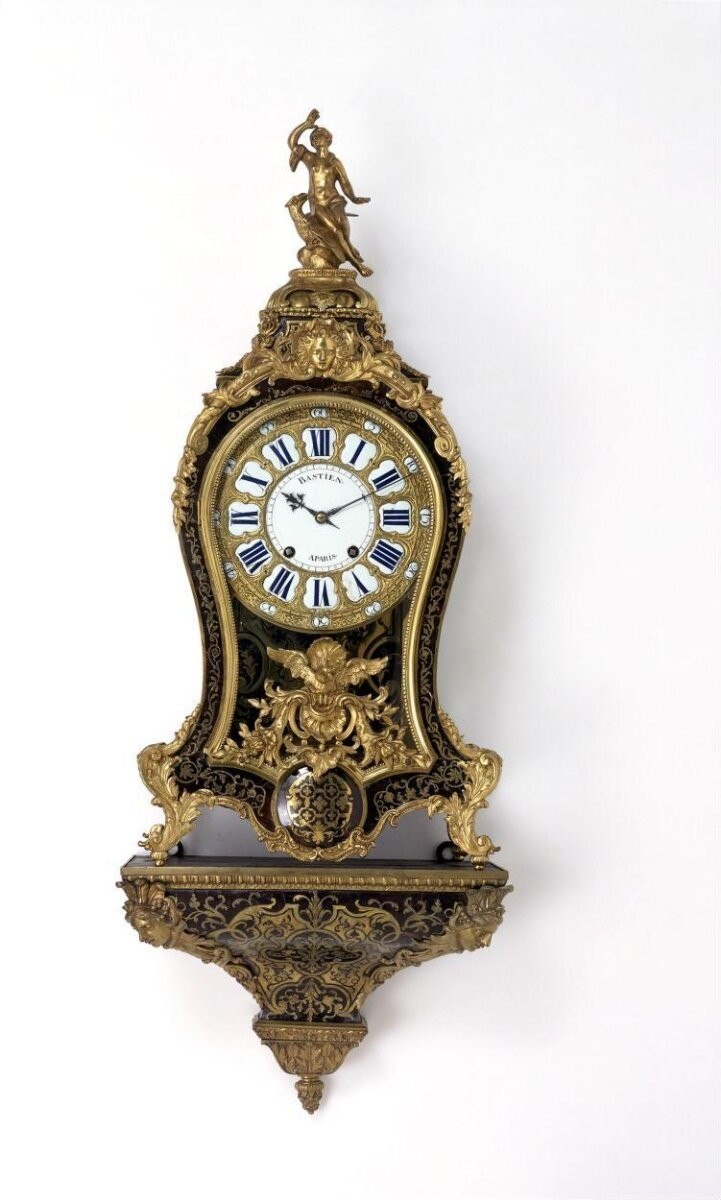
This wall clock and matching bracket comprise a single horological object of waisted, serpentine form. The carcase is primarily of oak for the clock and pine for the bracket, both of which are finished in a boulle marquetry veneer of turtleshell inlaid with engraved brass. The piece is further decorated with gilt-brass mounts. The dial is composed of thirteen individual enamel plaques—one central and twelve hour plaques—decorated with black Roman numerals and set into a gilt-brass frame. Surmounting the clock is a sculptural group depicting a young woman carried on an eagle. The clock movement, signed by Joseph-Joachim Bastien of Paris, features mainsprings signed by the maker Ladoüé, dated January 1740.

Wall clock with separate bracket, veneer of turtleshell and brass, signed by Bastien.
Wall clock with separate bracket, veneer of turtleshell and brass, signed by Bastien. — Victoria and Albert Museum, London. Rights pending — permission not yet requested. Original source

Catalogue identity

Source
collections.vam.ac.uk
Category
Clock · Wall clock
Maker / attribution
Joseph-Joachim Bastien
Reference
Not recorded
Catalogue / lot identifier
M.354&A-1940
Source-reported date
ca. 1740
Source-reported place
France

Source-reported attribution and specifications are not independent authentication. A listing does not establish present ownership, current display, availability or permission to reproduce.

Object description

Construction and Design

The wall clock is designed with a waisted, serpentine silhouette that incorporates both a clock case and a matching wall bracket. Both components are covered in a decorative veneer of boulle marquetry, which combines inlaid engraved brass with dark turtleshell. This decorative scheme is supplemented by cast and chased gilt-brass mounts. The top of the clock features a separate cresting section, which is topped by a sculptural group depicting a young woman being carried by an eagle.

The dial is constructed from a gilt-brass framework holding thirteen separate enamel plaques. These include a central plaque and twelve individual plaques for the hours, which are inscribed with black Roman numerals.

Evidence for this section
  • “Carcase probably of oak, the bracket of pine, both veneered in boulle marquetry of turtleshell and brass, with gilt-brass mounts”
  • “The dial is more up-to-date in style, with 13 separate plaques of enamel set into a gilt-brass framework”
  • “The sweeping lines of the case follow the fashionable curves of the Rococo style.”

Signatures and Inscriptions

The clock movement is signed by the maker Joseph-Joachim Bastien, with an inscription appearing on the exterior of the movement's backplate as 'Bastien Aparis'. The dial also displays the signature 'BASTIEN À PARIS' in black enamel. These signatures identify the maker of the clock movement as Bastien.

Additional technical documentation is found on the movement's components; both mainsprings are engraved with the signature 'Ladoüé Janvier 1740'. This practice indicates the involvement of a specialist component maker for the mainsprings, providing a specific date of January 1740 for the manufacture of these parts.

Evidence for this section
  • “Bastien, Joseph-Joachim”
  • “Bastien Aparis”
  • “Ladoüé Janvier 1740”
  • “Mainsprings were often signed in such a way by their specialist makers.”

Provenance and Identification

The object is catalogued in the museum collection under the accession number M.354&A-1940. It was acquired as a gift from Christina H. M. and Frances E. Holly. The item is identified as a wall clock of a form that was standard in France during the mid-eighteenth century, specifically the period between 1735 and 1760.

The design of the case adheres to the Rococo style, utilizing curved lines. While the movement and dial are contemporary with the manufacture date of circa 1740, the documentation notes that the decoration of such clocks could sometimes appear more traditional or old-fashioned when compared to other furnishings from the same period, as evidenced by the earlier style of the marquetry in this instance.

Evidence for this section
  • “Accession number: M.354&A-1940”
  • “Given by Christina H. M. and Frances E. Holly”
  • “This was the standard form for a fashionable wall clock in France from about 1735 to 1760.”
  • “In this example the tight, symmetrical scrolling pattern of the boulle marquetry – which combined brass and dark tortoiseshell and was named after André-Charles Boulle, cabinetmaker to Louis XIV – is closer to designs of the period before 1720 than to those of 1740.”

Open research questions

  • What is the specific relationship between the clock case cabinetmaker and the movement maker Bastien?
  • Are there visible indications of restoration to the boulle marquetry given the divergence in style from the 1740 date?

Source evidence

Recorded claims and source quotations for Wall clock with bracket
FieldSource-reported valueSource quotation
MakerJoseph-Joachim Bastien“Bastien, Joseph-Joachim”
Movement signatureBastien Aparis“Bastien Aparis”
Mainspring signaturesLadoüé Janvier 1740“Ladoüé Janvier 1740”
MaterialsOak, pine, turtleshell, brass, gilt-brass, enamel“Carcase probably of oak, the bracket of pine, both veneered in boulle marquetry of turtleshell and brass, with gilt-brass mounts; the dial plate enamelled in white, blue and black”
Production dateca. 1740“ca. 1740”

Visible details

  • Clock and bracket feature boulle marquetry of turtleshell and brass
  • Dial uses thirteen separate enamel plaques with Roman numerals
  • Cresting features a sculptural figure of a woman on an eagle
  • Waisted serpentine shape of clock and bracket

Research qualifications

  • The exact origin of the clock carcase wood is stated as 'probably' oak and the bracket 'probably' pine
  • The source describes the marquetry pattern as being closer to designs before 1720 than 1740, contrasting with the overall dating

Photograph identity and source facts were screened before import; rights clearance remains pending.

Terms in this record

Glossary explanations for terms named in this object’s record.