
Skip to content
The Encyclopedia of Horology

Clock · Wall clock

Wall Clock

Partially verified

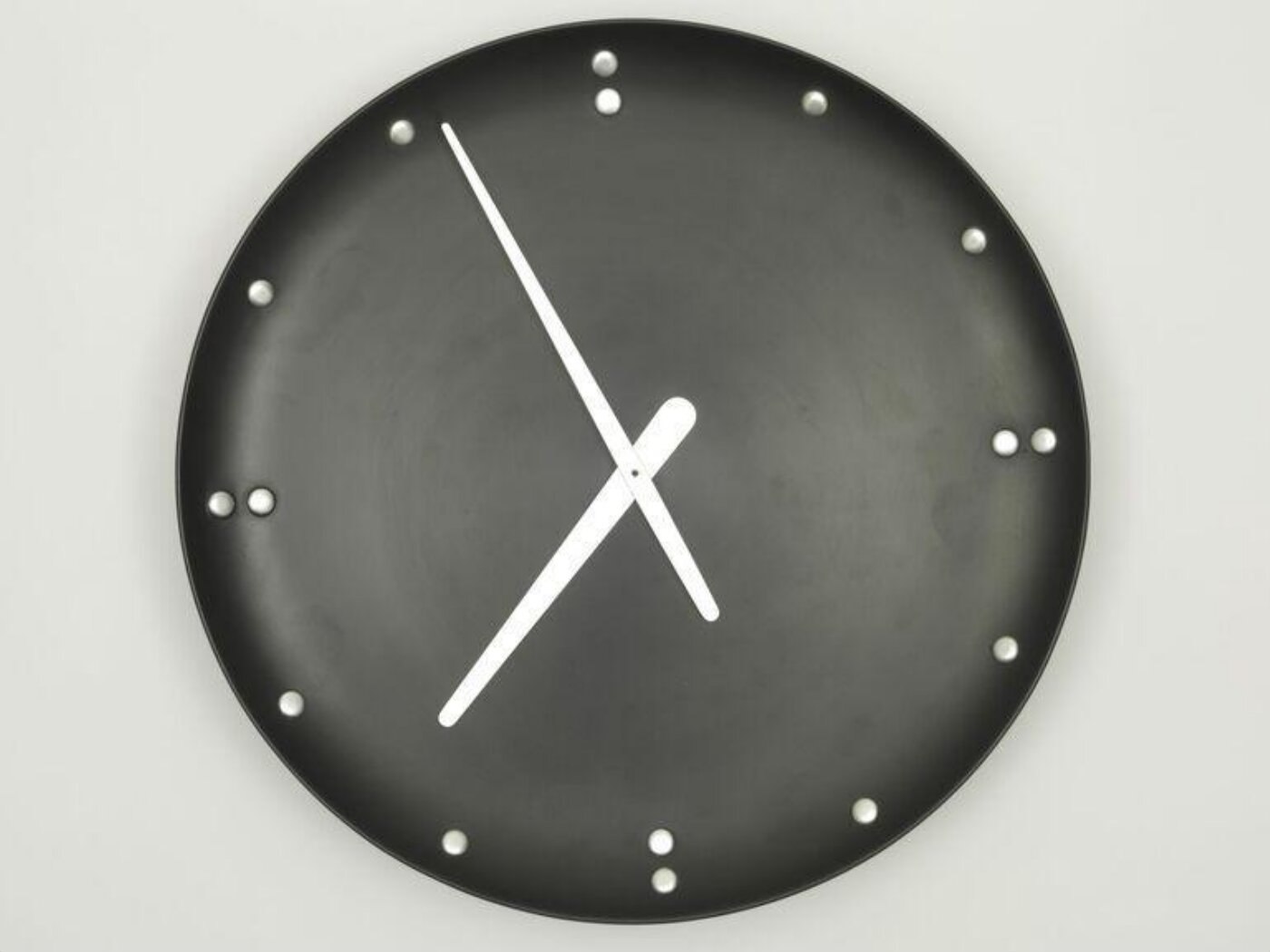
This wall clock is an circular timekeeping instrument designed by Finn Juhl and manufactured in Denmark after 1952. The clock face is crafted from dish-shaped carved wood, finished with a black painted surface. Aluminium is employed for the hour markers and the hands. The hourly graduation is marked by individual aluminium roundels positioned around the perimeter, with double roundels used to indicate the quarter-hour intervals. The centre of the dial features two aluminium hands of contrasting length: a thicker, shorter hour hand and a slimmer, longer minute hand. The reverse of the clock incorporates an aluminium bracket for mounting purposes, which also serves to conceal the internal electrical movement and the mounting hardware. The object measures 49.5 cm in diameter.

Front view of the circular wall clock showing the black dial, aluminium roundels, and aluminium hands.
Front view of the circular wall clock showing the black dial, aluminium roundels, and aluminium hands. — Victoria and Albert Museum, London. Rights pending — permission not yet requested. Original source

Catalogue identity

Source
collections.vam.ac.uk
Category
Clock · Wall clock
Maker / attribution
Finn Juhl (designer)
Reference
Not recorded
Catalogue / lot identifier
W.8-2020
Source-reported date
after 1952
Source-reported place
Denmark

Source-reported attribution and specifications are not independent authentication. A listing does not establish present ownership, current display, availability or permission to reproduce.

Object description

Design and Appearance

The wall clock features a distinctive circular, dish-shaped face constructed from carved wood. This main body is painted in black, providing a uniform dark background for the dial elements. The perimeter is punctuated by small aluminium roundels that function as indices for the twelve hours. At each quarter-hour position, these markers are doubled, with two roundels placed side-by-side to create a visual distinction from the single roundels marking the other hours.

Two aluminium hands are fixed at the centre of the dial. The hour hand is noticeably thicker and shorter, while the minute hand is slimmer in profile and extends further toward the edge of the dial, terminating just inside the circle of roundels. Both hands share a consistent metallic finish, contrasting with the dark face of the clock.

Evidence for this section
  • “carved and painted wood with aluminium dials”
  • “The clock’s numerals are distinguished by small aluminium roundels that circle its border.”
  • “Each quarter of the clock is illustrated by the repetition of two roundels stacked beside one another.”

Construction and Mechanics

The technical core of the clock is housed behind the primary dial face. The manufacturer responsible for the assembly of the piece remains unidentified in the records. The movement is specified as an electrical mechanism, which is housed within the casing.

The rear of the clock is equipped with an aluminium mounting bracket. This component serves a dual purpose: it provides the structural support required for hanging the object on a wall and acts as a protective cover for both the mounting hook and the electrical movement, keeping the internal mechanism concealed from view while the clock is in use.

Evidence for this section
  • “electrical mechanism”
  • “The back of the clock face consists of an aluminium bracket for mounting, which also conceals a hook and the clock’s electrical mechanism.”
  • “maker unknown”

Attribution and Dating

The design of the clock is attributed to the Danish designer Finn Juhl. Documentation indicates that the design was completed no later than 1952. However, the actual physical production of this specific object occurred at a later stage.

The chronological data provided for the object distinguishes between the design phase and the manufacture date. While the design is associated with a circa 1952 timeline, the source confirms that the object itself was manufactured subsequent to that period.

Evidence for this section
  • “designed by Finn Juhl, Denmark, not later than 1952”
  • “made after 1952”
  • “circa 1952”

Open research questions

  • What specific company or entity was responsible for the electrical movement utilized in this clock?
  • Are there known examples of this model that were produced prior to 1952 to verify the initial production timeline?

Source evidence

Recorded claims and source quotations for Wall Clock
FieldSource-reported valueSource quotation
DesignerFinn Juhl“Finn Juhl (designer)”
Accession NumberW.8-2020“Accession number: W.8-2020”
Place of OriginDenmark“Place of origin: Denmark (made)”
Diameter49.5 cm“Diameter: 49.5 cm”
Dial MaterialPainted wood“Painted wood, aluminium hands and hour markers, electrical mechanism”
DateAfter 1952“made after 1952”

Visible details

  • Dish-shaped wooden dial with matte black finish
  • Aluminium roundels serve as hour markers
  • Double roundel markers at quarter-hour positions
  • Two-handed aluminium display

Research qualifications

  • The manufacturer of the clock is currently unknown
  • The exact date of manufacture remains defined only as after 1952

Photograph identity and source facts were screened before import; rights clearance remains pending.

Consulted source

Wall Clock

Reviewed 2026-10-26 · Record a5c154f396

Terms in this record

Glossary explanations for terms named in this object’s record.