
Skip to content
The Encyclopedia of Horology

Clock · Mantel clock

Victorian Miniature Longcase Clock

Partially verified

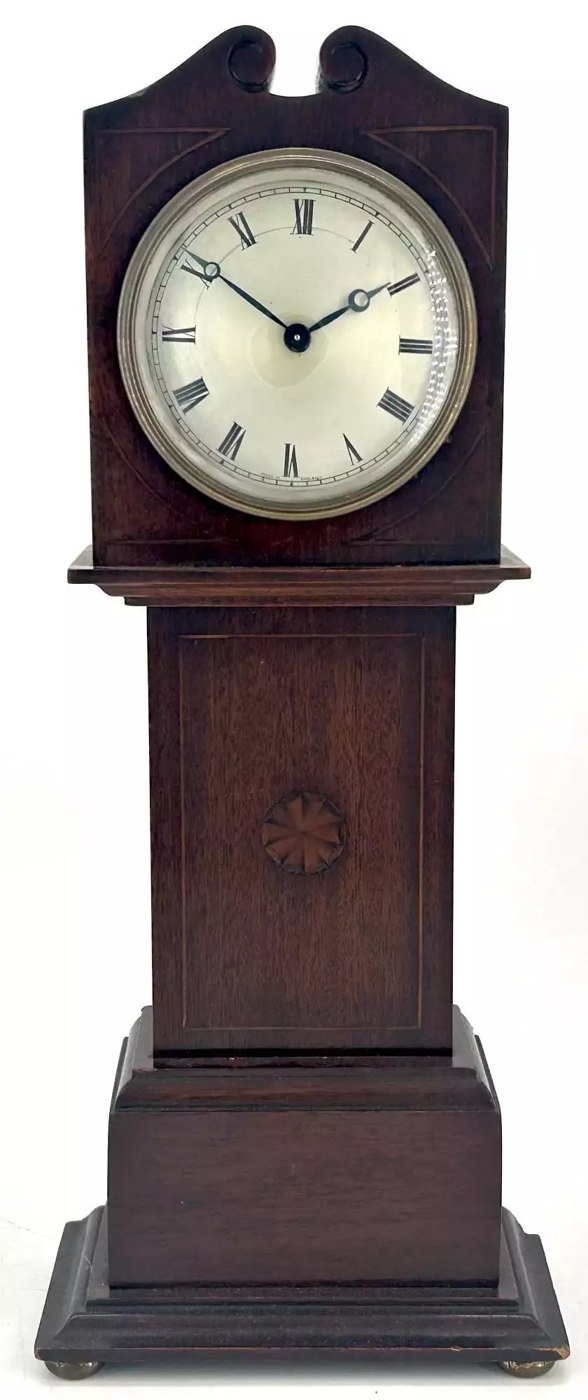
This miniature mantel clock is presented in a mahogany case designed to resemble a full-scale longcase or "grandfather" clock. Dated by the source to circa 1890, the woodwork features satinwood inlay and a floral medallion on the trunk, supported by four circular brass feet. The circular dial displays Roman numerals, minute tracks, and dark metallic hands. A brass bezel secures the dial, while a protective brass cover is fitted to the rear. The source identifies the movement as an eight-day mechanism with a striking bell, although photos reveal a platform escapement within a cylindrical brass housing, operated by a winding key. The origin remains subject to verification due to conflicting reports regarding French manufacture versus the English markings on the dial.

A mahogany cased miniature longcase clock with satinwood inlay, circa 1890.
A mahogany cased miniature longcase clock with satinwood inlay, circa 1890. — Vintage Clocks UK via Zamanito. Rights pending — permission not yet requested. Original source

Catalogue identity

Source
zamanito.com
Category
Clock · Mantel clock
Maker / attribution
Not established
Reference
Not recorded
Catalogue / lot identifier
Source URL identifies the listing
Source-reported date
circa 1890
Source-reported place
England

Source-reported attribution and specifications are not independent authentication. A listing does not establish present ownership, current display, availability or permission to reproduce.

Object description

Case and Dial Construction

The clock is constructed from mahogany wood, detailed with satinwood inlay and fine stringing. Its silhouette is that of a miniature longcase clock, featuring a central floral-motif medallion on the trunk. The base is elevated on four small, circular brass feet, which provide stability for the tall, narrow profile.

The dial is circular with a light-colored background, printed with Roman numerals and minute markers. Dark-toned metal hands indicate the time. The dial is enclosed by a brass bezel, and the rear of the clock is protected by a secondary brass cover, as noted in the provided documentation.

Evidence for this section
  • “بدنه از چوب ماهون (Mahogany) ساخته شده و دارای تزیینات معرق و خط‌کشی ظریف با چوب اطلسی (Satinwood)”
  • “بدنه بر اساس تصاویر به شکل یک ساعت ایستاده مینیاتوری (طرح گرندفادر) اجرا شده است”
  • “صفحه درون یک زهوار برنجی گرد جای گرفته و در قسمت پشت، با یک درپوش برنجی مجزا محافظت می‌شود.”

Movement and Escapement

According to the auction description, the clock is equipped with an eight-day movement designed to strike on a bell. However, examination of the provided photographic evidence indicates the presence of a winding-key operated movement housed within a cylindrical brass casing.

The escapement visible in the photographs is of the platform type, which includes an adjustment lever for regulating speed. This technical configuration differs from standard internal striking mechanisms frequently associated with balloon clocks of this period.

Evidence for this section
  • “موتور ساعت ۸ روزه بوده و به عنوان موتور دارای زنگ ضربه‌ای روی گنگ توصیف شده است”
  • “تصاویر پشتی دستگاه نمایانگر یک موتور کوکی مدور مجهز به سیستم مهار (Escapement) از نوع پلتفرم با اهرم تنظیم سرعت (Fast/Slow)”

Provenance and Verification

The seller attributes the clock to French manufacture and characterizes it as a "balloon" mantle clock. This description is contested by visual evidence, specifically the English-language inscription "Made in England" clearly visible on the dial, located below the six o'clock position.

Given these contradictions, the provenance and exact origin of the object remain unverified.

Evidence for this section
  • “با ادعای متن فروشنده مبنی بر فرانسوی بودن ساعت نیازمند تطبیق است”
  • “به دلیل وجود تضاد آشکار میان توضیحات متنی فروشنده (عنوان ساعت بالونی فرانسوی و سیستم زنگ گنگ) با تصاویر واقعی ساعت”

Open research questions

  • Does the 'Made in England' inscription definitively rule out a French origin for the movement?
  • Is the platform escapement a period-appropriate modification or a later replacement for a conventional striking movement?

Source evidence

Recorded claims and source quotations for Victorian Miniature Longcase Clock
FieldSource-reported valueSource quotation
MaterialMahogany with satinwood inlay“بدنه از چوب ماهون (Mahogany) ساخته شده و دارای تزیینات معرق و خط‌کشی ظریف با چوب اطلسی (Satinwood)”
Datecirca 1890“حدود ۱۸۹۰”
Dial InscriptionMade in England“در زیر عدد شش روی صفحه، عبارت مربوط به ساخت انگلستان به چشم می‌خورد”
MovementPlatform escapement“سیستم مهار (Escapement) از نوع پلتفرم”
ConditionGood working order“ساعت در وضعیت کاری مناسب (Good working order) قرار دارد”
Seller DescriptionVictorian French balloon mantle clock“ساعت روطاقچه‌ای فرانسوی طرح بالونی مربوط به دوران ویکتوریایی”

Visible details

  • Miniature longcase silhouette with mahogany construction and satinwood inlay
  • Floral medallion centerpiece on the trunk section
  • Circular white dial featuring Roman numerals and 'Made in England' inscription
  • Four brass feet and brass bezel surrounding the dial

Research qualifications

  • Conflict between seller's description of French origin and the English inscription on the dial
  • Discrepancy between the reported striking bell movement and the platform escapement shown in photos

Photograph identity and source facts were screened before import; rights clearance remains pending.

Consulted source

Awesome Victorian French Balloon Mantle Clock – ca1890

Reviewed 2026-11-02 · Record 26fade1b99

Terms in this record

Glossary explanations for terms named in this object’s record.