
Skip to content
The Encyclopedia of Horology

Clock · Pendulum clock

The Michelangelo Clock

Partially verified

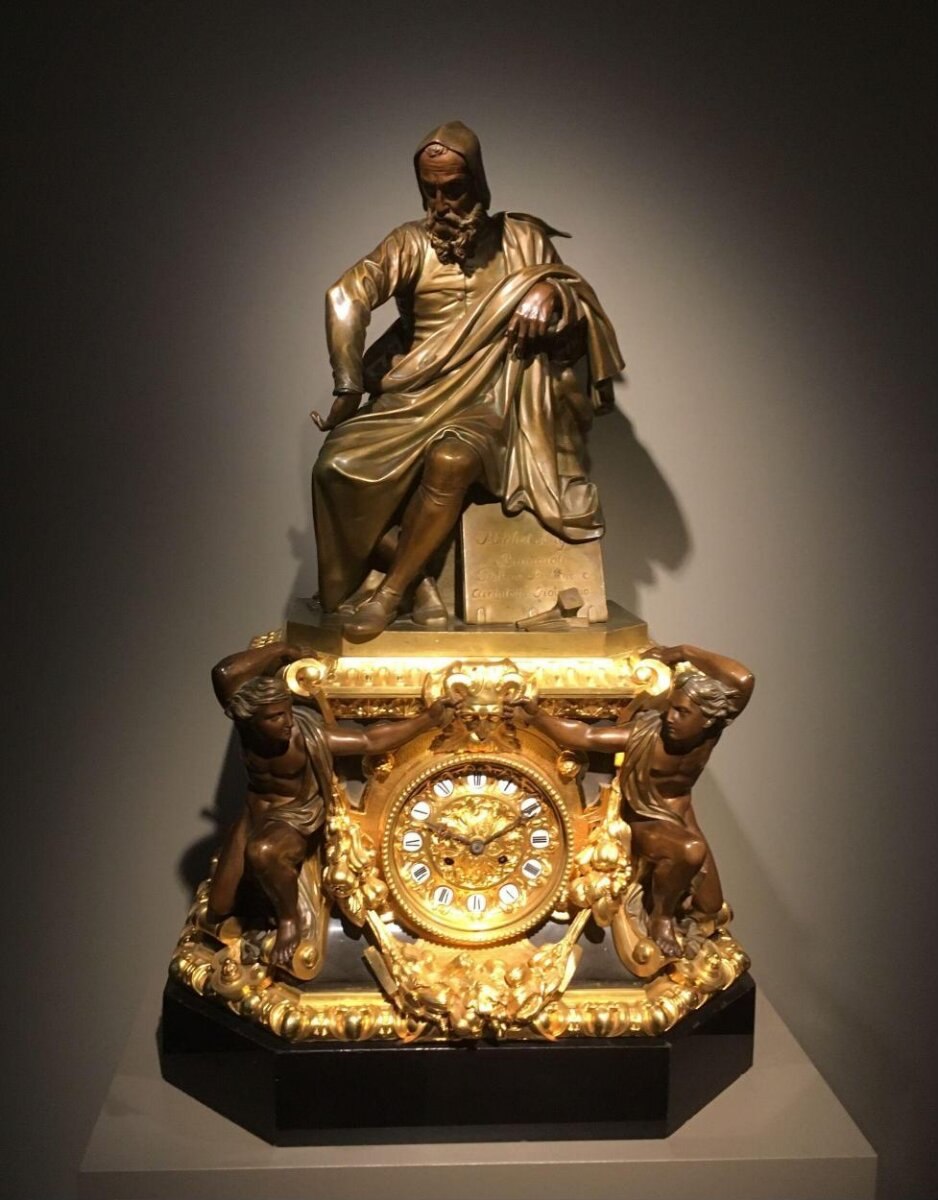
The Michelangelo Clock is a monumental pendulum clock created in Paris in 1849. The object features a bronze sculpture of the artist Michelangelo, modelled by Jean-Jacques Feuchère, depicting him seated atop a hexagonal base. The sculpture is cast and patinated by the bronze founder Gaspard-Joseph Vittoz. The base, constructed of wood with a black marble veneer by Mudesse, incorporates gilt metal mounts, an enamelled and gilt metal dial, and two bronze figures of adolescent males flanking the clock face. The clock movement, located within the base, was produced by Victor Cailly of St. Nicolas d'Aliermont. The clock is known as an exhibition piece, having been displayed at the 1849 Exposition in Paris and the 1851 Great Exhibition in London. The clock stands 79 cm high and is one of three known examples.

Full view of the Michelangelo Clock showing the bronze sculpture, clock face, and hexagonal base.
Full view of the Michelangelo Clock showing the bronze sculpture, clock face, and hexagonal base. — V&A Museum. Rights pending — permission not yet requested. Original source

Catalogue identity

Source
collections.vam.ac.uk
Category
Clock · Pendulum clock
Maker / attribution
Gaspard-Joseph Vittoz, Jean-Jacques Feuchère, Victor Cailly, Mudesse
Reference
Not recorded
Catalogue / lot identifier
M.15-2019
Source-reported date
1849
Source-reported place
France
Source-reported serial
435 7 2

Source-reported attribution and specifications are not independent authentication. A listing does not establish present ownership, current display, availability or permission to reproduce.

Object description

Design and Sculpture

The clock is designed as a monumental exhibition piece centered on a bronze sculpture of the Renaissance artist Michelangelo Buonarroti. The figure is depicted in a seated, contemplative pose, having set aside his tools, with a slave figure partially obscured beneath his cloak. This sculptural arrangement references Michelangelo's work on the tomb of Pope Julius II.

The composition is supported by a hexagonal base of wood finished with a black marble veneer. This section incorporates ornate gilt-metal mounts and features two bronze sculptures of adolescent males on either side of the dial. These figures are posed to suggest they are supporting the weight of the Michelangelo sculpture located above the clock face.

Evidence for this section
  • “The upper section is in the form of a toned bronze ('Florentine' patina) sculpture of the artist, Michelangelo”
  • “The hexagonal wooden and marble plinth houses the clock movement and is richly decorated with gilt metal mounts and an enamelled and gilt metal clock face either side of which is a small bronze sculpture of an adolescent male”

Collaborative Manufacture

The object represents a collaboration between four French makers. Jean-Jacques Feuchère was responsible for the sculpture, having previously created a model of the Michelangelo figure in 1831. The bronze casting and patination were executed by the workshop of Gaspard-Joseph Vittoz. The marble veneer for the base was supplied by the marble worker Mudesse.

The internal clock movement was produced by Victor Cailly, working in St. Nicolas d'Aliermont. The collaboration extended to various technical specialties, with the bronze figures on the base inspired by Michelangelo's ignudi, while the clock face combines enamel and gilt metal components. Marks stamped on the movement include information regarding the manufacturer and series numbering.

Evidence for this section
  • “It combines the artistic and technical skills of four French makers each celebrated in their own right”
  • “Inside the base is the movement, visible through a circular window at the back”

Exhibition History

The clock was intended as a piece for display, intended to generate visual impact. It was shown at the 1849 Exposition of Industrial and Agricultural Products in Paris, where the manufacturer received a silver medal. Subsequently, the clock was exhibited at the 1851 Great Exhibition held in the Crystal Palace in Hyde Park, London, earning a gold medal.

Documentation of the period indicates the clock was originally conceived as the center of a three-piece garniture, flanked by two candelabra. While the clock has been preserved, the whereabouts of the accompanying candelabra remain unknown. The object is one of three identified examples of this specific design.

Evidence for this section
  • “Vittoz exhibited the clock in Paris in 1849 where he won a silver medal and again at the Great Exhibition in Hyde Park in 1851 where he won gold”
  • “The Art Journal also stated that the clock was shown as the centrepiece between two candelabra although their whereabouts are not now known”
  • “One of three examples known.”

Open research questions

  • Are there discernible differences between this example and the pieces held by the Rijksmuseum and the Louvre?
  • What is the specific nature of the 'Florentine' patina applied to the central figure compared to the secondary bronze elements?

Source evidence

Recorded claims and source quotations for The Michelangelo Clock
FieldSource-reported valueSource quotation
Maker (Founder)Gaspard-Joseph Vittoz“by the bronze founder, Gaspar-Joseph Vittoz”
Maker (Movement)Victor Cailly“The clock movement inside the base was made by Victor Cailly”
Maker (Veneer)Mudesse“The base was given a marble veneer by Mudesse.”
Date1849“Paris, 1849”
Serial/Pattern Number435 7 2“Pattern numbers punched on the back of the movement inside the base”
ProvenanceJohannes Count Moy de Sons“recorded in 2019 as formerly in the collection of Johannes Count Moy de Sons'”

Visible details

  • Clock face features Roman numerals on an enamel ground
  • Michelangelo figure sits atop a book inscribed with his title and profession
  • Bronze ephebes flank the central dial and support the upper sculpture
  • Base includes gilt metal ornamentation surrounding the circular dial aperture

Research qualifications

  • The glass covering the circular rear window of the base is missing
  • The original accompanying candelabra are not present with the object

Photograph identity and source facts were screened before import; rights clearance remains pending.

Consulted source

Clock — The Michelangelo Clock, Paris, 1849

Reviewed 2026-11-02 · Record 084c61bf9a

Terms in this record

Glossary explanations for terms named in this object’s record.