
Skip to content
The Encyclopedia of Horology

Clock · Table clock

Table clock with tortoiseshell and pearwood veneer

Partially verified

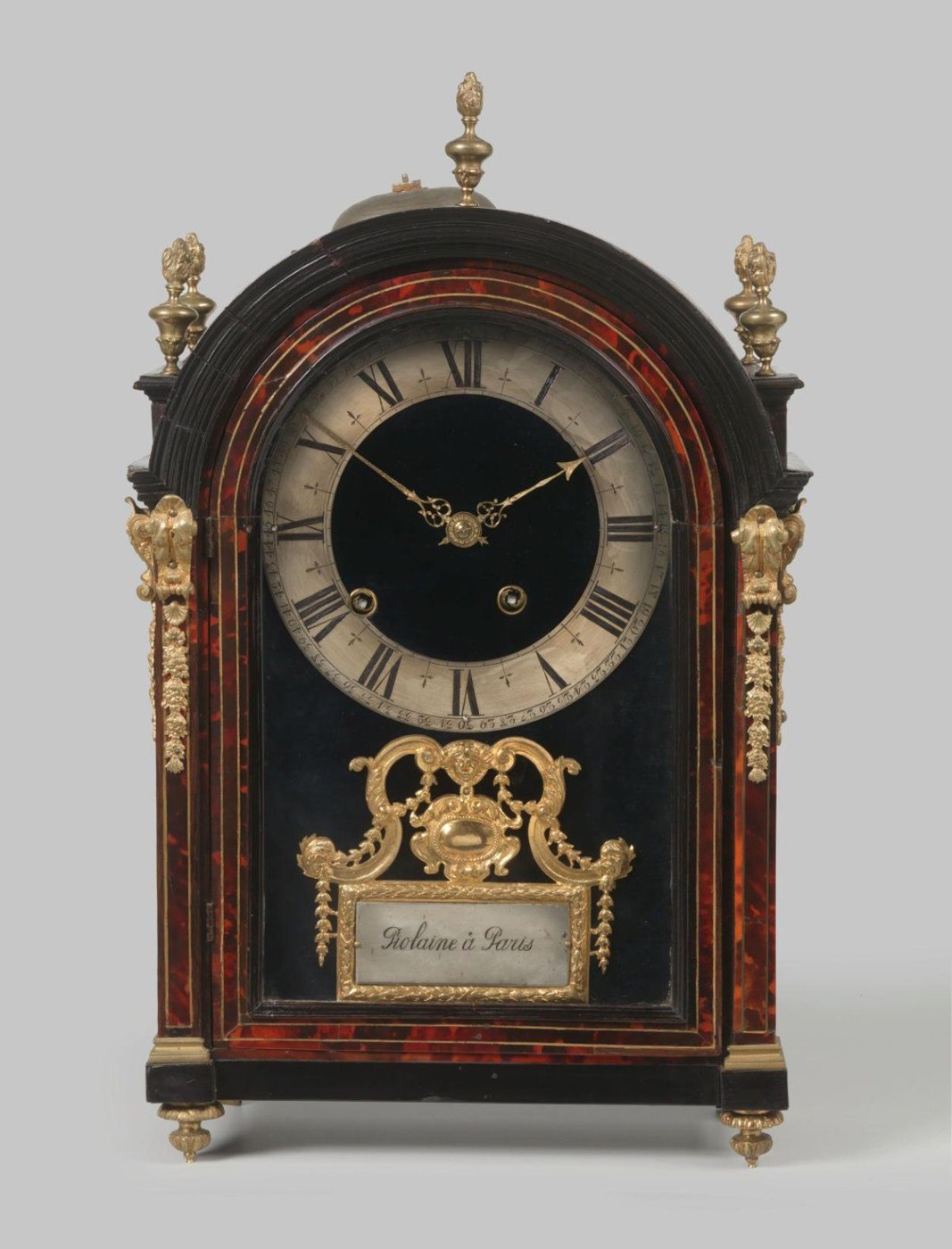
This table clock, catalogued under accession number BK-15990-A, is constructed from a wooden case veneered with tortoiseshell and black-stained pearwood, accented with gilt bronze moldings. It stands 52 cm high, 32 cm wide, and 15 cm deep. The design features a semi-circular hood and is supported by gilt brass feet. The crowning element consists of five gilt bronze urns topped with flames. The front of the clock is decorated with gilt bronze mounts in the form of consoles and garlands. Beneath the dial, a rectangular gilt bronze frame features a central cartouche inscribed "PIOLAINE à PARIS," framed by S-shaped volutes. The clock is associated with a matching console, identified as BK-15990-B. While attributed to Michel-François Piolaine, the documentation notes that the movement is a later replacement, estimated to date between 1770 and 1790, with the case dating to 1700-1725.

Front view of the table clock, showing the tortoiseshell and pearwood veneer, gilt bronze urns, and signature plaque.
Front view of the table clock, showing the tortoiseshell and pearwood veneer, gilt bronze urns, and signature plaque. — Rijksmuseum. Rights pending — permission not yet requested. Original source

Catalogue identity

Source
www.rijksmuseum.nl
Category
Clock · Table clock
Maker / attribution
Michel-François Piolaine
Reference
Not recorded
Catalogue / lot identifier
BK-15990-A
Source-reported date
1700 - 1725
Source-reported place
France

Source-reported attribution and specifications are not independent authentication. A listing does not establish present ownership, current display, availability or permission to reproduce.

Object description

Case Design and Ornamentation

The architectural form is defined by its semi-circular hood, which gives the clock an arched profile. The case is elevated on four gilt brass feet, providing a stable base for the vertical structure.

Decorative elements are applied in gilt bronze, including console mounts and floral garlands positioned at the corners of the face. The top of the hood is finished with a formal arrangement of five flame-topped urns. Below the dial, a rectangular frame encloses the maker's signature plaque, which is framed by S-shaped volutes, creating a focal point that breaks the solid surface of the veneer.

Evidence for this section
  • “gefineerd met schildpad en zwart perenhout, met verguld bronzen ijsten”
  • “De klok, met verguld messing poten, wordt aan de voorzijde door een halfcirkelvormige kap afgesloten”
  • “Vijf verguld bronzen vazen met vlammen dienen ter bekroning.”

Signatures and Provenance

The identification of the piece is anchored by the maker's mark on the front, located on a rectangular frame beneath the dial. This inscription explicitly attributes the work to Piolaine of Paris. The documentation also references an inscription on the rear of the clock mentioning "R. May," although no further context for this name is provided within the source materials.

The object is part of the Rijksmuseum collection and is documented as having an associated console element. The disparity between the manufacturing date of the case and the documented period of the movement suggest a complex history of assembly or repair during the 18th century.

Evidence for this section
  • “het beslag onder de wijzerplaat vertoont een cartouche op een rechthoekige lijst, met het opschrift: PIOLAINE à PARIS”
  • “achterzijde: ‘R. May’”
  • “Bijpassende console: BK-15990-B.”

Movement and Dating

The clock reflects an evolution in its mechanical components, as the original internal mechanism was replaced. This replacement occurs after the initial manufacturing period of the case, which is placed between 1700 and 1725.

The transition from the early 18th-century case construction to the late 18th-century movement indicates that the clock remained in use and underwent significant maintenance.

Evidence for this section
  • “Het werk vernieuwd, vermoedelijk ca. 1770 - 1790 door Piolaine.”
  • “Datering 1700 - 1725”

Open research questions

  • What is the historical significance of the name 'R. May' found on the back of the clock case?
  • Are there specific technical identifiers in the replacement movement that confirm the 1770-1790 dating?

Source evidence

Recorded claims and source quotations for Table clock with tortoiseshell and pearwood veneer
FieldSource-reported valueSource quotation
MakerMichel-François Piolaine“uurwerkmaker: Michel-François Piolaine, Parijs”
Object NumberBK-15990-A“Objectnummer BK-15990-A”
Dimensions52 cm x 32 cm x 15 cm“hoogte 52 cm x breedte 32 cm x diepte 15 cm”
MaterialsTortoiseshell, pearwood, gilt bronze, gilt brass“gefineerd met schildpad en zwart perenhout, en met verguld bronzen lijsten”
Date Range1700-1725 (case)“1700 - 1725”
Movement HistoryRenewed circa 1770-1790“Het werk vernieuwd, vermoedelijk ca. 1770 - 1790 door Piolaine.”

Visible details

  • The dial features Roman numerals for the hours.
  • Gilt bronze flame-topped urns crown the arch of the case.
  • The signature 'Piolaine à Paris' appears on a metal plaque below the dial.
  • The clock stands on four small metal feet.

Research qualifications

  • The provenance of the name 'R. May' found on the back is not explained.
  • The exact nature of the clock's movement replacement remains an estimation.

Photograph identity and source facts were screened before import; rights clearance remains pending.

Terms in this record

Glossary explanations for terms named in this object’s record.