
Skip to content
The Encyclopedia of Horology

Clock · Table clock

Table clock

Partially verified

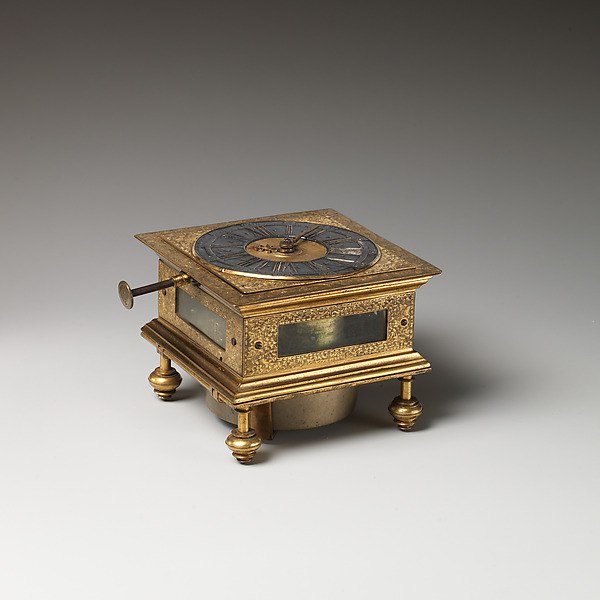
This 17th-century table clock is held in the collection of The Metropolitan Museum of Art, New York, under accession number 29.52.2. The horological instrument is attributed to the German maker Johann Heinrich Kleinschmidt. Constructed primarily from brass and silver, the clock measures approximately 3 inches in height, 5 1/4 inches in width, and 4 inches in depth. Its design incorporates metal panels and a dial integrated into the top surface of the case, supported by small decorative feet. The item has been catalogued by the museum's European Sculpture and Decorative Arts department. It remains an example of 17th-century horological production preserved within an institutional collection, providing evidence of the materials and structural forms used by makers such as Kleinschmidt during this time.

The table clock, 17th century, viewed from the side-front angle showing the dial and metal construction.
The table clock, 17th century, viewed from the side-front angle showing the dial and metal construction. — The Metropolitan Museum of Art, New York. Rights pending — permission not yet requested. Original source

Catalogue identity

Source
orbiscollectibles.com
Category
Clock · Table clock
Maker / attribution
Johann Heinrich Kleinschmidt
Reference
29.52.2
Catalogue / lot identifier
29.52.2
Source-reported date
17th century
Source-reported place
Germany

Source-reported attribution and specifications are not independent authentication. A listing does not establish present ownership, current display, availability or permission to reproduce.

Object description

Construction and Form

The table clock is designed with a low, rectangular profile, reflecting a configuration intended for tabletop display. The primary structural material is identified as brass, which comprises the body of the case and the decorative support feet. The dimensions of the object are modest, with an overall height of 3 inches, a width of 5 1/4 inches, and a depth of 4 inches, making it a compact horological specimen.

The aesthetic finish of the brass surfaces appears textured or chased. The design includes distinct panels on the vertical sides, and the timepiece is raised on four small feet, elevating the main housing above the surface upon which it sits.

Evidence for this section
  • “The museum records the medium as Brass, silver and the dimensions as Overall: 3 × 5 1/4 × 4 in. (7.6 × 13.3 × 10.2 cm).”

Dial and Timekeeping

The clock features a dial positioned on the horizontal top surface rather than a traditional vertical face. The dial incorporates a silver-toned chapter ring with Roman numerals indicating the hours, surrounding a central area that houses the hands.

The hour and minute indicators are centrally mounted. The surface of the dial area and the surrounding top plate appear to share the textured brass finish observed on the case sides. This configuration centralizes the time-telling function to the top of the device, emphasizing the functional role of the clock as a horizontal table instrument.

Evidence for this section
  • “Table clock, 17th century”

Attribution and Documentation

This object is part of the collection at The Metropolitan Museum of Art in New York, where it is catalogued under the accession number 29.52.2. The piece has been documented by the museum's European Sculpture and Decorative Arts department, which provides the dating of the 17th century. The attribution of the clock to the maker Johann Heinrich Kleinschmidt is established through the museum's records.

While the object is held in a major institutional collection, the records note that it represents a type requiring further research to verify the maker and date against broader specialist references. The documentation provided serves as an institutional record of the item's current location, dimensions, and attributed maker as recognized by the Metropolitan Museum of Art.

Evidence for this section
  • “It is attributed to Johann Heinrich Kleinschmidt (German).”
  • “Table clock in The Metropolitan Museum of Art, New York (accession 29.52.2), catalogued by the museum's European Sculpture and Decorative Arts department.”
  • “Research required: confirm the wider type, maker and date against a specialist reference.”

Open research questions

  • What are the mechanical features of the movement housed within the 29.52.2 brass case?
  • Can further evidence be identified to confirm the attribution to Johann Heinrich Kleinschmidt?

Source evidence

Recorded claims and source quotations for Table clock
FieldSource-reported valueSource quotation
MakerJohann Heinrich Kleinschmidt“It is attributed to Johann Heinrich Kleinschmidt (German).”
Date17th century“The museum dates it 17th century.”
MaterialsBrass and silver“The museum records the medium as Brass, silver”
Dimensions7.6 x 13.3 x 10.2 cm“Overall: 3 × 5 1/4 × 4 in. (7.6 × 13.3 × 10.2 cm).”
Accession Number29.52.2“Museum object number 29.52.2”
DepartmentEuropean Sculpture and Decorative Arts“catalogued by the museum's European Sculpture and Decorative Arts department.”

Visible details

  • Top-mounted dial with Roman numerals
  • Rectangular case with panelled sides
  • Small baluster-shaped support feet
  • Side-mounted winding or setting pin

Research qualifications

  • Attribution to Johann Heinrich Kleinschmidt remains an attribution rather than a confirmed signature
  • The wider typology of this specific clock awaits further independent specialist verification

Photograph identity and source facts were screened before import; rights clearance remains pending.

Consulted source

Table clock, 17th century

Reviewed 2026-11-02 · Record ddba9388fa

Terms in this record

Glossary explanations for terms named in this object’s record.