
Skip to content
The Encyclopedia of Horology

Clock · Table clock

Table Clock by the Workshop of David Roentgen

Partially verified

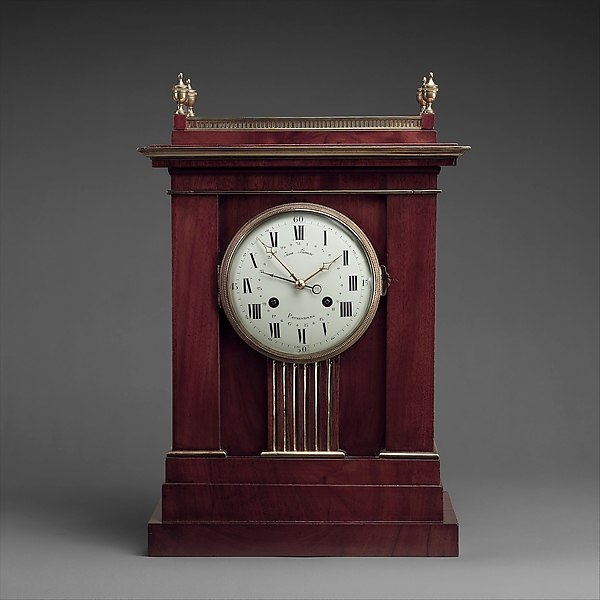
This table clock, attributed to the Workshop of David Roentgen, is dated to circa 1780–90. The object originates from Neuwied am Rhein, Germany, a location associated with the Roentgen workshop's activities during the late 18th century. The clock is constructed primarily from oak, pine, and mahogany, with visible mahogany veneers and decorative elements in brass and gilt bronze. The dial is composed of enamel. The overall dimensions of the piece are 18 1/4 by 12 1/2 by 8 1/4 inches (46.4 by 31.8 by 21 cm). The clock is currently held in the collection of The Metropolitan Museum of Art. It displays a rectangular mahogany-veneered case topped with a brass gallery and finials, with the circular enamel dial featuring Roman numerals and subsidiary indicators, set above vertical brass rods. The rear of the clock includes a glazed access panel revealing the internal mechanism and pendulum.

Front view of the table clock, showing the mahogany case, enamel dial, and brass gallery.
Front view of the table clock, showing the mahogany case, enamel dial, and brass gallery. — The Metropolitan Museum of Art. Rights pending — permission not yet requested. Original source

Catalogue identity

Source
orbiscollectibles.com
Category
Clock · Table clock
Maker / attribution
Workshop of David Roentgen
Reference
Not recorded
Catalogue / lot identifier
2002.237
Source-reported date
ca. 1780–90
Source-reported place
Germany

Source-reported attribution and specifications are not independent authentication. A listing does not establish present ownership, current display, availability or permission to reproduce.

Object description

Case Construction and Materials

The clock is built upon a substrate consisting of oak and pine, which is finished with mahogany veneers. The rectangular case design adheres to a symmetric, architectural profile, elevated on a molded base. The wood surfaces are accented by brass and gilt bronze fittings, which provide contrast to the mahogany veneer.

The upper section of the clock terminates in a flat top, surrounded by a brass gallery with finials at each corner. The visual composition is further refined by vertical brass elements situated beneath the circular dial, which add a rhythmic quality to the front façade of the case.

The construction incorporates a hinged or removable glazed panel at the rear. This design allows for visual access to the clock's movement, including the bell and the bob of the pendulum.

Evidence for this section
  • “Oak, pine, and mahogany, veneered with mahogany; brass, gilt bronze and enamel”

Dial and Timekeeping Display

The circular enamel dial is centrally positioned on the front of the case. It displays Roman numerals for the primary hour markings. The dial also includes what appear to be subsidiary rings or indicator scales, suggesting additional timekeeping functions beyond standard hours and minutes.

The hands, mounted at the center, rotate over the enamel surface. The placement of the dial within the mahogany case is framed by a circular brass bezel, consistent with the use of brass accents throughout the clock's exterior composition.

Evidence for this section
  • “brass, gilt bronze and enamel”

Provenance and Documentation

The clock is identified in the collection of The Metropolitan Museum of Art under the accession number 2002.237. The museum documents the object as a product of the Workshop of David Roentgen, originating from Neuwied am Rhein.

The object was received by the museum as a gift from The Ruth Stanton Family Foundation, donated in honor of Wolfram Koeppe in 2002. This documentation remains the primary reference for the object's attribution, date, and provenance.

Evidence for this section
  • “The Metropolitan Museum of Art holds this object as 2002.237”
  • “Gift of The Ruth Stanton Family Foundation, in honor of Wolfram Koeppe, 2002”

Open research questions

  • What specific functions are served by the subsidiary indicators on the dial?
  • Does the movement show marks or signatures indicating specific collaboration within the Roentgen workshop?

Source evidence

Recorded claims and source quotations for Table Clock by the Workshop of David Roentgen
FieldSource-reported valueSource quotation
MakerWorkshop of David Roentgen“Workshop of David Roentgen (German, Herrnhaag 1743–1807 Wiesbaden, master 1780)”
Dateca. 1780–90“ca. 1780–90”
MaterialsOak, pine, mahogany, brass, gilt bronze, enamel“Oak, pine, and mahogany, veneered with mahogany; brass, gilt bronze and enamel”
Dimensions18 1/4 × 12 1/2 × 8 1/4 in.“Overall: 18 1/4 × 12 1/2 × 8 1/4 in. (46.4 × 31.8 × 21 cm)”
OriginNeuwied am Rhein“German, Neuwied am Rhein”
Museum Number2002.237“2002.237”

Visible details

  • Case features a rectangular mahogany-veneered structure
  • Dial has Roman numerals and appears to feature subsidiary markings
  • Top of the case is fitted with a brass gallery and four finials
  • Rear panel is glazed, allowing view of the bell and pendulum

Research qualifications

  • Uncertainties remain regarding the full extent of the specific type's history
  • The attribution is linked to the workshop, rather than an individual maker's signed work

Photograph identity and source facts were screened before import; rights clearance remains pending.

Consulted source

Clock, David Roentgen, ca. 1780–90

Reviewed 2026-11-02 · Record 3fafc6b693

Terms in this record

Glossary explanations for terms named in this object’s record.