
Skip to content
The Encyclopedia of Horology

Clock · Table clock

Table clock by Daniel Picardi

Partially verified

This table clock, attributed to the maker Daniel Picardi, originates from Stettin in the 17th century and is currently held in the collection of The Metropolitan Museum of Art (accession number 00.12.2). The object is constructed from a combination of materials including gilt brass, silver, glass, brass, and steel. It measures approximately 6 1/2 by 3 1/2 inches (16.5 by 8.9 cm). This item was acquired by the museum as part of the Bequest of Thomas Egleston in 1900.

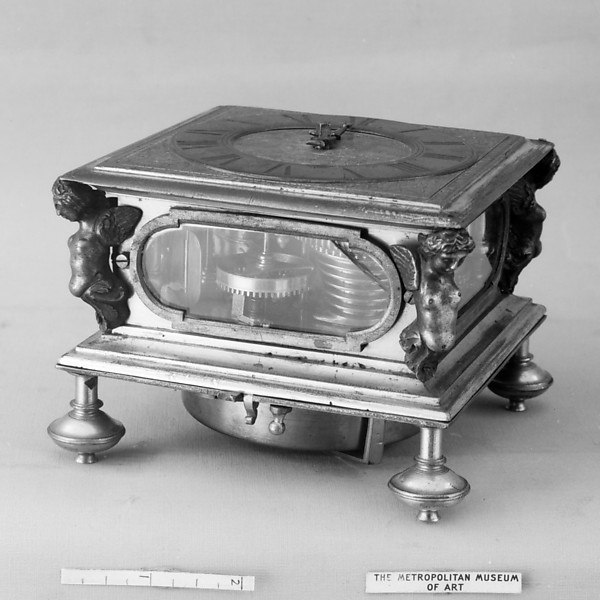
The table clock shown in a static position, featuring a top-mounted dial, glass-paneled case, and decorative figures at the corners.
The table clock shown in a static position, featuring a top-mounted dial, glass-paneled case, and decorative figures at the corners. — The Metropolitan Museum of Art, New York. Rights pending — permission not yet requested. Original source

Catalogue identity

Source
orbiscollectibles.com
Category
Clock · Table clock
Maker / attribution
Daniel Picardi
Reference
Not recorded
Catalogue / lot identifier
00.12.2
Source-reported date
17th century
Source-reported place
German, Stettin

Source-reported attribution and specifications are not independent authentication. A listing does not establish present ownership, current display, availability or permission to reproduce.

Object description

Construction and Design

The table clock is characterized by a horizontal layout, featuring a dial mounted on the top surface rather than a vertical front plate. The case is constructed from brass, much of which is gilt, combined with silver elements. A distinctive feature of the housing includes glazed side panels that expose the internal movement to view, framed by metallic mounts and decorative corner figures resembling cherubs.

The clock stands on four individual feet, which elevate the base of the case above the surface upon which it rests. The overall proportions are relatively compact, conforming to the documented dimensions of 6 1/2 by 3 1/2 inches.

Evidence for this section
  • “Brass gilt, silver, glass, brass, steel”
  • “6 1/2 × 3 1/2 in. (16.5 × 8.9 cm)”
  • “German, Stettin”

Maker and Provenance

The object is attributed to the clockmaker Daniel Picardi. It was added to the collections of The Metropolitan Museum of Art as a bequest from the estate of Thomas Egleston in 1900. The museum categorizes the object within its European Sculpture and Decorative Arts department.

Documentation for the clock identifies its origin as Stettin, then part of a German-influenced horological region during the 17th century.

Evidence for this section
  • “Clockmaker: Daniel Picardi”
  • “Bequest of Thomas Egleston, 1900”
  • “German, Stettin”
  • “00.12.2”

Condition and Technical Considerations

The clock is documented as being comprised of brass, gilt brass, silver, glass, and steel. As is common with complex horological pieces from this period, the museum notes that cases and movements were frequently manufactured by different workshops and occasionally married or repaired in subsequent centuries. This possibility necessitates careful examination of the internal mechanism to determine the historical integrity of the components.

There is no provided technical report regarding the current working order of the movement. Research into the specific horological characteristics of Daniel Picardi's output remains limited, and the attribution is presented here as per the museum's cataloguing records rather than independent technical validation.

Evidence for this section
  • “Brass gilt, silver, glass, brass, steel”
  • “movements and cases were frequently made by different workshops and were sometimes married later.”

Open research questions

  • What is the established horological record for Daniel Picardi and are there other signed examples of his work?
  • To what degree are the components of the movement original to the case based on a physical inspection of the escapement and train?

Source evidence

Recorded claims and source quotations for Table clock by Daniel Picardi
FieldSource-reported valueSource quotation
MakerDaniel Picardi“Clockmaker: Daniel Picardi”
Place of originStettin, Germany“German, Stettin”
Date17th century“17th century”
MaterialsGilt brass, silver, glass, brass, and steel“Brass gilt, silver, glass, brass, steel”
Dimensions16.5 x 8.9 cm“6 1/2 × 3 1/2 in. (16.5 × 8.9 cm)”
Accession number00.12.2“00.12.2”
ProvenanceBequest of Thomas Egleston, 1900“Bequest of Thomas Egleston, 1900”

Visible details

  • Rectangular gilt-brass case with glass panels on the sides
  • Horizontal dial located on the top surface of the clock
  • Four decorative feet support the base of the clock
  • Figures of cherubs or putti positioned at the corners of the case

Research qualifications

  • The exact extent of original movement components versus later replacements has not been verified.
  • The attribution to the maker Daniel Picardi requires further horological research for confirmation.

Photograph identity and source facts were screened before import; rights clearance remains pending.

Consulted source

Table clock by Daniel Picardi, German, Stettin, 17th century

Reviewed 2026-11-02 · Record 1213065235

Terms in this record

Glossary explanations for terms named in this object’s record.