
Skip to content
The Encyclopedia of Horology

Movement · Synchronous motor driven clock movement

Synchronous motor driven clock movement, Venner Ltd., type ER

Partially verified

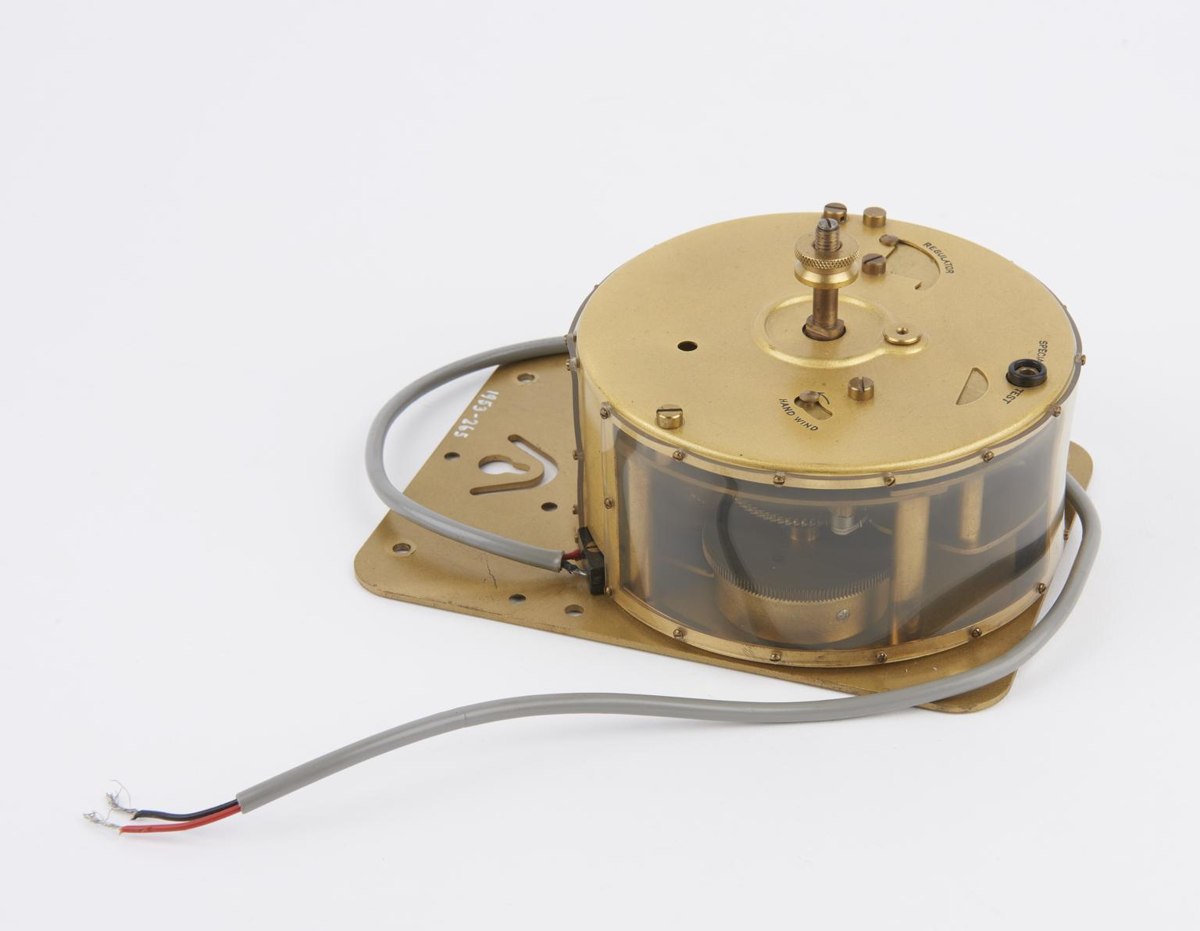
According to the Science Museum Group, this synchronous motor-driven clock movement with a thirty-hour auxiliary spring reserve was made between 1940 and 1953 by Venner Ltd. in New Malden, Surrey, England. Catalogued under object number 1953-265 (part 1953-265/1), the movement is constructed from brass, steel, and unidentified transparent plastic. It features a drum-like cylindrical body with transparent curved casing revealing interior gearing, mounted to an extended flat brass plate. The top plate is marked with slots and labels reading 'REGULATOR', 'HAND WIND', and 'SPECIAL TEST', while an electrical lead extends from the casing.

Synchronous motor driven clock movement, type ER, by Venner Ltd., 1940–1953
Synchronous motor driven clock movement, type ER, by Venner Ltd., 1940–1953 — The Board of Trustees of the Science Museum. Rights pending — permission not yet requested. Original source

Catalogue identity

Source
collection.sciencemuseumgroup.org.uk
Category
Movement · Synchronous motor driven clock movement
Maker / attribution
Venner Ltd.
Reference
type ER
Catalogue / lot identifier
Source URL identifies the listing
Source-reported date
1940-1953
Country
England

Source-reported attribution and specifications are not independent authentication. A listing does not establish present ownership, current display, availability or permission to reproduce.

Object description

Identity and Classification

The Science Museum Group catalogues this object as a synchronous motor driven clock movement with a 30 hours auxiliary spring reserve, identified as type ER. It is attributed to maker Venner Ltd. in New Malden, Kingston-upon-Thames, London, England, and dated to between 1940 and 1953 under accession number 1953-265.

The museum catalogue lists the entry with two constituent parts: the movement itself under object number 1953-265/1 and four brass wood-screws under 1953-265/2. The overall dimensions and weight recorded in the museum record are 175 mm by 130 mm by 100 mm and 1.55 kg.

Evidence for this section
  • “Synchronous motor driven clock movement with 30 hours auxiliary spring reserve, type ER, by Venner Ltd., New Malden, Kingston-upon-Thames, London, England, 1940-1953”
  • “Object Number: 1953-265/1”
  • “Object Number: 1953-265/2”
  • “overall: 175 mm x 130 mm x 100 mm, 1.55kg”

Physical Housing and Visible Controls

Visual examination reveals a cylindrical housing fitted with a transparent curved side wall displaying internal brass and steel gearing. This cylindrical body is attached to an extended flat brass mounting plate that is marked with the white accession number '1953-265'.

The upper plate features engraved or printed labels reading 'REGULATOR', 'HAND WIND', and 'SPECIAL TEST', alongside a central threaded brass shaft extending upwards with a knurled disc collar. An insulated grey two-core electric wire extends outward from the assembly, terminating in exposed copper leads.

Evidence for this section
  • “Cylindrical housing with transparent curved side wall revealing internal brass and steel gearing”
  • “White accession number '1953-265' inscribed on the extended flat brass mounting plate”
  • “Engraved or printed labels on the top surface reading 'REGULATOR', 'HAND WIND', and 'SPECIAL TEST'”
  • “Central threaded brass shaft extending upwards with a knurled disc collar”
  • “Grey two-core insulated electric wire with exposed copper leads at the end”

Material Composition and Source Limitations

The museum record documents the materials for the movement as brass (copper, zinc alloy), steel (metal), and unidentified plastic. While the transparent section exposes internal brass and steel components, the specific composition of the transparent polymer is not identified in the source.

Although the record lists four brass wood-screws under object number 1953-265/2, these screws are not visible in the provided photograph of the movement. Furthermore, the operational functionality and 30-hour duration of the auxiliary spring reserve are catalogued claims rather than directly verified mechanical tests in this source.

Evidence for this section
  • “Materials: plastic (unidentified) , brass (copper, zinc alloy) and steel (metal)”
  • “Four brass wood-screws for synchronous motor driven clock movement, England, 1940-1953”
  • “with 30 hours auxiliary spring reserve”

Open research questions

  • What specific type of plastic polymer was used by Venner Ltd. for the transparent curved casing on movement type ER?
  • How does the auxiliary spring reserve mechanically engage upon disconnection or failure of the mains synchronous motor?
  • Are the four brass wood-screws catalogued under 1953-265/2 stored separately or originally mounted with part 1953-265/1?

Source evidence

Recorded claims and source quotations for Synchronous motor driven clock movement, Venner Ltd., type ER
FieldSource-reported valueSource quotation
MakerVenner Ltd.“by Venner Ltd., New Malden, Kingston-upon-Thames, London, England”
Model Typetype ER“type ER”
Date of Manufacture1940-1953“Made: 1940-1953 in New Malden and Surrey”
Spring Reserve30 hours auxiliary spring reserve“with 30 hours auxiliary spring reserve”
Object Number1953-265“Object Number: 1953-265”
Dimensions and Weight175 mm x 130 mm x 100 mm, 1.55kg“overall: 175 mm x 130 mm x 100 mm, 1.55kg”
Museum CreditVenner Ltd.“credit: Venner Ltd.”
Museum CategoryTime Measurement“Category: Time Measurement”
Part Number for Movement1953-265/1“Object Number: 1953-265/1”
Part Number for Screws1953-265/2“Object Number: 1953-265/2”

Visible details

  • Cylindrical housing with transparent curved side wall revealing internal brass and steel gearing
  • Central threaded brass shaft extending upwards with a knurled disc collar
  • Engraved or printed labels on the top surface reading 'REGULATOR', 'HAND WIND', and 'SPECIAL TEST'
  • White accession number '1953-265' inscribed on the extended flat brass mounting plate
  • Grey two-core insulated electric wire with exposed copper leads at the end

Research qualifications

  • Source notes the museum lot includes four brass wood-screws (part 1953-265/2), which are not present in the photograph
  • Specific plastic polymer is noted as unidentified by the source

Photograph identity and source facts were screened before import; rights clearance remains pending.

Terms in this record

Glossary explanations for terms named in this object’s record.