Construction and Decoration
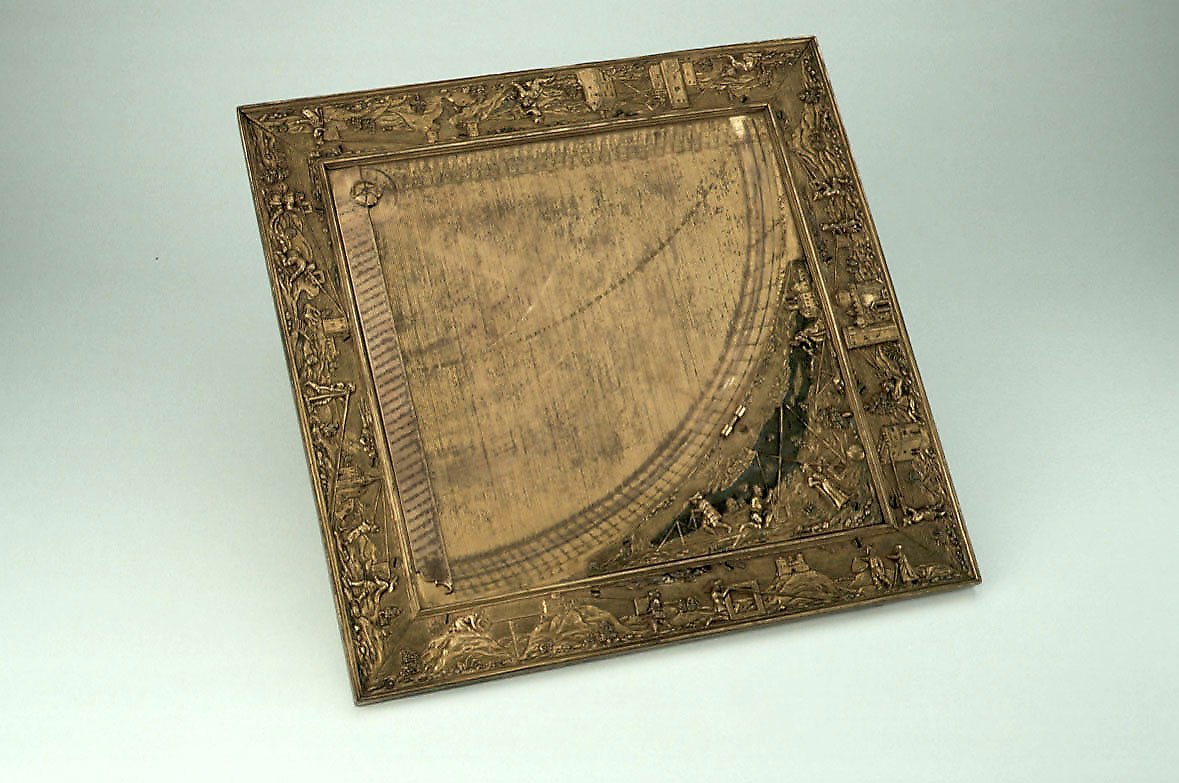
The surveying quadrant is a substantial instrument measuring 345 mm square, crafted from multiple layers of gilt copper that are secured with screws and rivets. The instrument is marked by extensive decorative relief work covering its outer surfaces and border. These reliefs feature a variety of figures, specifically European and Ottoman geometers, engaged in surveying tasks with instruments including quadrants, dividers, and cross staffs.
The wear on the gilding reveals the underlying copper substrate across the instrument's surface. On the lower frame, a cartouche contains the formal signature of the maker alongside vignettes depicting an instrument workshop environment with various tools. Originally, the lower frame featured two hinged pieces, though only one currently survives, exhibiting a form comparable to a belt buckle.
Evidence for this section
- “The instrument is made up of several layers which are riveted and screwed together.”
- “The outer surfaces are gilt and worn areas show copper as the underlying metal.”
- “In the spandrel of the quadrant and on the decorative border is a set of decorative reliefs showing European and Ottoman geometers measuring and surveying with various forms of square, quadrants, dividers and cross staff .”
- “Signed on the lower part of the frame in a cartouche: 'CHRISTOPHORVS SCHISSLER GEOMETRICVS AC ASTRONOMICVS ARTIFEX AVGVSTAE VINDELICORVM FACIEBAR ANNO DOMINI .15.79.'”
Geometric Scales and Functionality
The obverse of the instrument features a quadrant scale accompanied by a rotating index rule marked 'SCALA GEOMETRICI CVRSORIS'. This rule pivots from the top left and bears double scales of equal parts. The quadrant itself includes vertical lines and a transversal scale, with the arc inscribed 'PVNCTA ALTITVDINIS STATIONIS', indicating its role in measuring heights and distances.
The reverse side serves as a repository for complex calculations, dominated by a large table titled 'TABVLA SCALAE GEOMETRICAE MILLE PVNCTORVM VMBRAE VERSAE ET RECTAE'. This table, along with a secondary table for 200 points, allowed the user to calculate dimensions without manual arithmetic. Additional features include a slot with a sliding mechanism on the reverse, potentially used for clamping the rule, and an inscription reading 'SCALA DEFERENTIS QVI REGVLAM HYPOTHENVSA ADDVCIT ATQ<VE> ABDVCIT'.
Evidence for this section
- “The obverse has a scale in the form of a quadrant with a rotating index rule.”
- “The main feature of the reverse is a table titled 'TABVLA SCALAE GEOMETRICAE MILLE PVNCTORVM VMBRAE VERSAE ET RECTAE'.”
- “On the right of the table is a slot with a sliding piece of uncertain function - perhaps to clamp the rule in a particular position.”
History and Provenance
The instrument’s history is well-documented from the early 17th century, when it was presented to the Bodleian Library in Oxford in 1601 by Sir Josias Bodley. It remained in the Library's collection for centuries before being placed on loan to the Museum of the History of Science in 1952. While the instrument was originally intended to be part of a high-status collection, its primary patron remains unknown.
At the time of its donation, the quadrant was accompanied by a matching level, which has been preserved alongside the main object. The instrument is designed to stand on its own base, which incorporates two decorated circular sights featuring pinholes for sighting operations, and it includes a suspension point for a plumb bob, facilitating its use as a survey tool.
Evidence for this section
- “However, it was presented to the Bodleian Library in Oxford as early as 1601.”
- “Provenance: presented to the Bodleian Library in 1601 by Sir Josias Bodley; lent to the museum in 1952 (Accession no. 52-83).”
- “At that time this instrument, with its tables for determining distances, was already accompanied by a level , which still survives.”