
Skip to content
The Encyclopedia of Horology

Tool · Heliochronometer

'Sunquest' Mean-Time Sundial

Partially verified

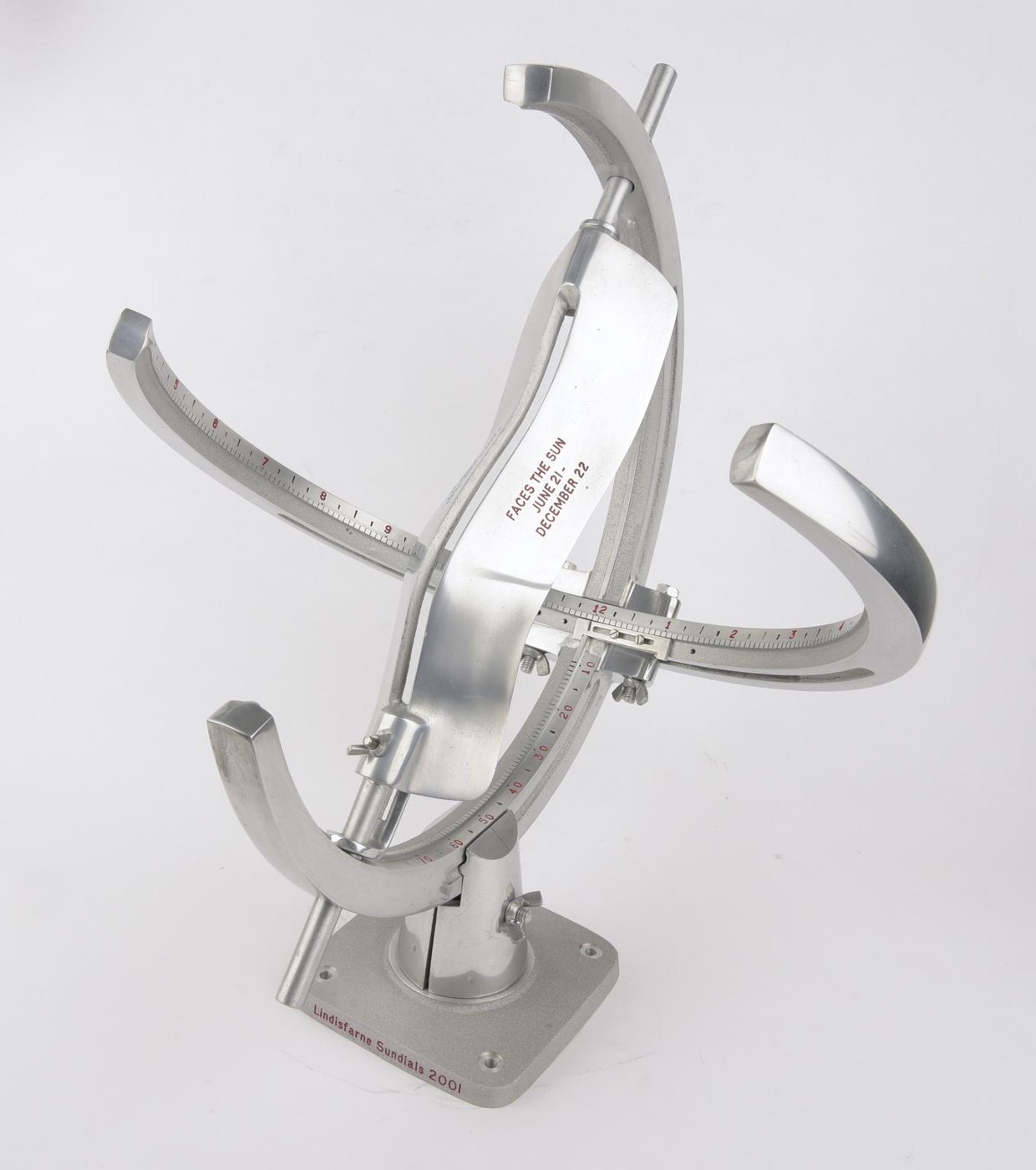
This 'Sunquest' mean-time sundial, or heliochronometer, was produced in 2001 by Tony Moss of Lindisfarne Sundials in Bedlington, Northumberland. The object was designed by R. L. Schmoyer, based on original pattern designs dating to 1959. Constructed of metal, the instrument functions by tracking solar movement to indicate mean time. The structure includes various calibrated arcs and a central adjustment plate inscribed with temporal information. It measures approximately 480 mm by 380 mm by 360 mm. The design facilitates alignment with the sun, with specific inscriptions visible on the central assembly regarding solstitial orientation, serving as an functional tool for timekeeping based on solar position.

The 'Sunquest' heliochronometer, showing the central calibrated arc and base inscription
The 'Sunquest' heliochronometer, showing the central calibrated arc and base inscription — Tony Moss, Lindisfarne Sundials. Rights pending — permission not yet requested. Original source

Catalogue identity

Source
collection.sciencemuseumgroup.org.uk
Category
Tool · Heliochronometer
Maker / attribution
R. L. Schmoyer; Tony Moss
Reference
Not recorded
Catalogue / lot identifier
2003-213
Source-reported date
2001
Source-reported place
England

Source-reported attribution and specifications are not independent authentication. A listing does not establish present ownership, current display, availability or permission to reproduce.

Object description

Design and Origins

The 'Sunquest' heliochronometer originated from designs by R. L. Schmoyer, who created the initial patterns for the device in 1959. These designs are maintained by the American Sundial Society, which served as the source for the castings used in the creation of this specific instrument.

The production of the object took place in Bedlington, Northumberland, where Tony Moss of Lindisfarne Sundials executed the final assembly in 2001.

Evidence for this section
  • “heliochronometer designed by R. L. Schmoyer”
  • “The castings were made in America from Schmoyer's original 1959 pattern designs, and now held held by the American Sundial Society.”
  • “made by Tony Moss, Lindisfarne Sundials, Bedlington, Northumberland 2001.”

Construction and Inscriptions

Constructed primarily from metal, the sundial features an complex array of arcs designed to track the sun and output mean time. The central, curved plate is prominently engraved with instructions regarding its orientation, specifying that it 'FACES THE SUN' during the period between the summer and winter solstices (June 21 to December 22).

The base of the instrument is cast with clear identifiers, including the name of the workshop and the year of manufacture. The mechanical nature of the object allows for user-adjustable settings, with various visible scales calibrated along its circular components to enable accurate solar reading.

Evidence for this section
  • “Lindisfarne sundials”

Provenance and Identification

The object is catalogued in the Science Museum Group collection under the accession number 2003-213. It is identified as a 'Sunquest' mean-time sundial. The source material provides overlapping production dates, attributing the design to 1959 and the final manufacture of this piece to 2001, though some descriptive text suggests an earlier production period in the 1990s.

Its measurements of 480 mm by 380 mm by 360 mm classify it as a substantial table-top instrument.

Evidence for this section
  • “Accession number: 2003-213”
  • “'Sunquest' mean time sundial or heliochronometer designed by R. L. Schmoyer c.1950, made by Tony Moss of Lindisfarne Sundials, Bedlington, Northumberland, between about 1990 and 1999.”

Open research questions

  • Determine the exact production year given the conflicting 2001 and 1990-1999 dates
  • Verify if the 1959 design pattern date is the primary intended date of origin

Source evidence

Recorded claims and source quotations for 'Sunquest' Mean-Time Sundial
FieldSource-reported valueSource quotation
MakerTony Moss, Lindisfarne Sundials“made by Tony Moss, Lindisfarne Sundials, Bedlington, Northumberland 2001”
DesignerR. L. Schmoyer“heliochronometer designed by R. L. Schmoyer”
Origin of castingsAmerica“The castings were made in America from Schmoyer's original 1959 pattern designs”
Accession Number2003-213“2003-213”
Measurements480 mm x 380 mm x 360 mm“overall: 480 mm x 380 mm x 360 mm”
MaterialMetal“The castings were made in America”

Visible details

  • Base is inscribed with 'Lindisfarne Sundials 2001'
  • Central plate features the inscription 'FACES THE SUN JUNE 21 - DECEMBER 22'
  • Primary components are manufactured from cast metal with a smooth finish
  • The assembly includes calibrated circular and curved arcs for adjusting settings

Research qualifications

  • Discrepancy exists between the 2001 date in the title and the 'between about 1990 and 1999' date range in the description
  • Source lists multiple dates for design and production without clarity on the final assembly timeline

Photograph identity and source facts were screened before import; rights clearance remains pending.

Consulted source

'Sunquest' Mean-Time Sundial, Designed by R. L. Schmoyer, 2001

Reviewed 2026-10-26 · Record 77fb3e72d1

Terms in this record

Glossary explanations for terms named in this object’s record.