
Skip to content
The Encyclopedia of Horology

Clock · Aircraft cockpit clock

Smiths RAF Aircraft Dashboard Clock, Model 5ACA / Ref. 6A/2089

Partially verified

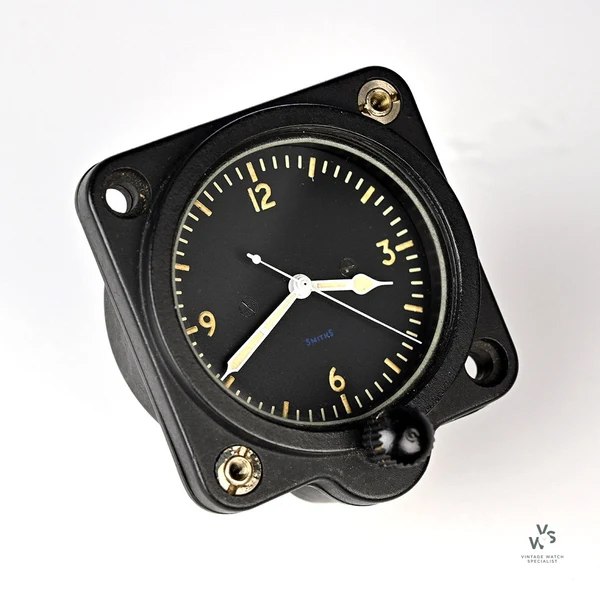
This post-war British military aircraft cockpit clock is signed by Smiths and reported by the source to date to 1957. Fitted into a powder-coated aluminium instrument housing with a square mounting flange, the unit measures 60.5 mm in width. According to the seller, the rear instrument plate bears code 5 ACA, reference 6A/2089, serial number 24/57, and a British military broad arrow (pheon). The black dial features luminous quarter Arabic numerals, baton minute indexes, a minute track, luminescent hands, a central seconds hand, and a blue-printed Smiths signature above 6 o'clock. It is powered by a manual-wind 10-jewel calibre 302 movement.

Oblique view of the Smiths aircraft cockpit clock showing the black dial, flange, and bottom setting knob
Oblique view of the Smiths aircraft cockpit clock showing the black dial, flange, and bottom setting knob — Vintage Watch Specialist. Rights pending — permission not yet requested. Original source

Catalogue identity

Source
vintagewatchspecialist.com
Category
Clock · Aircraft cockpit clock
Maker / attribution
Smiths
Reference
6A/2089
Catalogue / lot identifier
vws2053
Source-reported date
1957
Country
United Kingdom
Source-reported serial
24/57

Source-reported attribution and specifications are not independent authentication. A listing does not establish present ownership, current display, availability or permission to reproduce.

Object description

Housing and Physical Configuration

The instrument is built within a powder-coated aluminium housing measuring 60.5 mm in width excluding the crown. Direct observation shows a square front mounting flange finished in black coating, fitted with corner mounting apertures containing threaded metal inserts intended for dashboard installation.

Operation and adjustment are handled via a front control interface. As seen on the lower bezel rim, a knurled setting and winding knob is located directly below the 6 o'clock position. The seller describes the bezel as fixed, noting that it incorporates a cog mechanism that must be pulled outward in order to set the time.

Evidence for this section
  • “Case: Powder Coated Aluminium”
  • “Width (without crown): 60.5”
  • “Square black-coated flange with corner mounting apertures and threaded metal inserts”
  • “Front knurled setting/winding knob situated at the lower bezel edge below 6 o'clock”
  • “The bezel is fixed and is fitted with a cog that must be pulled out to set the time.”

Dial Design and Display

The instrument features a matte black dial under a glass crystal. Time is indicated with bold luminous Arabic numerals at the quarters (12, 3, 6, and 9) alongside baton minute markers and an outer minute track. In visible inspection, the luminous compound across the markers and numerals exhibits an aged, yellowish coloration.

Handset configuration comprises cathedral-style luminescent hour and minute hands paired with a white-finished central sweep seconds hand. A subtle, blue-printed 'SMITHS' signature is applied to the dial plane immediately above the 6 o'clock numeral.

Evidence for this section
  • “Crystal: Glass”
  • “Matte black dial with yellowed luminous Arabic quarter numerals (12, 3, 6, 9) and baton minute markers”
  • “White-finished central seconds hand and luminescent cathedral-style hour and minute hands”
  • “Subtle blue-printed 'SMITHS' lettering positioned above the 6 o'clock numeral”

Reported Markings and Mechanism

Internal operation is reported by the vendor to be powered by a manual-wind mechanical movement, specifically calibre 302 containing 10 jewels. Because the movement is completely enclosed within the instrument housing, this calibre specification is not verified by visual evidence.

The vendor also reports that the rear of the clock is fitted with an original Smiths instrument reference plate recording code '5 ACA', reference number '6A/2089', and serial number '24/57', accompanied by a British military broad arrow (pheon). Neither the plate nor its stamped markings are visible in the supplied object photograph.

Evidence for this section
  • “Caliber: 302”
  • “Jewels: 10”
  • “fitted with an original Smiths instrument reference plate to the back which denotes code 5 ACA and its reference number as 6A/2089 and its serial number as 24/57.”
  • “It also boasts the military Pheon, denoting it as the property of the MoD.”

Open research questions

  • What explains the discrepancy between the vendor's narrative dating of 1957 (supported by serial suffix /57) and the tabular specification listing 'Date of issue: 1953'?
  • Can direct inspection of the rear instrument reference plate confirm the presence and transcription of code 5 ACA, reference 6A/2089, serial 24/57, and the military pheon?
  • Does inspection of the interior casing confirm the presence and condition of the reported Smiths calibre 302 10-jewel movement?

Source evidence

Recorded claims and source quotations for Smiths RAF Aircraft Dashboard Clock, Model 5ACA / Ref. 6A/2089
FieldSource-reported valueSource quotation
Instrument code5 ACA“fitted with an original Smiths instrument reference plate to the back which denotes code 5 ACA”
Reference number6A/2089“reference number as 6A/2089”
Serial number24/57“serial number as 24/57”
Calibre302“Caliber: 302”
Jewels10“Jewels: 10”
Case materialPowder Coated Aluminium“Case: Powder Coated Aluminium”
Width60.5 mm“Width (without crown): 60.5”
Crystal materialGlass“Crystal: Glass”
Reported issue date specification1953“Date of issue: 1953”
Reported movement typeMechanical“Movement Type: Mechanical”
Reported winding typeManual“Winding: Manual”

Visible details

  • Square black-coated flange with corner mounting apertures and threaded metal inserts
  • Front knurled setting/winding knob situated at the lower bezel edge below 6 o'clock
  • Matte black dial with yellowed luminous Arabic quarter numerals (12, 3, 6, 9) and baton minute markers
  • Subtle blue-printed 'SMITHS' lettering positioned above the 6 o'clock numeral
  • White-finished central seconds hand and luminescent cathedral-style hour and minute hands

Research qualifications

  • The source text refers to the piece being issued or dated to 1957 in the title and narrative, yet lists 'Date of issue: 1953' in the technical specifications.
  • The rear instrument reference plate, MoD pheon, and calibre 302 movement are described by the seller but not visible in the supplied photo.

Photograph identity and source facts were screened before import; rights clearance remains pending.

Terms in this record

Glossary explanations for terms named in this object’s record.