
Skip to content
The Encyclopedia of Horology

Clock · Skeleton clock

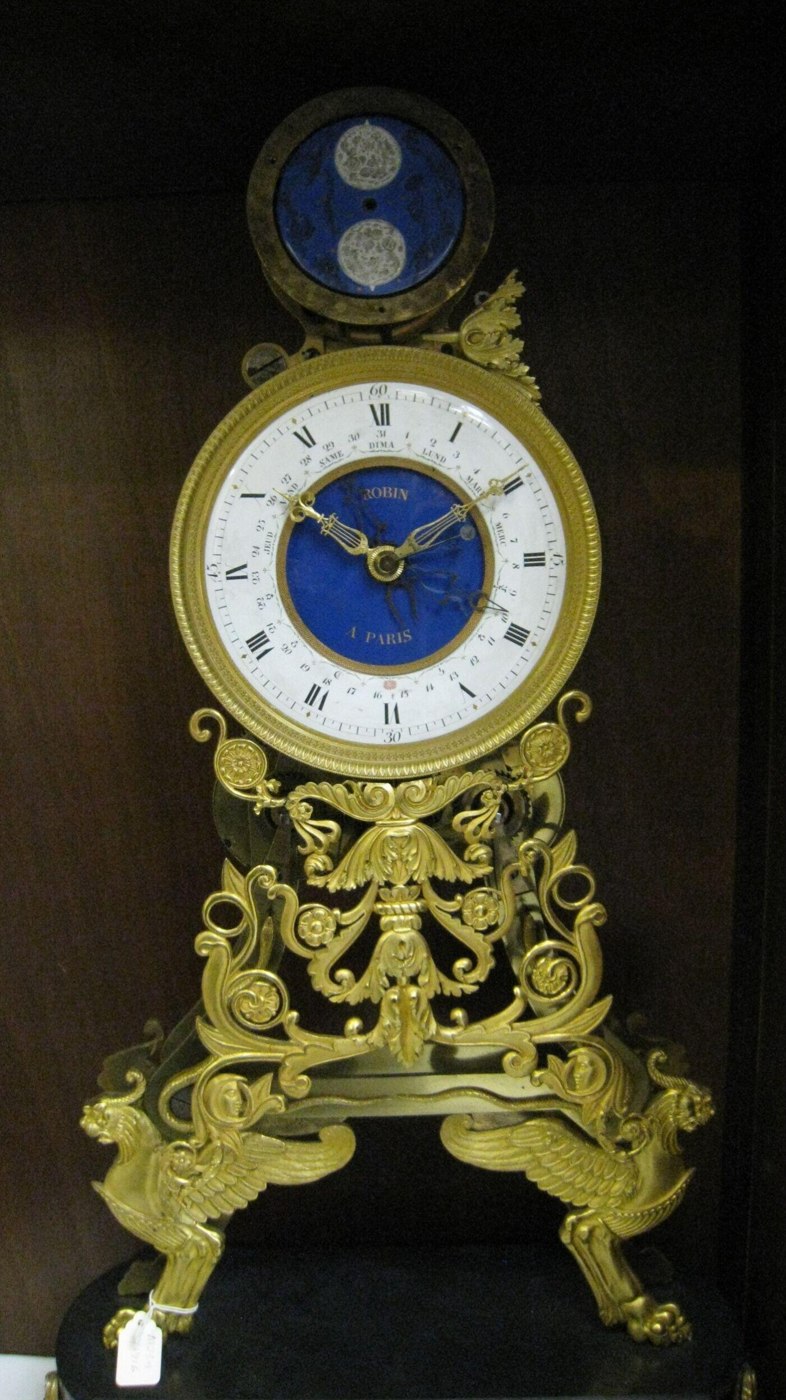
Skeleton clock by Robin a Paris

Partially verified

This skeleton clock is signed 'ROBIN A PARIS' on the backplate and main dial. Produced in the early 19th century by Nicolas-Robert and Jean-Joseph Robin, the clock consists of a brass skeleton frame, enamelled dials, and ormolu mounts, raised on a mahogany pedestal. The movement features a pin-wheel escapement and a gridiron compensation pendulum composed of five steel and four brass rods. A thermometer mechanism is integrated into the pendulum assembly, with an enamel scale marked '+15' to '-15' and inscribed 'Chaud', 'Tempere', 'Froid'. The dial displays hours, minutes, seconds, date, day of the week, and lunar phases. The clock strikes the hours and half-hours on a locking-plate system. It is housed within a glazed cabinet and rests upon a mahogany pedestal embellished with ormolu mounts depicting a nymph and four swans.

Frontal view of the skeleton clock showing the dual enamel dials, pierced lyre-shaped hands, and the ornate ormolu base with winged lion motifs.
Frontal view of the skeleton clock showing the dual enamel dials, pierced lyre-shaped hands, and the ornate ormolu base with winged lion motifs. — Victoria and Albert Museum. Rights pending — permission not yet requested. Original source

Catalogue identity

Source
collections.vam.ac.uk
Category
Clock · Skeleton clock
Maker / attribution
Robin, Nicolas Robert and Jean-Joseph
Reference
Not recorded
Catalogue / lot identifier
M.234:1 to 8-1916
Source-reported date
early 19th century
Source-reported place
Paris, France

Source-reported attribution and specifications are not independent authentication. A listing does not establish present ownership, current display, availability or permission to reproduce.

Object description

Case and Dials

The clock is constructed with an ormolu skeleton frame resting on a polished slate plinth. The primary ormolu dial features a recessed white-enamel chapter ring with Roman numerals for the hours and Arabic numerals for the minutes, which also serves for the center-seconds. Internal rings provide calendar information including the date (1-31) and abbreviated French weekday names, alongside a lunar phase dial decorated with a landscape painting.

The housing consists of a glazed cabinet supported by a mahogany pedestal. The pedestal displays ormolu mounts, specifically a central lozenge containing a figure of a nymph holding a garland and four circular frames featuring swans. The skeleton frame itself is mounted on four lion's legs that terminate in winged lion heads, with additional floral openwork plaques attached to the dial structure.

Evidence for this section
  • “Case: ormolu clock with polished slate plinth, enamelled dials, and brass skeleton frame. In a glazed cabinet on a mahogany pedestal with ormolu mounts.”
  • “The frame rises on four lions' legs terminating in winged lions' heads.”
  • “The mahogany pedestal is decorated with an applied openwork plaque of floral design in front with the figure of a nymph holding a garland in a lozenge shaped frame and four swans in circular frames”

Movement and Pendulum

The timepiece includes both going and striking trains, with a fourteen-day duration and going barrels rotating once every three days. The striking mechanism utilizes a locking-plate system, while the calendar and lunar functions are driven by a wheel linked to the striking train.

The timekeeping is regulated by an Amant-type pin-wheel escapement and a gridiron compensation pendulum. The pendulum is constructed of five steel and four brass rods to compensate for temperature variations. A supplementary thermometer mechanism is integrated into the pendulum assembly, featuring an enamel scale ranging from +15 to -15, marked for temperature conditions ('Chaud', 'Tempere', 'Froid').

Evidence for this section
  • “The going train has an Amant-type of pin-wheel escapement and a gridiron compensation pendulum, with 5 steel and 4 brass rods.”
  • “The striking train is of locking-plate type, and the count-wheel permits an extra single stroke at each half-hour.”
  • “A simple thermometer mechanism is incorporated in the pendulum, part of which is missing, but the indicating pointer survives, also the scale, engraved on a white-enamel arc”

Signatures and History

The clock is signed 'ROBIN A PARIS' on both the main dial and the backplate. The production is attributed to Nicolas-Robert and Jean-Joseph Robin, who were the sons of the clockmaker Robert Robin. Following the death of their father in 1799, the brothers continued the family business.

The object was acquired by the Victoria and Albert Museum as a gift from Somers Clarke.

Evidence for this section
  • “The backplate is signed 'ROBIN A PARIS'.”
  • “This clock was made by Nicholas-Robert and Jean-Joseph Robin, sons of Louis XVI's clockmaker Robert Robin, who succeeded to their father's business on his death in 1799.”
  • “Given by Somers Clarke”

Open research questions

  • What is the missing portion of the thermometer mechanism?
  • Is there a specific model name for this piece beyond the generic description of a skeleton clock?

Source evidence

Recorded claims and source quotations for Skeleton clock by Robin a Paris
FieldSource-reported valueSource quotation
MakerRobin, Nicolas Robert and Jean-Joseph“Maker: Robin, Nicolas Robert and Jean-Joseph (maker)”
Dateearly 19th century“Date: early 19th century”
Place of originParis“Place of origin: Paris (made)”
EscapementAmant-type pin-wheel“The going train has an Amant-type of pin-wheel escapement”
PendulumGridiron compensation“gridiron compensation pendulum, with 5 steel and 4 brass rods”
SignedROBIN A PARIS“The backplate is signed 'ROBIN A PARIS'.”
Accession numberM.234:1 to 8-1916“Accession number: M.234:1 to 8-1916”
Thermometer inscriptionClementa suis propriis annis victo“entitled collectively 'Clementa suis propriis annis victo (Clements their own years in defeat).”

Visible details

  • Lyre-shaped pierced steel and gilt brass hands
  • Four winged lion heads and legs supporting the skeleton frame
  • Thermometer scale engraved on a white-enamel arc attached to the pendulum
  • Dial showing lunar phases with painted landscape

Research qualifications

  • The thermometer mechanism is incomplete with parts missing
  • Precise attribution within the early 19th century is limited to the makers' succession to their father's business in 1799

Photograph identity and source facts were screened before import; rights clearance remains pending.

Consulted source

Clock case

Reviewed 2026-10-26 · Record ada8658485

Terms in this record

Glossary explanations for terms named in this object’s record.