
Skip to content
The Encyclopedia of Horology

Clock · Desk clock

Rudolf Kämmer Biscuit Porcelain Desk Clock

Partially verified

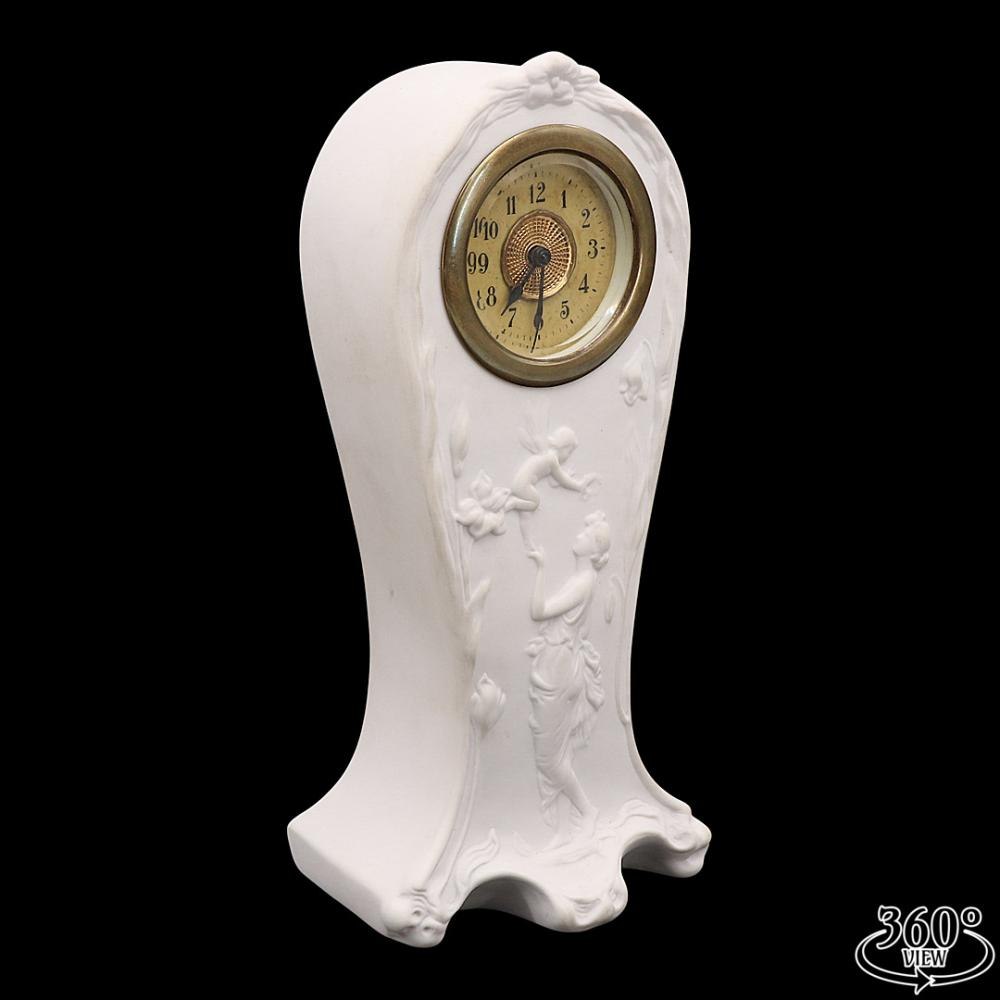
This desk clock is manufactured by the German workshop Rudolf Kämmer, date-attributed to the late 20th century. The object is constructed from matte biscuit porcelain, featuring a figural design described as following Art Nouveau aesthetics. The porcelain housing depicts a standing female figure dressed in flowing robes, accompanied by a small angel. These figures are surrounded by a naturalistic relief of floral and foliage elements, which frame the circular clock case. The timepiece incorporates a mechanical movement with a winding mechanism integrated into the porcelain structure. The dial is white and displays curved Arabic numerals. The piece measures 22 cm in height, 10 cm in width, and 8 cm in depth. The auction description notes that the movement is currently in functional condition, and the overall item is in good condition for its age. The maker's mark is visible on the base of the porcelain case.

Full view of the Rudolf Kämmer biscuit porcelain desk clock showing the figural porcelain relief and the integrated clock dial.
Full view of the Rudolf Kämmer biscuit porcelain desk clock showing the figural porcelain relief and the integrated clock dial. — Kunst- und Auktionshaus Quedlinburg (via Invaluable). Rights pending — permission not yet requested. Original source

Catalogue identity

Source
www.invaluable.com
Category
Clock · Desk clock
Maker / attribution
Rudolf Kämmer
Reference
Not recorded
Catalogue / lot identifier
691
Source-reported date
Late 20th C.
Source-reported place
Germany

Source-reported attribution and specifications are not independent authentication. A listing does not establish present ownership, current display, availability or permission to reproduce.

Object description

Porcelain Case and Design

The clock is housed within a hand-sculpted biscuit porcelain casing that utilizes a matte finish. The design incorporates figural elements consisting of a standing female figure draped in flowing garments with an accompanying smaller angel figure. This composition is set within a relief of naturalistic botanical elements, including leaves and flowers, which transition into the integrated, circular clock case structure.

The overall form is vertical in orientation, designed for placement on a desk or mantle, with a stable base that provides a platform for the sculptural components.

Evidence for this section
  • “An artistic figural clock made of matte biscuit porcelain, its design characterized by the organic forms of Art Nouveau.”
  • “The composition depicts a graceful, standing female figure in a flowing robe, towards whom a small angel is leaning.”

Dial and Timekeeping

The clock features a white dial face located within a round aperture in the porcelain housing. The dial is printed with Arabic numerals styled in a curved, decorative typeface. The dial is surrounded by a metallic, circular bezel that provides a visual border between the porcelain sculpture and the clock face.

According to the provided descriptions, the clock is equipped with an old mechanical movement that includes a manual winding function. This movement is reported to be integrated into the porcelain housing.

Evidence for this section
  • “The white dial features curved, Arabic numerals.”
  • “The old, mechanical movement with a winding mechanism is artfully integrated into the porcelain case, good age-appropriate condition, the movement is running.”

Marks and Condition

The object is identified by a maker's mark located on the underside of the porcelain base. This mark consists of a crown positioned above the letter 'K', which is rendered in a blue glaze. This mark serves to attribute the item to the Rudolf Kämmer production facility.

The physical condition of the clock is described by the auction house as being in good, age-appropriate condition. The surface of the biscuit porcelain remains matte, and the porcelain components appear consistent with the production standards of the late 20th-century German workshop mentioned in the description.

Evidence for this section
  • “Biscuit porcelain, marked on the base.”
  • “altersgemäß guter Zustand, Uhrwerk läuft.”

Open research questions

  • What is the specific significance of the crown and 'K' mark in relation to the specific Rudolf Kämmer factory production cycles?
  • Can the movement be removed for service or maintenance without risking damage to the integrated porcelain casing?

Source evidence

Recorded claims and source quotations for Rudolf Kämmer Biscuit Porcelain Desk Clock
FieldSource-reported valueSource quotation
MakerRudolf Kämmer“Rudolf Kämmer Desk Clock”
MaterialBiscuit porcelain“Biscuit porcelain”
DateLate 20th C.“Late 20th C.”
Dimensions22 x 10 x 8 cm“22 x 10 x 8 cm (HxWxD)”
Movement typeMechanical“The old, mechanical movement with a winding mechanism is artfully integrated into the porcelain case”
MarkingsMarked on base“marked on the base.”

Visible details

  • Relief decoration of a female figure and angel
  • Matte biscuit porcelain texture
  • Mark with crown and letter K on the underside
  • Circular metal bezel housing the clock dial

Research qualifications

  • The exact model designation or specific production year remains unconfirmed beyond the general date range provided.
  • The specific technical details, caliber, or provenance of the integrated mechanical movement are not documented.

Photograph identity and source facts were screened before import; rights clearance remains pending.

Consulted source

Rudolf Kämmer Desk Clock, Biscuit Porcelain in Art Nouveau Style, Late 20th C.

Reviewed 2026-10-26 · Record 27e30a4853

Terms in this record

Glossary explanations for terms named in this object’s record.