
Skip to content
The Encyclopedia of Horology

Tool · Portable equatorial sundial

Portable equatorial sundial

Partially verified

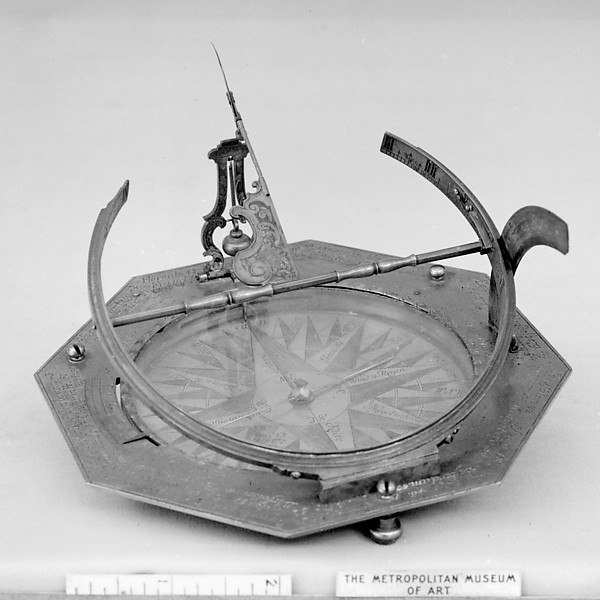
This portable equatorial sundial is preserved in the collection of The Metropolitan Museum of Art (accession number 03.21.22) and is attributed to the maker Ludewig. Dated to approximately 1725, the instrument is constructed primarily from brass, which has been finished with water-gilding and silvering, incorporating additional silver components. Measuring overall 2 3/4 by 5 1/8 by 5 1/8 inches, the piece follows an octagonal base design. The instrument functions as an equatorial sundial, featuring an integrated compass and complex adjustable arc and gnomon elements mounted atop the base. The object is catalogued by the museum as a sundial within the broader classification of horology. This entry is based directly on technical documentation provided by the institution, serving as a primary reference for the piece in its current public collection.

Portable equatorial sundial, ca. 1725, showing the central compass and hinged equatorial ring assembly.
Portable equatorial sundial, ca. 1725, showing the central compass and hinged equatorial ring assembly. — The Metropolitan Museum of Art, New York. Rights pending — permission not yet requested. Original source

Catalogue identity

Source
orbiscollectibles.com
Category
Tool · Portable equatorial sundial
Maker / attribution
Ludewig
Reference
Not recorded
Catalogue / lot identifier
03.21.22
Source-reported date
ca. 1725
Source-reported place
Not established

Source-reported attribution and specifications are not independent authentication. A listing does not establish present ownership, current display, availability or permission to reproduce.

Object description

Construction and Design

The sundial is built upon a substantial octagonal brass plate, which serves as the foundation for the various timekeeping and orientation components. The surface of the brass has undergone specific decorative treatments, being both water-gilded and silvered to provide a refined finish. The overall dimensions of the object, measuring 2 3/4 by 5 1/8 by 5 1/8 inches, indicate a compact design intended for portability.

Centered within the octagonal plate is a magnetic compass, protected by glass, which allows the user to orient the instrument correctly before use. Rising from the plate is a hinged, ornate vertical support, which provides structural integrity for the adjustable components. A metal gnomon extends from this support, interacting with the circular equatorial ring to indicate time. Additional silver elements are integrated throughout the construction, contributing to the structural and aesthetic composition of the dial.

Evidence for this section
  • “Brass, water-gilded and silvered; silver”
  • “Overall: 2 3/4 × 5 1/8 × 5 1/8 in. (7 × 13 × 13 cm).”

Attribution and Documentation

The object is held within the collection of The Metropolitan Museum of Art and is catalogued under the accession number 03.21.22. It has been reviewed by the museum's European Sculpture and Decorative Arts department. The primary attribution for the manufacture of the instrument is given to an individual identified as Ludewig.

The dating of the object is established by the museum as approximately 1725. This designation is maintained in the institutional records as the current historical estimation for its creation. The museum documents the object as a portable equatorial sundial, and it is categorized under horological collections. No other catalogue numbers are currently associated with the piece, and it remains a documented part of the museum's open-access online collection.

Evidence for this section
  • “It is attributed to Ludewig.”
  • “The museum dates it ca. 1725.”
  • “Portable equatorial sundial in The Metropolitan Museum of Art, New York (accession 03.21.22)”

Function and Mechanics

As an equatorial sundial, the instrument requires careful alignment with the Earth's axis, a process facilitated by its integral compass. The circular arc, visible in the object's configuration, is designed to be set to the user's latitude, allowing the gnomon to cast a shadow that corresponds with the sun's position relative to the equatorial plane.

The movable parts of the dial, including the hinged vertical support and the adjustable equatorial ring, allow the instrument to be folded or collapsed, emphasizing its classification as a portable device. The interplay between the fixed compass plate and the adjustable solar components allows the user to determine the solar time based on the shadow cast onto the ring.

Evidence for this section
  • “Portable equatorial sundial”
  • “Portable equatorial sundial in The Metropolitan Museum of Art”

Open research questions

  • Can archival documentation or signature analysis confirm the identity of 'Ludewig' as a specific maker of scientific instruments?
  • Are there similar extant dials from the same maker that confirm the specific design features of this instrument?

Source evidence

Recorded claims and source quotations for Portable equatorial sundial
FieldSource-reported valueSource quotation
MakerLudewig“It is attributed to Ludewig.”
Dateca. 1725“The museum dates it ca. 1725.”
MaterialsBrass, water-gilded and silvered; silver“Brass, water-gilded and silvered; silver”
Accession number03.21.22“Museum object number 03.21.22”
Dimensions2 3/4 × 5 1/8 × 5 1/8 in. (7 × 13 × 13 cm)“Overall: 2 3/4 × 5 1/8 × 5 1/8 in. (7 × 13 × 13 cm).”
CollectionThe Metropolitan Museum of Art“Portable equatorial sundial in The Metropolitan Museum of Art, New York”

Visible details

  • Octagonal base plate configuration
  • Integrated central magnetic compass
  • Ornate hinged vertical support member
  • Adjustable circular ring component

Research qualifications

  • The maker attribution to Ludewig remains subject to further scholarly verification.
  • The exact provenance and historical context beyond the museum record are currently limited.

Photograph identity and source facts were screened before import; rights clearance remains pending.

Consulted source

Portable equatorial sundial, ca. 1725

Reviewed 2026-11-02 · Record 2058854d4e

Terms in this record

Glossary explanations for terms named in this object’s record.

Other portable equatorial sundial records