
Skip to content
The Encyclopedia of Horology

Tool · Diptych sundial

Portable diptych sundial by Hans Tröschel the Younger

Partially verified

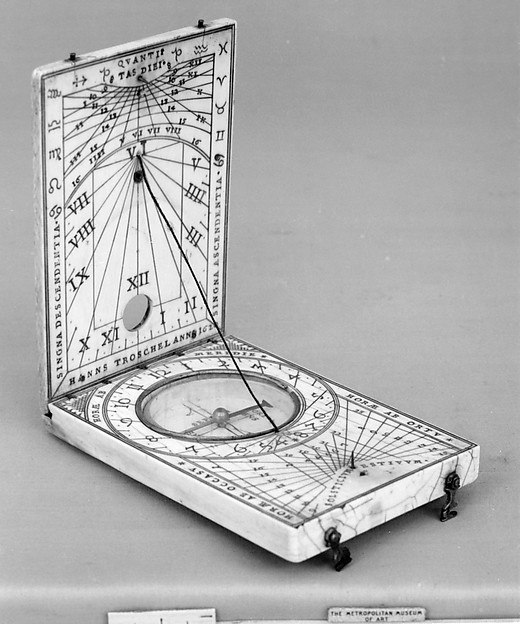
This portable diptych sundial, crafted in 1620 in Nuremberg, Germany, is attributed to Hans Tröschel the Younger. Measuring 3 7/8 by 2 5/8 inches, the object is constructed from ivory and brass. The instrument consists of two hinged plates that, when opened, allow the user to determine time through the alignment of a string gnomon with the sun. The dial surface is intricately engraved with various scales for timekeeping, including solar hours and seasonal adjustments. It incorporates a central compass to assist in proper orientation, alongside additional lunar and astrological information inscribed on the reverse surfaces. The object is held by the Metropolitan Museum of Art as part of its European Sculpture and Decorative Arts collection.

A portable diptych sundial by Hans Tröschel the Younger, dated 1620, displaying the interior dials and compass.
A portable diptych sundial by Hans Tröschel the Younger, dated 1620, displaying the interior dials and compass. — The Metropolitan Museum of Art, New York. Rights pending — permission not yet requested. Original source

Catalogue identity

Source
orbiscollectibles.com
Category
Tool · Diptych sundial
Maker / attribution
Hans Tröschel the Younger
Reference
Not recorded
Catalogue / lot identifier
03.21.53
Source-reported date
1620
Source-reported place
Germany

Source-reported attribution and specifications are not independent authentication. A listing does not establish present ownership, current display, availability or permission to reproduce.

Object description

Construction and Materials

This portable diptych sundial is composed of two primary sections made from ivory, joined by hinges that allow the instrument to be folded for transport or opened for use. The base leaf contains a recessed circular compartment designed for an internal compass, which provides the necessary orientation for accurate solar time reading. The vertical leaf serves as the primary dial face, featuring etched markings for hours and seasonal solar positioning.

The assembly is further reinforced by brass components, which are used for the hinges and the securement hardware located on the exterior edges. The overall dimensions of the object are approximately 3 7/8 by 2 5/8 inches, classifying it as a compact tool designed for personal use.

Evidence for this section
  • “The museum records its materials as: Ivory, brass.”
  • “Overall: 3 7/8 × 2 5/8 in. (9.8 × 6.7 cm).”

Timekeeping Functions

The sundial operates through the alignment of a string gnomon that spans between the vertical and horizontal plates. By orienting the device using the integrated compass, the user positions the instrument to cast a shadow across the inscribed scales. These scales provide solar time readings adjusted for seasonal changes, as indicated by the various lines and arcs etched into the ivory.

Beyond simple solar time, the dial includes complex astronomical features. The reverse side of the instrument displays lunar information, allowing the user to track cycles and related chronological data. These multiple engraved interfaces demonstrate the multi-functional capability of the diptych form, which serves as a portable reference for astronomical and calendar-based calculations in addition to daily timekeeping.

Evidence for this section
  • “Portable diptych sundial”

Attribution and Provenance

The sundial is attributed to the maker Hans Tröschel the Younger, who was active in Nuremberg during the early seventeenth century. The date 1620 is inscribed directly onto the instrument, anchoring it to this specific period in German instrument making. The documentation provided by the Metropolitan Museum of Art explicitly links the object to this maker and location.

The object is part of the museum's European Sculpture and Decorative Arts collection, recorded under accession number 03.21.53. The record is based on institutional data, and while it is firmly assigned to Tröschel, the museum notes that further research is required to verify its broader context within the maker’s known corpus of work. The provenance of the piece includes a gift from Mrs. Stephen D. Tucker in 1903.

Evidence for this section
  • “Portable diptych sundial made by Hans Tröschel the Younger (German, probably born 1599, died before 1634), dated 1620”
  • “The Metropolitan Museum of Art holds this object as 03.21.53”
  • “Gift of Mrs. Stephen D. Tucker, 1903”

Open research questions

  • What specific astronomical tables or manuals from the 1620 period correlate most closely with the lunar scales present on this instrument?
  • How does the specific engraving style of this piece compare to other signed instruments attributed to the Tröschel workshop during the same decade?

Source evidence

Recorded claims and source quotations for Portable diptych sundial by Hans Tröschel the Younger
FieldSource-reported valueSource quotation
MakerHans Tröschel the Younger“Hans Tröschel the Younger (German, probably born 1599, died before 1634)”
Date1620“dated 1620”
Place of originNuremberg, Germany“from German, Nuremberg.”
MaterialsIvory and brass“Ivory, brass.”
Dimensions3 7/8 by 2 5/8 inches“Overall: 3 7/8 × 2 5/8 in. (9.8 × 6.7 cm).”
CollectionMetropolitan Museum of Art“The Metropolitan Museum of Art holds this object as 03.21.53”
DepartmentEuropean Sculpture and Decorative Arts“European Sculpture and Decorative Arts”

Visible details

  • The dial features an integrated circular compass in the center of the base leaf.
  • Intricate numerical and astrological scales are etched into the ivory surfaces of both leaves.
  • A thin string gnomon connects the upper vertical leaf to the lower horizontal leaf when the dial is opened.
  • Two metal hooks are visible on the exterior edge for securing the two leaves together when closed.

Research qualifications

  • The exact birth and death dates of Hans Tröschel the Younger remain unverified in the records provided.
  • The extent to which this individual instrument represents the wider production output of the maker's workshop is not independently confirmed.

Photograph identity and source facts were screened before import; rights clearance remains pending.

Consulted source

Portable diptych sundial by Hans Tröschel the Younger, German, Nuremberg, 1620

Reviewed 2026-11-02 · Record 29e9fc1797

Terms in this record

Glossary explanations for terms named in this object’s record.