
Skip to content
The Encyclopedia of Horology

Tool · Diptych sundial

Ivory diptych sundial by Leonhart Miller

Partially verified

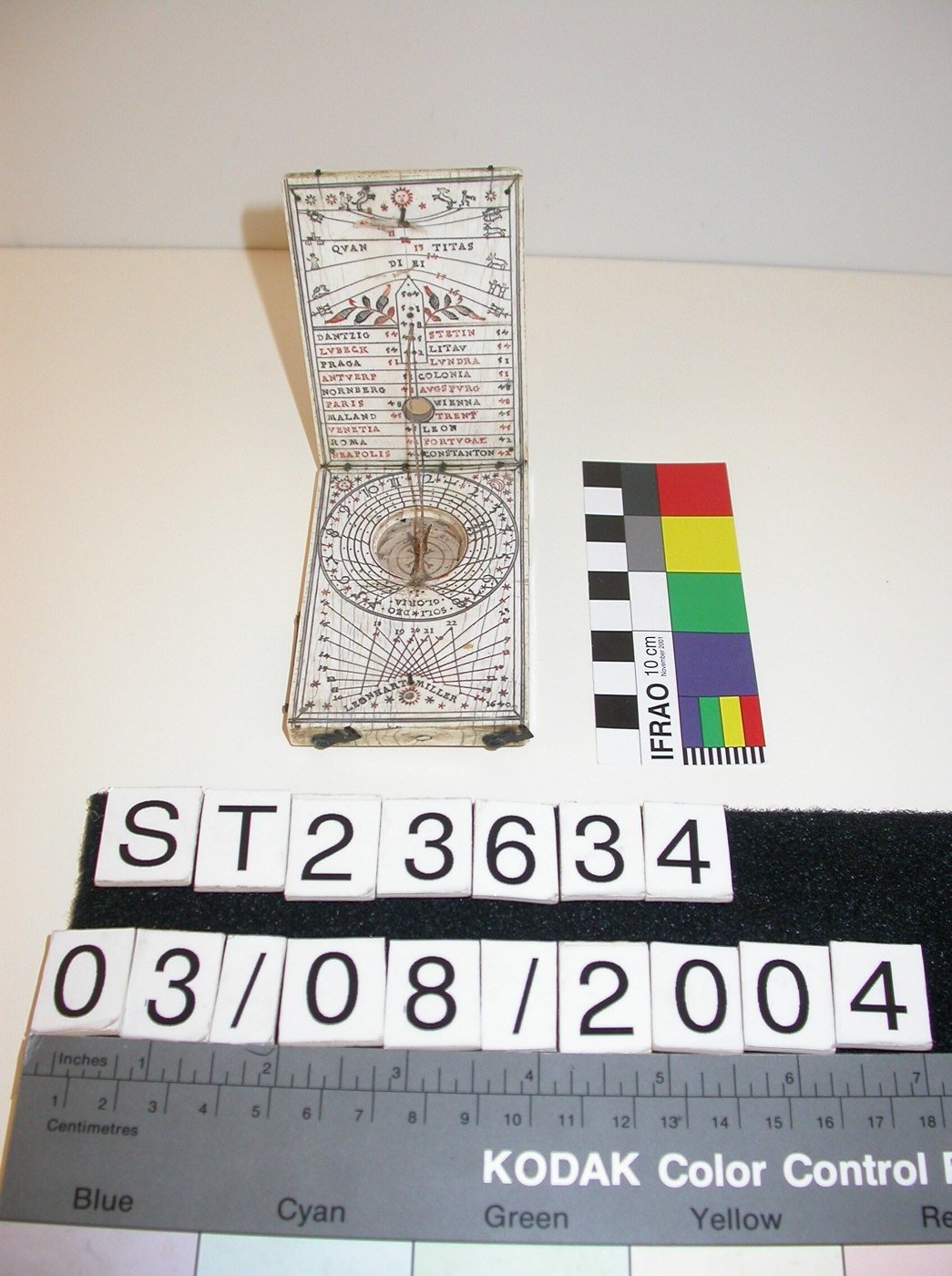
This ivory diptych sundial was created by Leonhart Miller in Augsburg, Germany, in 1640. The user can calibrate the gnomon to specific latitudes ranging from 42 to 54 degrees by passing the thread through designated holes in the lid. The inner surface of the lid provides a table listing the latitudes of various European cities to facilitate operation in different locations. The base of the device contains a compass recess, though the needle is currently missing. Exterior features include a rotating metal disc on the underside of the base, which is surrounded by two concentric circular scales, one marked with Arabic numbers 1 to 12 and the other 1 to 29.

Ivory diptych sundial by Leonhart Miller, dated 1640, showing the lid table and horizontal dial plate.
Ivory diptych sundial by Leonhart Miller, dated 1640, showing the lid table and horizontal dial plate. — Museums Victoria. Rights pending — permission not yet requested. Original source

Catalogue identity

Source
collections.museumsvictoria.com.au
Category
Tool · Diptych sundial
Maker / attribution
Leonhart Miller
Reference
Not recorded
Catalogue / lot identifier
ST 23634
Source-reported date
1640
Source-reported place
Germany

Source-reported attribution and specifications are not independent authentication. A listing does not establish present ownership, current display, availability or permission to reproduce.

Object description

Construction and Dialing

The sundial is constructed in the diptych format using ivory, with a hinged design that allows it to fold into a compact block. The horizontal dial on the base is activated by a thread gnomon connected between the base and the underside of the lid. This thread functions as the shadow-casting element, with the angle adjusted by selecting one of five holes in the lid, corresponding to latitudes of 42, 45, 48, 51, and 54 degrees.

The base component houses a central circular compass, intended for proper orientation of the instrument. While the compass recess remains, the needle is not present. The underside of the base features a rotating metal disc with an associated pointer, surrounded by two circular scales. The inner scale is calibrated with Arabic numerals 1 to 12 repeated twice, while the outer scale is graduated from 1 to 29.

Evidence for this section
  • “The angle of the thread can be adjusted to 42, 45, 48, 51 or 54 degrees to correspond to the latitude, by passing the thread through the appropriate hole in the lid.”
  • “Cord from lid to base, compass in base but needle missing.”
  • “Under base rotating metal disc with pointer, around disc 2 circular scales with arabic numbers, inner scale 1 to 12 twice, outer scale 1 to 29, on top of lid.”

Signatures and Inscriptions

The instrument bears distinct engravings that identify the maker and provide thematic mottos. The maker, Leonhart Miller, is identified by name, along with the year of production, 1640, which is engraved on the instrument.

A religious inscription, 'Soli Deo Gloria', is placed around the sundial circle surrounding the compass. The interior of the lid features a list of European cities with corresponding numerical values related to the latitude table, which is marked using German labels.

Evidence for this section
  • “Association: type: Maker, name: Leonhart Miller, date: 1640”
  • “Sundial circle around compass marked 'Soli Deo Gloria'.”
  • “German labels, inside lid list of places with numbers”

Condition and Provenance

The object is held in the collection of the Museums Victoria under registration number ST 23634. Conservation notes indicate that the dimensions were measured while the object was in a closed state, with the physical description confirming the current status of the components.

Documentation confirms the instrument has lost its compass needle, a detail noted in the physical description of the piece. The overall physical integrity is represented by the described dimensions and the functional state of the thread-adjustment system.

Evidence for this section
  • “Registration number: ST 23634”
  • “dimensions: 9 cm (Length), 5.5 cm (Width), 1.3 cm (Height); dimensions: 90 mm (Length), 56 mm (Width), 15 mm (Height), comments: Measurement From Conservation. Measuring Method: Closed”
  • “Cord from lid to base, compass in base but needle missing.”

Open research questions

  • What is the specific purpose of the numerical scale 1 to 29 on the underside of the base?
  • Are there remaining traces of the original compass needle pivot in the base recess?

Source evidence

Recorded claims and source quotations for Ivory diptych sundial by Leonhart Miller
FieldSource-reported valueSource quotation
MakerLeonhart Miller“Association: type: Maker, name: Leonhart Miller”
Date1640“date: 1640”
Registration NumberST 23634“Registration number: ST 23634”
Latitude Calibration42, 45, 48, 51 or 54 degrees“The angle of the thread can be adjusted to 42, 45, 48, 51 or 54 degrees to correspond to the latitude, by passing the thread through the appropriate hole in the lid.”
Base MarkingsSoli Deo Gloria“Sundial circle around compass marked 'Soli Deo Gloria'.”
Dimensions9 cm x 5.5 cm x 1.3 cm“9 cm (Length), 5.5 cm (Width), 1.3 cm (Height)”
OriginAugsburg, Germany“Augsburg, Germany, 1640”

Visible details

  • The compass needle is missing from the base recess.
  • The lid interior displays a table of European cities with their respective latitudes.
  • The gnomon consists of a thin thread adjustable for specific latitudes.
  • The dial plate is engraved with the inscription 'Soli Deo Gloria'.

Research qualifications

  • The compass needle is absent.
  • The original extent of the thread gnomon components is not explicitly described beyond being a thin thread.

Photograph identity and source facts were screened before import; rights clearance remains pending.

Consulted source

Sundial - Diptych, Leonhart Miller, Augsburg, Germany, 1640

Reviewed 2026-10-26 · Record 1ab95cf384

Terms in this record

Glossary explanations for terms named in this object’s record.