
Skip to content
The Encyclopedia of Horology

Tool · Diptych sundial

Nuremberg Diptych Dial

Partially verified

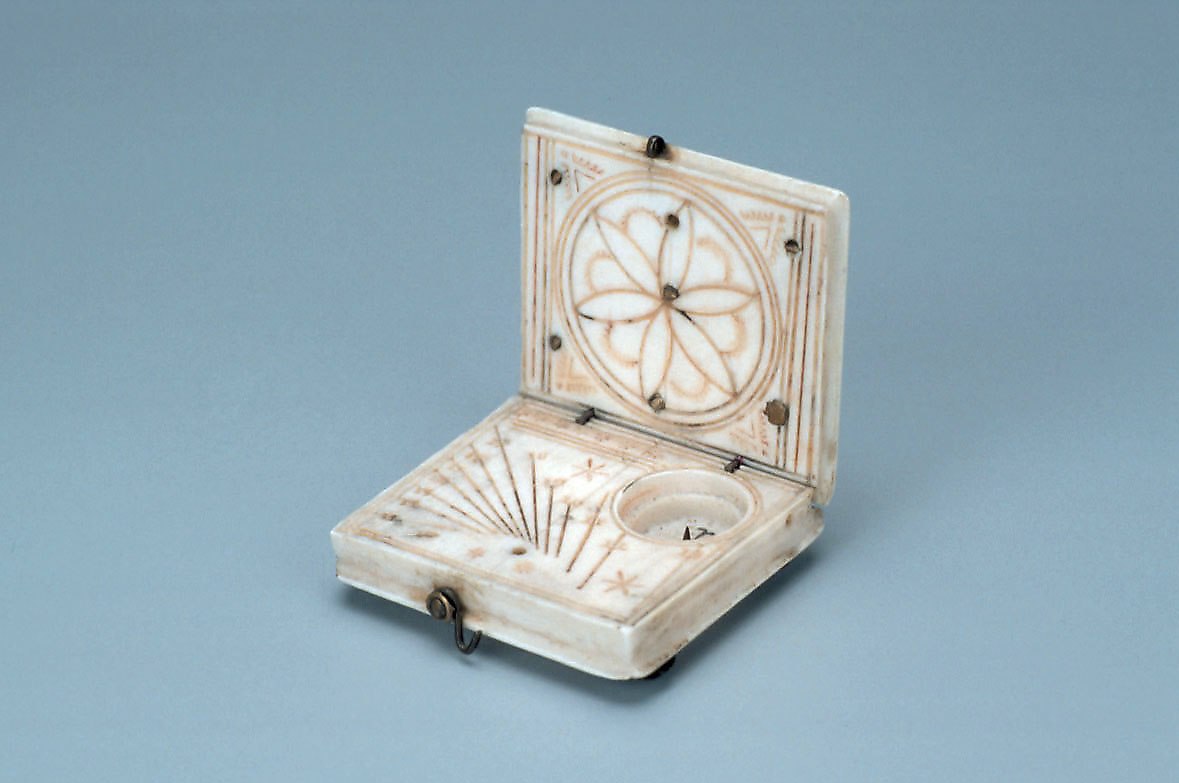
This diptych dial is a portable sundial originating from Nuremberg, dated to approximately 1600. It measures 28 x 28 x 7 mm, dimensions that establish it as one of the smallest surviving examples of its type and the smallest in the collection of the Museum of the History of Science, Oxford. The object is constructed from ivory and brass, configured in a book-like format featuring brass bun feet. The functional design incorporates an integrated compass and a pin gnomon dial calibrated for Italian hours. An unidentified maker's mark, resembling a bunch of grapes, is punched onto the lower leaf. The dial remains in an incomplete state with components missing, reflecting its historical preservation.

Opened view of the 1600 Nuremberg diptych dial showing the interior dial plate and compass housing.
Opened view of the 1600 Nuremberg diptych dial showing the interior dial plate and compass housing. — Museum of the History of Science, Oxford. Rights pending — permission not yet requested. Original source

Catalogue identity

Source
www.mhs.ox.ac.uk
Category
Tool · Diptych sundial
Maker / attribution
Not established
Reference
Not recorded
Catalogue / lot identifier
42629
Source-reported date
circa 1600
Source-reported place
Germany

Source-reported attribution and specifications are not independent authentication. A listing does not establish present ownership, current display, availability or permission to reproduce.

Object description

Construction and Design

The diptych dial is crafted from ivory and incorporates brass elements, including hinges and bun feet. The instrument is designed as a small book, a form factor that allows for portability. Its compact size is a primary characteristic, measuring 28 mm by 28 mm by 7 mm.

The exterior surfaces feature blind-tooling decoration, while the interior surfaces are adorned with specific motifs. The inner part of the upper leaf features a twelve-leaf flower design inscribed within a circle. The lower leaf integrates a compass housing and a dial plate marked for Italian hours, accompanied by a star motif in two varying sizes.

Evidence for this section
  • “It is made in the form of a book with brass bun feet”
  • “The inner part of the upper leaf has a decoration in the form of a twelve-leaf flower inscribed in a circle.”
  • “The outer part of the upper leaf has an imitation of blind-tooling and five brass feet.”

Horological Functionality

The device functions as a portable timekeeper using a pin gnomon to cast a shadow on the lower dial plate. The dial is specifically calibrated for Italian hours, which are numbered from 10 to 23. This method of timekeeping represents a specific regional tradition prevalent in European horology during the era.

A compass is embedded within the lower leaf to orient the dial correctly. Currently, the instrument is incomplete; the glass, the compass needle, the ring, and the pin gnomon itself are missing from the assembly, limiting its current ability to function as a sundial.

Evidence for this section
  • “The inner part of the lower leaf has a compass (glass, needle and ring missing) and a pin gnomon dial (pin missing) for Italian hours numbered from 10 to 23.”

Identification and Marks

The dial is unsigned, and while a maker's mark is present, it has not been positively identified. This mark is punched onto the outer side of the lower leaf and is described by researchers as resembling a bunch of grapes.

The instrument is attributed to the Nuremberg region based on historical manufacturing context. It has been documented as a notable piece due to its exceptionally small scale, which positions it as a significant item within the Museum of the History of Science catalogue.

Evidence for this section
  • “Unsigned”
  • “The maker's mark is punched on the outer side of the lower leaf but has not been identified.”

Open research questions

  • Can the unidentified bunch-of-grapes maker's mark be attributed to any known Nuremberg ivory turners from the 1600s?
  • Were the missing compass components lost during historical use or removed at a later date?

Source evidence

Recorded claims and source quotations for Nuremberg Diptych Dial
FieldSource-reported valueSource quotation
Inventory Number42629“Inventory number: 42629”
Dimensions28 x 28 x 7 mm“28 x 28 x 7 mm”
Maker's MarkUnidentified mark similar to a bunch of grapes“The maker's mark is punched on the outer side of the lower leaf but has not been identified.”
MaterialIvory and brass“Ivory and brass”
OriginNuremberg“circa 1600; Nuremberg”

Visible details

  • Ivory construction featuring brass bun feet and hinges
  • Inner leaf decoration includes a central twelve-leaf flower inscribed in a circle
  • Pin gnomon dial surface engraved with Italian hour markers from 10 to 23
  • Compass housing and pin gnomon are absent

Research qualifications

  • The maker's identity remains unknown despite the presence of a punched mark
  • The functional accuracy is compromised by missing components including the compass needle and gnomon pin

Photograph identity and source facts were screened before import; rights clearance remains pending.

Consulted source

Diptych Dial

Reviewed 2026-10-26 · Record 68e342235a

Terms in this record

Glossary explanations for terms named in this object’s record.