
Skip to content
The Encyclopedia of Horology

Clock · Table clock

Pieter Visbach Wooden Table Clock

Partially verified

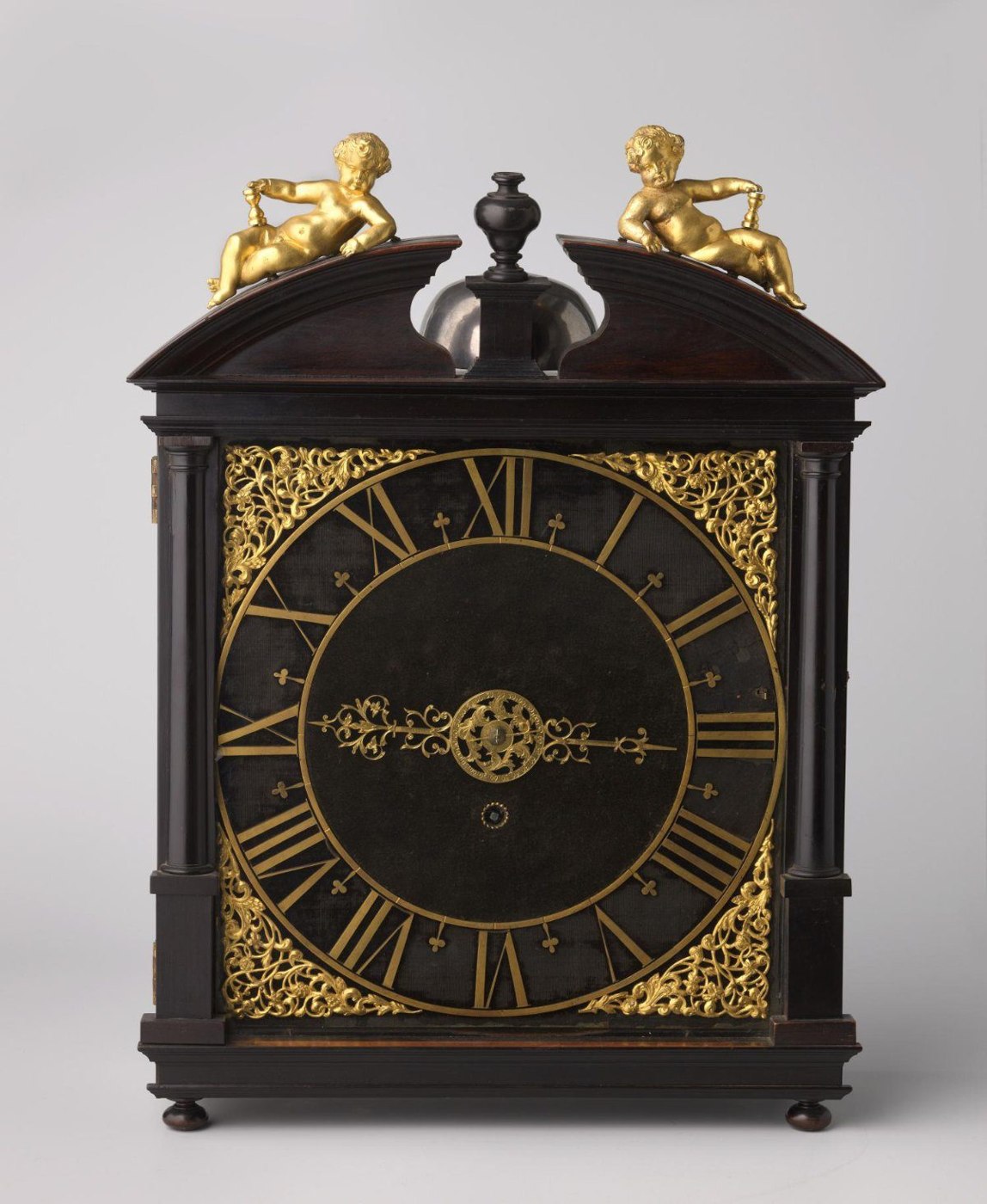
This wooden table clock was crafted by the clockmaker Pieter Visbach (I) in The Hague between 1650 and 1700. The mechanical movement is housed within a square wooden case supported by flattened ball feet. The face of the clock is flanked by two Tuscan engaged columns. Decorative brass spandrels, designed with openwork foliate motifs, adorn the corners of the dial. The case is surmounted by a broken quarter-round pediment, featuring a central vase situated on a pedestal. Positioned on the two sections of the pediment are two figures of children, oriented with their backs facing one another. The maker's signature, "Pieter Visbach Fecit Hagae," is located on the back of the movement. According to historical accounts, the clock is reported to have belonged to Michiel Adriaenszoon de Ruyter.

Front view of the wooden table clock by Pieter Visbach, showing the dial, Tuscan columns, and decorative figures on the pediment.
Front view of the wooden table clock by Pieter Visbach, showing the dial, Tuscan columns, and decorative figures on the pediment. — Rijksmuseum. Rights pending — permission not yet requested. Original source

Catalogue identity

Source
www.rijksmuseum.nl
Category
Clock · Table clock
Maker / attribution
Pieter Visbach (I)
Reference
Not recorded
Catalogue / lot identifier
BK-NM-3483
Source-reported date
1650 - 1700
Source-reported place
The Netherlands

Source-reported attribution and specifications are not independent authentication. A listing does not establish present ownership, current display, availability or permission to reproduce.

Object description

Case Architecture and Design

The housing of this table clock is constructed from wood and follows a square, architectural form. The primary structure is elevated on small, flattened ball feet. A distinct feature of the facade is the placement of the movement behind a dial flanked by a pair of engaged Tuscan columns, which provide vertical structure to the face. The corners of the dial area are enriched with brass spandrels displaying openwork rankmotifs, a contrast to the darker wood casing.

The top of the clock terminates in a broken quarter-round pediment. Centrally positioned between the pediment sections is a vase resting on a dedicated pedestal. Complementing this central ornament, two sculptural figures of children are set upon the pediment, positioned so their backs face each other. The overall dimensions of the case are recorded as 48.3 cm in height, 32.5 cm in width, and 13.2 cm in depth.

Evidence for this section
  • “Het uurwerk is gevat in een kleine vierkante kast op afgeplatte bolpoten, tussen twee Toscaanse halfzuilen.”
  • “De zwikken zijn gevuld met opengewerkte rankmotieven.”
  • “De kast wordt bekroond met een gebroken kwartrond fronton, met in het midden een vaas op een voetstuk. Op de twee delen van het fronton rusten twee kinderen, met de ruggen naar elkaar toe.”

Movement and Signatures

The mechanical movement is signed by the maker on its reverse side. The inscription identifies the maker as Pieter Visbach (I), with the location specified as 'Hagae', referring to The Hague. Technical specifications indicate the dimensions of the movement plates are 11.9 cm by 9.5 cm. The bell, integral to the clock's striking function, measures 0.9 cm in diameter.

The signature is explicitly placed on the movement plates, confirming the attribution to the Visbach workshop. The mechanical configuration is consistent with table clocks of the 17th-century Dutch tradition produced by Visbach.

Evidence for this section
  • “Het uurwerk is aan de achterzijde gemerkt: "Pieter Visbach Fecit Hagae”
  • “signatuur, platine: ‘Pieter Visbach // Fecit Hagae’”
  • “platine: lengte 11,9 cm x breedte 9,5 cm”

Provenance and Documentation

The provenance of this object is associated with the Dutch naval figure Michiel Adriaenszoon de Ruyter, although the museum notes this is based on tradition rather than primary evidence. The clock is catalogued under the accession number BK-NM-3483 within the Rijksmuseum collection.

The documentation of the clock references A.J. de Boer's work titled 'Uurwerken', published in Haarlem in 1980, where the piece is noted on page 132. These references provide the context for the identification and historical classification of the clock within the museum's holdings.

Evidence for this section
  • “De klok zou volgens overlevering van Michiel Adriaenszoon de Ruyter zijn geweest.”
  • “Objectnummer BK-NM-3483”
  • “A.J. de Boer, Uurwerken, Haarlem, 1980, p.132.”

Open research questions

  • What is the specific mechanical escapement type utilized in this clock movement?
  • Are there archival documents in the Rijksmuseum that corroborate the link between this clock and Michiel Adriaenszoon de Ruyter?

Source evidence

Recorded claims and source quotations for Pieter Visbach Wooden Table Clock
FieldSource-reported valueSource quotation
MakerPieter Visbach (I)“Pieter Visbach (I)”
Place of originThe Hague“Den Haag”
Date1650-1700“1650 - 1700”
Signature locationBack of movement“Het uurwerk is aan de achterzijde gemerkt: "Pieter Visbach Fecit Hagae”
Height48.3 cm“hoogte 48,3 cm (met tympaan)”
ProvenanceMichiel Adriaenszoon de Ruyter“De klok zou volgens overlevering van Michiel Adriaenszoon de Ruyter zijn geweest.”

Visible details

  • Case features two Tuscan engaged columns
  • Broken pediment topped by a central vase and two child figures
  • Dial corners decorated with openwork foliate brass spandrels
  • Flattened ball feet supporting the wooden case

Research qualifications

  • The claim of provenance relating to Michiel Adriaenszoon de Ruyter is based on tradition
  • Attribution to Pieter Visbach (I) covers a 50-year range

Photograph identity and source facts were screened before import; rights clearance remains pending.

Terms in this record

Glossary explanations for terms named in this object’s record.