
Skip to content
The Encyclopedia of Horology

Clock · Musical bracket clock

Pierre Jaquet Droz Eight-Tune Triple-Mechanism Musical Clock

Partially verified

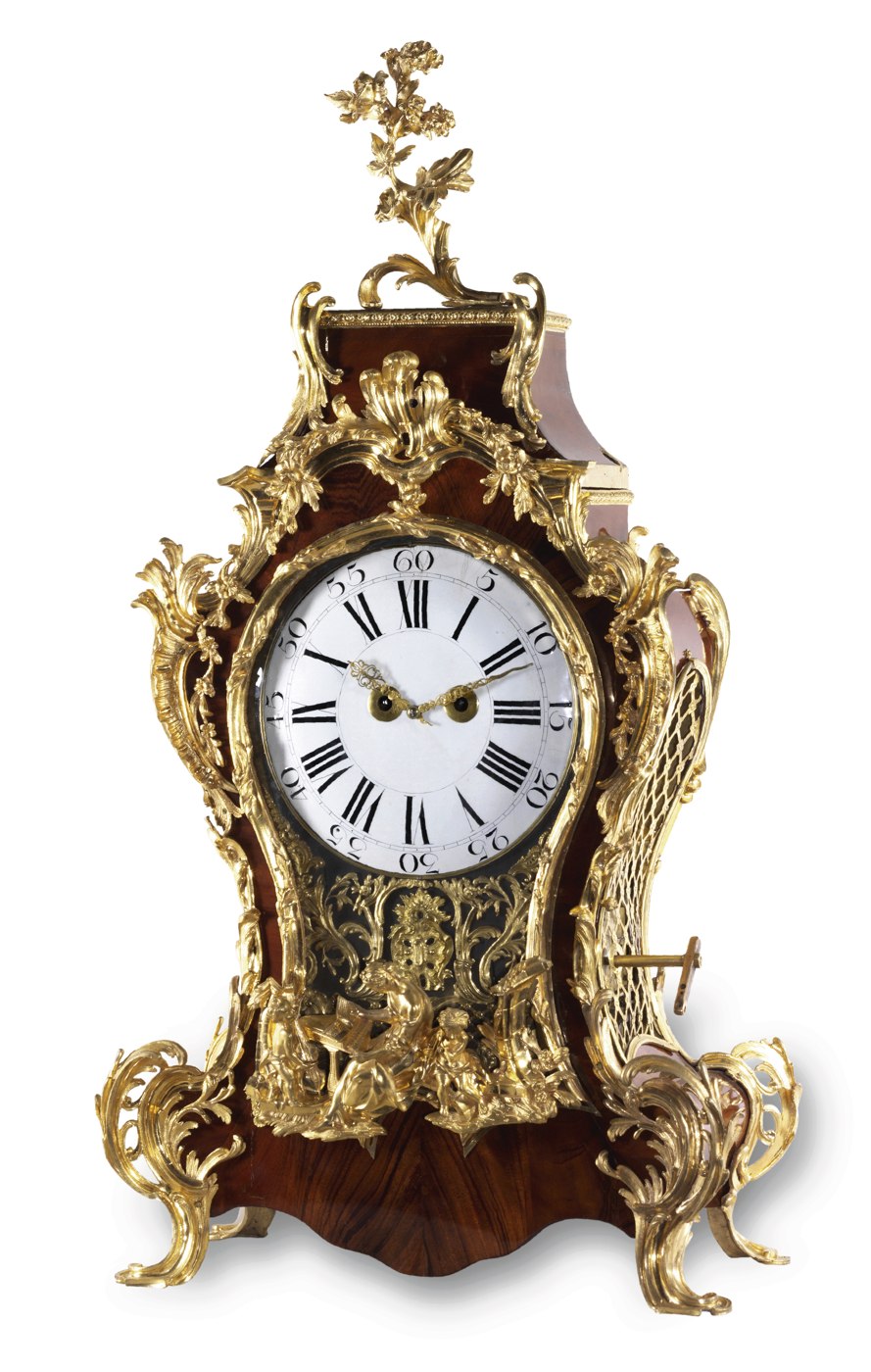
This musical bracket clock, attributed to Pierre Jaquet Droz of La Chaux-de-Fonds, dates to approximately 1770. The mahogany case features a waisted design with ormolu rococo mounts, including foliate scroll feet and pierced brass side grilles. The door is adorned with a gilt bronze figural scene depicting a lady playing a harpsichord accompanied by two putti playing string instruments. The white enamel dial displays radial Roman numerals and Arabic five-minute intervals. Internally, the clock houses a complex movement comprising three distinct systems: an 8-day going and striking train, a musical bell mechanism playing eight tunes on eleven bells via a pinned cylinder, and two pipe organs. The larger organ features 14 pipes, while the smaller organ is housed in the clock's cresting and utilizes 9 pipes. The assembly is described as an extremely rare, possibly unique, integration of multiple musical mechanisms within a single clock.

Front view of the Jaquet Droz musical bracket clock featuring ormolu figural mounts and enamel dial.
Front view of the Jaquet Droz musical bracket clock featuring ormolu figural mounts and enamel dial. — Antiquorum. Rights pending — permission not yet requested. Original source

Catalogue identity

Source
catalog.antiquorum.swiss
Category
Clock · Musical bracket clock
Maker / attribution
Pierre Jaquet Droz
Reference
Not recorded
Catalogue / lot identifier
213-297
Source-reported date
circa 1770
Source-reported place
Switzerland

Source-reported attribution and specifications are not independent authentication. A listing does not establish present ownership, current display, availability or permission to reproduce.

Object description

Case and Dial Design

The clock is housed in a waisted mahogany case featuring gilt bronze rococo scroll and rocaille mounts. The base rests on foliate scroll feet, while the sides are equipped with pierced brass grilles. A prominent feature is the gilt bronze door mount depicting a lady playing a harpsichord with two putti playing the viola and violin. A flower and scroll finial surmounts the clock.

The dial is composed of white enamel with a convex shape. It displays bold Roman numerals for the hours, with an outer minute track and Arabic numerals indicating five-minute intervals. The dial mask incorporates gilt bronze foliate and floral ornamentation. Additionally, a white enamel tune selection dial is located at the lower left, complemented by tune selection and damper levers for the musical bell mechanism.

Evidence for this section
  • “Waisted form veneered with mahogany, rococo gilt bronze scroll and rocaille mounts”
  • “scroll and flower finial, foliate scroll feet”
  • “White enamel, convex, bold radial Roman numerals”

Musical and Horological Movement

The movement is a complex assembly measuring 27 x 10 cm. The timekeeping and striking functions operate on an 8-day going train with a massive fusee and gut line, using a verge escapement and a steel rod pendulum with a circular brass bob. The clock strikes hours and quarters on two bells.

Three musical mechanisms are integrated: a bell movement with eleven bells and nineteen hammers playing eight tunes on a 16 cm pinned cylinder; a large organ with 14 pipes driven by two massive fusees; and a small organ with 9 pipes mounted in the cresting. These systems trigger sequentially on the hour or at the user's discretion.

Evidence for this section
  • “massive fusee and gut for the going train, fusee and chain for the striking train, verge escapement”
  • “16 cm pinned brass cylinder, playing a selection of eight tunes on eleven bells with nineteen hammers”
  • “Large organ movement: driven by two massive fusees with gut lines, mounted between plates above the organ”

Maker and Rarity

The clock is signed by Pierre Jaquet Droz, a clockmaker active in La Chaux-de-Fonds. The auction description notes the rarity of this piece, stating that few clocks by this maker incorporating organs are known to survive. The auction report further suggests that during the era of manufacture, Jaquet-Droz was the primary producer of complex musical clocks in Switzerland.

The specific arrangement of a musical bell movement combined with two distinct pipe organs is described as an extremely rare, or potentially unique, configuration for this maker.

Evidence for this section
  • “Very few clocks by Jaquet Droz with organs exist”
  • “The heavy, compacted brass movement is typical of Jaquet-Droz”
  • “During this period Jaquet-Droz was the only maker in Switzerland producing complicated musical clocks.”

Open research questions

  • Does the movement bear a specific signature or serial number not visible in the primary photo?
  • Are there any identifiable marks or stamps on the ormolu mounts indicating a specific bronze caster or gilder?

Source evidence

Recorded claims and source quotations for Pierre Jaquet Droz Eight-Tune Triple-Mechanism Musical Clock
FieldSource-reported valueSource quotation
MakerPierre Jaquet Droz, a la Chaux-de-Fonds“Pierre Jaquet Droz, a la Chaux-de-Fonds.”
Datingcirca 1770“Made circa 1770.”
Musical capabilitiesEight-tune triple-mechanism“Eight-Tune Triple-Mechanism Musical Clock”
Case materialsMahogany and ormolu“mahogany and ormolu”
Clock dimensions123 x 65 x 29 cm“Dim. 123 x 65 x 29 cm.”
EscapementVerge escapement“verge escapement”

Visible details

  • Figural gilt bronze door mount with musicians
  • Pierced brass grilles on case sides
  • White enamel dial with convex profile
  • Pierced and engraved gilt brass hands

Research qualifications

  • The exact uniqueness is suggested but not verified by documentation
  • The internal mechanical condition and functionality remain subject to specialist assessment

Photograph identity and source facts were screened before import; rights clearance remains pending.

Terms in this record

Glossary explanations for terms named in this object’s record.

Other musical bracket clock records