
Skip to content
The Encyclopedia of Horology

Component · Clock pendulum

Pendulum from Reproduction of Huygens Clock Movement

Partially verified

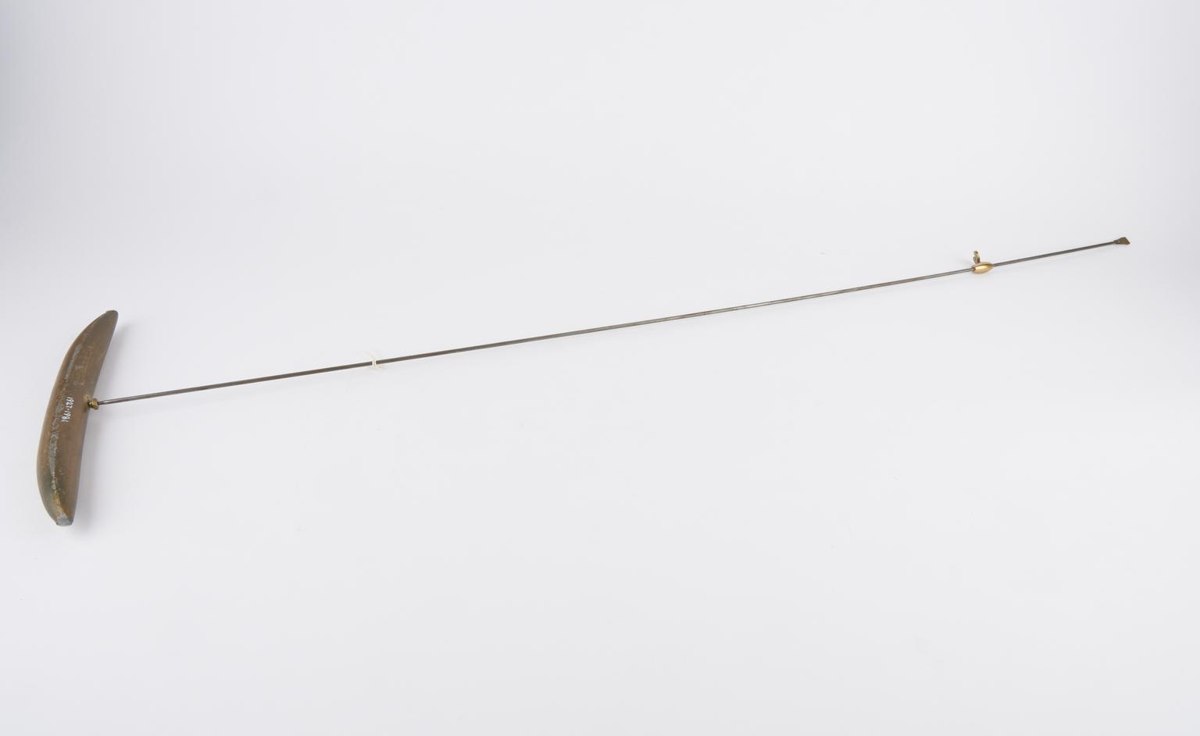
This clock pendulum, catalogued as object number 1927-1981 Pt1/1, was produced in 1927 by J. Morrison & Sons in London as part of a reproduction of Christiaan Huygens's 1673 clock movement described in Horologium Oscillatorium. The component is preserved in the Science Museum Group Collection as a part of the larger clock reproduction assembly 1927-1981 Pt1. The pendulum comprises a straight, slender rod terminating in a curved, transverse pendulum bob at the lower end, along with an upper sliding brass weight with a thumbscrew fitting near the suspension end.

Reproduction Huygens clock pendulum (1927-1981 Pt1/1) showing curved transverse bob and slender rod
Reproduction Huygens clock pendulum (1927-1981 Pt1/1) showing curved transverse bob and slender rod — The Board of Trustees of the Science Museum. Rights pending — permission not yet requested. Original source

Catalogue identity

Source
collection.sciencemuseumgroup.org.uk
Category
Component · Clock pendulum
Maker / attribution
J. Morrison & Sons
Reference
Not recorded
Catalogue / lot identifier
1927-1981 Pt1/1
Source-reported date
1927
Country
United Kingdom

Source-reported attribution and specifications are not independent authentication. A listing does not establish present ownership, current display, availability or permission to reproduce.

Object description

Object Identity and Context

This component is identified as a pendulum (accession number 1927-1981 Pt1/1), part of a 1927 reproduction of Christiaan Huygens's 1673 clock movement, 'Horologium Oscillatorium', constructed by J. Morrison & Sons of London.

The pendulum is catalogued as a component of the larger reproduction assembly 1927-1981 Pt1.

Evidence for this section
  • “Pendulum from reproduction of Huygens clock movement (from "Horologium Oscillatorium" 1673), J. Morrison & Sons, London, 1927.”
  • “Object Number: 1927-1981 Pt1/1”
  • “Part of: 1927-1981 Pt1”

Physical Description

The component is described as a slender, straight metallic pendulum rod with a curved, crescent-like transverse pendulum bob attached at the bottom. A small brass auxiliary weight or collar featuring a thumbscrew is positioned along the upper section of the rod, which terminates in a flattened or shaped suspension terminal.

The museum accession number is marked on the surface of the lower curved bob.

Evidence for this section
  • “Slender, straight metallic pendulum rod”
  • “Curved, crescent-like transverse pendulum bob attached at the bottom”
  • “Small brass auxiliary weight or collar with thumbscrew positioned along the upper section of the rod”
  • “Museum accession number marked on the surface of the lower curved bob”

Historical Design Notes

The reproduction timepiece differs from that illustrated in Huygens's 1658 work, 'Horologium', regarding the method of pendulum suspension.

The pendulum is hung between cycloidal 'cheeks' to demonstrate Huygens's calculations concerning the period of a pendulum's arc.

Evidence for this section
  • “The timepiece differs slightly from that illustrated in Huygen's "Horologium" work of 1658 due to the hanging of the pendulum, it is hung between cycloidal 'cheeks'.”
  • “Huygen's calculations show that a pendulum's period of swing can be the same for all arcs of swing.”

Open research questions

  • What are the precise metallurgical properties of the pendulum rod beyond the materials listed for the overall assembly?
  • Does the source confirm the specific function of the sliding brass weight in the regulation of the pendulum's period?

Source evidence

Recorded claims and source quotations for Pendulum from Reproduction of Huygens Clock Movement
FieldSource-reported valueSource quotation
MakerJ. Morrison & Sons“J. Morrison & Sons, London, 1927”
Date Made1927“Made: 1927 in London”
Object Number1927-1981 Pt1/1“Object Number: 1927-1981 Pt1/1”
Typependulum“type: pendulum”
Historical ModelHorologium Oscillatorium 1673“from "Horologium Oscillatorium" 1673”
MakerJ. Morrison & Sons“J. Morrison & Sons, London, 1927”
Date Made1927“Made: 1927 in London”
Object Number1927-1981 Pt1/1“Object Number: 1927-1981 Pt1/1”

Visible details

  • Slender, straight metallic pendulum rod
  • Curved, crescent-like transverse pendulum bob attached at the bottom
  • Museum accession number marked on the surface of the lower curved bob
  • Small brass auxiliary weight or collar with thumbscrew positioned along the upper section of the rod
  • Flattened or shaped suspension terminal at the upper tip

Research qualifications

  • This entry describes only the pendulum component (Pt1/1), not the complete clock movement or dials catalogued under other part numbers
  • Detailed separate measurements and metallurgical analysis for this specific component are not enumerated in the source text

Photograph identity and source facts were screened before import; rights clearance remains pending.

Consulted source

Reproduction of Huygens clock movement | Science Museum Group Collection

Reviewed 2026-10-25 · Record bce43eefb2

Terms in this record

Glossary explanations for terms named in this object’s record.