
Skip to content
The Encyclopedia of Horology

Clock · Figurative mantel clock

Pendule « L'Amérique »

Partially verified

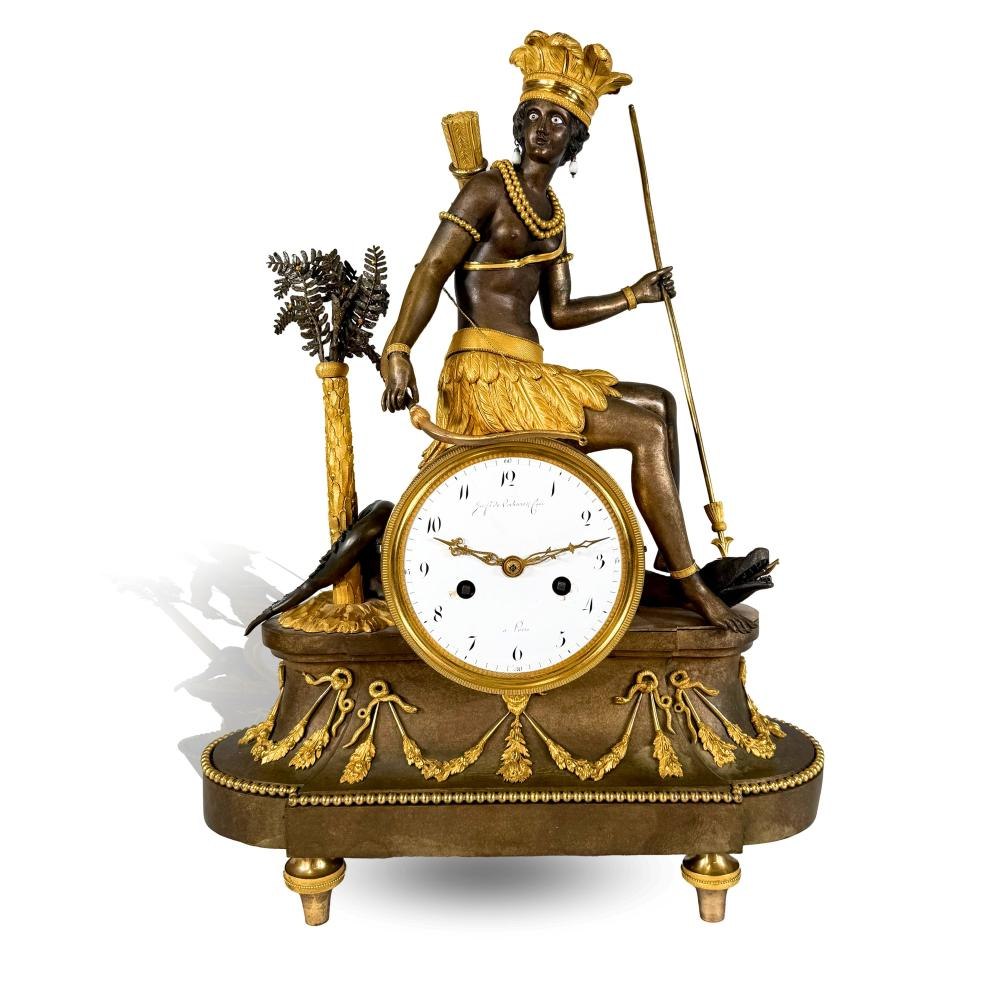
This figurative mantel clock, known as the "Aux Amériques" model, was produced by the workshop of Jean-Simon Deverberie (1764-1824) between 1800 and 1810. The clock features a large bronze sculpture of a seated Native American female figure, accented with a feather headdress, jewelry, and a gilt spear. A naturalistically rendered crocodile is positioned at her feet, while a palm tree stands at the rear of the clock. The white enamel dial is signed "Inventé par De Verberie & Cie, à Paris" and houses an original movement with silk-thread suspension, designed to strike hours and half-hours on a bell. The bronze elements display original mercury gilding in matte and burnished finishes. The piece measures 49 cm in height and 36 cm in length, maintaining its original attributes, including opaline earrings and blown-glass eyes, though the pendulum and rear glass are currently missing.

The "Aux Amériques" figurative clock by Jean-Simon Deverberie, featuring a central Native American figure and enamel dial, seen from the front.
The "Aux Amériques" figurative clock by Jean-Simon Deverberie, featuring a central Native American figure and enamel dial, seen from the front. — Swiss Encheres (via Invaluable). Rights pending — permission not yet requested. Original source

Catalogue identity

Source
www.invaluable.com
Category
Clock · Figurative mantel clock
Maker / attribution
Jean-Simon Deverberie
Reference
Not recorded
Catalogue / lot identifier
65
Source-reported date
circa 1800-1810
Source-reported place
France

Source-reported attribution and specifications are not independent authentication. A listing does not establish present ownership, current display, availability or permission to reproduce.

Object description

Case and Iconography

The primary sculptural element is a seated Native American female figure adorned with a feather headdress, necklaces, and bracelets, holding a gilt spear. The base is decorated with gilt bronze motifs, while a palm tree rises behind the central figure.

The composition includes a naturalistically rendered crocodile at the feet of the main figure. The piece retains original delicate attributes, specifically opaline earrings and blown-glass eyes. The mercury gilding, alternating between matte and burnished textures, is described as being in original condition without modern restorations, exhibiting wear consistent with the period.

Evidence for this section
  • “Ce modèle, d’un format important, se distingue par la puissance sculpturale de la figure féminine amérindienne assise, parée d’un panache de plumes, de colliers, de bracelets, tenant une lance dorée, et accompagnée d’un crocodile naturaliste à ses pieds.”
  • “Les délicats attributs d’origine: boucles d’oreilles en opaline ancienne et yeux en verre soufflé, témoignent d’un état de conservation exceptionnel.”
  • “La dorure au mercure, alternant mat et bruni, est entièrement d’époque, sans reprises modernes, avec de très belles usures homogènes caractéristiques des meilleurs bronzes Directoire.”

Movement and Dial

The clock utilizes an original Parisian movement equipped with a silk-thread suspension system. It is designed to strike both the hours and half-hours on a bell. As noted in the auction condition report, the movement is currently unserviced and lacks a pendulum, which will require attention to restore the clock to functional timekeeping.

The white enamel dial features pierced gilt-bronze hands of the period. It bears the mark "Inventé par De Verberie & Cie, à Paris," which the auction description indicates is a specific indicator of items produced directly within the Deverberie workshop. The enamel displays minor losses around the winding holes, though it remains otherwise intact without modern repairs or restoration.

Evidence for this section
  • “Le mouvement parisien d’origine, à suspension à fil de soie, sonne les heures et demi-heures sur timbre ; balancier et verre arrière manquent”
  • “Le cadran émaillé blanc porte la mention « Inventé par De Verberie & Cie, à Paris », signe distinctif des créations sorties directement de l’atelier.”
  • “Il présente un léger saut d’émail autour des trous du remontoir, sans perte d’intégrité ni reprise.”

Provenance and Documentation

The piece is recognized as a documented model within the output of Jean-Simon Deverberie, with references to the design found in institutional collections and historical literature. The model is specifically associated with the artistic taste of the 1790–1810 period, drawing inspiration from contemporary literary works such as those by Bernardin de Saint-Pierre, Chateaubriand, and Daniel Defoe.

The auction catalogue lists its provenance as being from a private collection in Switzerland, and it is compared to the aquarelle drawing of the model preserved at the Bibliothèque Nationale de France in the Cabinet des Estampes.

Evidence for this section
  • “Voir le dessin aquarellé du modèle, n° 12, Bibliothèque Nationale de France, Cabinet des Estampes.”
  • “H. Ottomeyer & P. Pröschel, Vergoldete Bronzen, Munich, 1986, vol. I, p. 379-381.”
  • “L’ensemble, parfaitement conforme aux modèles documentés, s’impose comme l’une des plus belles expressions du génie décoratif de Deverberie.”

Open research questions

  • What is the specific history of the missing rear glass component and pendulum in the context of the provenance chain?
  • Are there variations in the placement of the crocodile and palm tree in other known "Aux Amériques" models by Deverberie?

Source evidence

Recorded claims and source quotations for Pendule « L'Amérique »
FieldSource-reported valueSource quotation
MakerJean-Simon Deverberie“Jean-Simon Deverberie (1764–1824)”
Datecirca 1800–1810“vers 1800–1810”
Dial inscriptionInventé par De Verberie & Cie, à Paris“Le cadran émaillé blanc porte la mention « Inventé par De Verberie & Cie, à Paris »”
Dimensions49 cm x 36 cm“H.: 49 cm L: 36 cm”
Movement typeSilk-thread suspension“mouvement parisien d’origine, à suspension à fil de soie”
Striking mechanismHours and half-hours on a bell“sonne les heures et demi-heures sur timbre”
ConditionMissing pendulum and rear glass“balancier et verre arrière manquent”
GildingMercury gilding with no modern restorations“La dorure au mercure, alternant mat et bruni, est entièrement d’époque, sans reprises modernes”

Visible details

  • The female figure wears opaline earrings and has blown-glass eyes.
  • The dial is signed "Inventé par De Verberie & Cie, à Paris".
  • The base features swags of laurel or floral decoration in gilt bronze.
  • The clock lacks a rear glass cover and an internal pendulum.

Research qualifications

  • The exact dating is estimated by the source as 1800-1810 rather than a fixed year.
  • The source notes the pendulum is missing, meaning the mechanism's current timekeeping functionality is untested.

Photograph identity and source facts were screened before import; rights clearance remains pending.

Terms in this record

Glossary explanations for terms named in this object’s record.