
Skip to content
The Encyclopedia of Horology

Clock · Pendule d'officier

Pendule d'officier clock

Partially verified

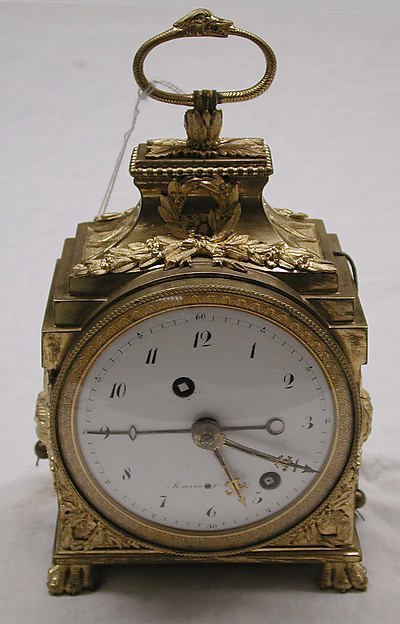
This pendule d'officier, or officer's clock, is held in the collection of The Metropolitan Museum of Art (accession number 1998.293). Dated to approximately 1800, the clock is attributed to the Firm of Meuron et Companie, an entity associated with production in both Geneva and Paris. The object is constructed from a combination of gilt bronze, enamel, and blued steel for the exterior case, while the internal movement is composed of brass and steel components. The enamel dial displays numerals and blued steel hands, housed within a decorative gilt bronze frame with an integrated handle. The piece is part of the museum's European Sculpture and Decorative Arts department collection.

A frontal view of the pendule d'officier clock, showing the gilt bronze case, enamel dial, and top-mounted handle.
A frontal view of the pendule d'officier clock, showing the gilt bronze case, enamel dial, and top-mounted handle. — The Metropolitan Museum of Art, New York. Rights pending — permission not yet requested. Original source

Catalogue identity

Source
orbiscollectibles.com
Category
Clock · Pendule d'officier
Maker / attribution
Firm of Meuron et Companie
Reference
Not recorded
Catalogue / lot identifier
1998.293
Source-reported date
ca. 1800
Source-reported place
Geneva and Paris

Source-reported attribution and specifications are not independent authentication. A listing does not establish present ownership, current display, availability or permission to reproduce.

Object description

Case and Dial Construction

The clock is defined as a pendule d'officier, a classification indicating a portable timepiece designed for travel or personal use. The exterior case is crafted from gilt bronze, which provides the structural housing and decorative aesthetic for the unit. Integrated into the top of the case is a handle, allowing for transport.

The face of the clock features an enamel dial, a choice in material consistent with durability and visibility for the period. The dial is punctuated by Arabic numerals for hour markers and is complemented by blued steel hands. This arrangement is set within the brass and steel movement structure housed internally.

Evidence for this section
  • “Case: gilt bronze, enamel, blued steel”
  • “movement: brass and steel”

Attribution and Origin

The clock is attributed to the Firm of Meuron et Companie, an entity identified as operating out of both Geneva and Paris. Documentation provided by The Metropolitan Museum of Art suggests an association with this firm circa 1790, though the clock itself is dated to approximately 1800.

The identification of the maker is part of the archival record maintained by the museum's European Sculpture and Decorative Arts department. This attribution identifies the dual location of the firm, connecting the production to Swiss and French horological environments prevalent at the time.

Evidence for this section
  • “attributed to Firm of Meuron et Companie, Geneva and Paris (ca. 1790)”
  • “The museum dates it ca. 1800”

Documentation and Provenance

This object is catalogued by The Metropolitan Museum of Art under the accession number 1998.293. The record is managed by the institution’s European Sculpture and Decorative Arts department, which provides the classification of the item as a clock of the pendule d'officier type.

The current information is derived from the museum's open-access database. The documentation establishes the physical measurements of the object at 8 7/8 by 5 1/2 by 4 1/8 inches. The museum record serves as the primary source for the specifications and the identified maker associated with this specific horological instrument.

Evidence for this section
  • “Clock in The Metropolitan Museum of Art, New York (accession 1998.293)”
  • “catalogued by the museum's European Sculpture and Decorative Arts department”

Open research questions

  • Can the association with the Firm of Meuron et Companie be confirmed through specific horological registers?
  • Does the movement exhibit specific technical features characteristic of Geneva or Paris production from this era?

Source evidence

Recorded claims and source quotations for Pendule d'officier clock
FieldSource-reported valueSource quotation
Museum Object Number1998.293“1998.293”
MakerFirm of Meuron et Companie“Firm of Meuron et Companie, Geneva and Paris”
Dateca. 1800“ca. 1800”
Case Materialsgilt bronze, enamel, blued steel“Case: gilt bronze, enamel, blued steel”
Movement Materialsbrass and steel“movement: brass and steel”
Dimensions8 7/8 × 5 1/2 × 4 1/8 in. (22.5 × 14 × 10.5 cm)“8 7/8 × 5 1/2 × 4 1/8 in. (22.5 × 14 × 10.5 cm)”

Visible details

  • Integrated top-mounted handle for portability
  • Enamel dial with Arabic numerals
  • Gilt bronze case with decorative relief work
  • Four footed base construction

Research qualifications

  • Attribution to the Firm of Meuron et Companie is subject to further specialist verification
  • The dating of circa 1800 is an estimate provided by the museum

Photograph identity and source facts were screened before import; rights clearance remains pending.

Consulted source

Clock (pendule d'officier), ca. 1800

Reviewed 2026-11-02 · Record 9f9d097c6c

Terms in this record

Glossary explanations for terms named in this object’s record.