
Skip to content
The Encyclopedia of Horology

Wristwatch · Manual-winding wristwatch

Patek Philippe Calatrava 'Disco Volante' Reference 2594/5

Partially verified

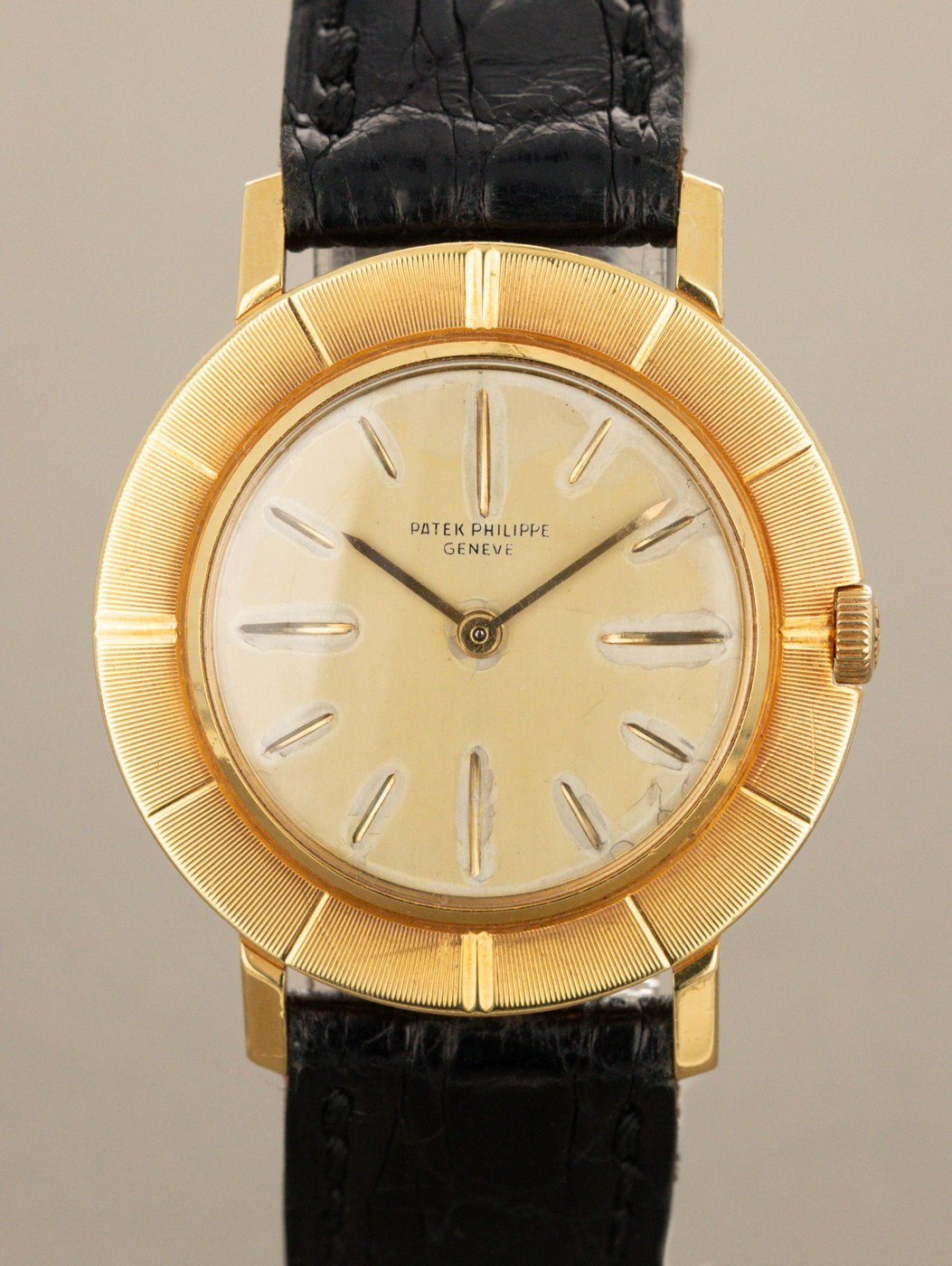
This Patek Philippe Calatrava, reference 2594/5, is a manual-winding wristwatch dated to approximately 1962. Part of the 'Disco Volante' or 'UFO' design series, it features a 32mm diameter case characterized by a radially engine-turned top bezel, a recessed signed crown, and downward-sloping lugs. The watch retains a champagne-colored dial with applied foil indices and baton-style hands. The dial exhibits surface patina, with distinct areas around the 'flinqué' engraved indices. It is powered by the Patek Philippe Calibre 23-300 manual-winding movement. The exterior of the case shows evidence of general wear, including hallmarks and a subtle rosy patina on the metal surface. The watch is currently fitted with a dark leather strap. This timepiece reflects the design language associated with the Calatrava line, specifically the aesthetic adaptations categorized as 'Disco Volante' within the mid-20th-century Patek Philippe production.

Front view of the Patek Philippe 'Disco Volante' ref. 2594/5, showing the engine-turned bezel and champagne dial.
Front view of the Patek Philippe 'Disco Volante' ref. 2594/5, showing the engine-turned bezel and champagne dial. — Oliver & Clarke. Rights pending — permission not yet requested. Original source

Catalogue identity

Source
www.oliverandclarke.com
Category
Wristwatch · Manual-winding wristwatch
Maker / attribution
Patek Philippe
Reference
2594/5
Catalogue / lot identifier
Source URL identifies the listing
Source-reported date
circa 1962
Source-reported place
Not established

Source-reported attribution and specifications are not independent authentication. A listing does not establish present ownership, current display, availability or permission to reproduce.

Object description

Case and Dial Design

The Patek Philippe reference 2594/5 features a distinct circular case design known as the 'Disco Volante' or 'UFO'. This model is noted for its 32mm diameter and the application of engine-turned finishing on the top bezel. The case construction includes a recessed crown that maintains the profile of the casing, and the lugs are designed with a downward slope.

The champagne-colored dial incorporates applied indices described as 'flinqué' engraved 'foil' markers. Visible aging is present across the dial surface, with the source noting a specific contrast where patina is absent around the individual indices. The dial is equipped with baton-style hour and minute hands. The watch is marked with hallmarks and exhibits a rosy patina on the case material.

Evidence for this section
  • “dates to circa 1962 and is also known as a UFO or Disco Volante for its 'flying saucer'-like case design.”
  • “features a beautiful 'engine-turned' finishing on the top case, with a signed, recessed crown”
  • “simply time-only champagne dial exhibits patina across the surface with an interesting lack of patina around the 'flinqué' engraved 'foil' indices.”

Movement and Function

The watch is driven by the Patek Philippe Calibre 23-300 manual-winding movement. This caliber is described as a long-running and proven mechanism within the brand's history. The movement provides simple, time-only functionality for the watch.

The mechanical system is housed within the 32mm case and is adjusted via the signed crown. The source reports that the movement is a foundational component for this reference, consistent with the manual-winding requirements of the Calatrava line during the 1960s.

Evidence for this section
  • “It is powered by Patek's long-running and proven Cal. 23-300 manual-winding movement.”

Condition and Attribution

The auction description reports that the object shows normal wear throughout the case. The watch features hallmarks on the case, confirming its identification and production specifications.

The piece is identified as part of the Calatrava line, which the source dates to 1932 onwards, with this specific example attributed to approximately 1962. The documentation confirms the reference number and provides a physical description of the aging patterns on the dial and case as observable in the provided photography.

Evidence for this section
  • “It shows normal wear throughout with nice hallmarks and a light 'rosy' patina developing.”
  • “dates to circa 1962”

Open research questions

  • What is the specific precious metal composition of the case as indicated by the hallmarks?
  • Are there archival records confirming the production date and initial sale date of reference 2594/5?

Source evidence

Recorded claims and source quotations for Patek Philippe Calatrava 'Disco Volante' Reference 2594/5
FieldSource-reported valueSource quotation
MakerPatek Philippe“Patek Philippe”
Reference2594/5“Reference 2594”
Diameter32mm“comes in at 32mm in diameter”
MovementCal. 23-300“Patek's long-running and proven Cal. 23-300 manual-winding movement.”
Approximate Datecirca 1962“dates to circa 1962”
Dial detailsChampagne-toned with 'flinqué' indices“simply time-only champagne dial exhibits patina across the surface with an interesting lack of patina around the 'flinqué' engraved 'foil' indices.”
Case featuresEngine-turned top case, recessed crown“features a beautiful 'engine-turned' finishing on the top case, with a signed, recessed crown, and simple downward sloping lugs.”

Visible details

  • Radially engine-turned texture on the fixed bezel
  • Recessed crown positioned at 3 o'clock
  • Downward-sloping, short lugs
  • Applied foil-style indices on a champagne-toned dial

Research qualifications

  • The exact metal composition is not specified beyond mentions of hallmarks and a 'rosy' patina
  • Long-term mechanical history is not provided beyond the identification of the movement caliber

Photograph identity and source facts were screened before import; rights clearance remains pending.

Consulted source

ساعت مچی Patek Philippe Calatrava 'Disco Volante' رفرنس 2594/5

Reviewed 2026-11-02 · Record 3a28716463

Terms in this record

Glossary explanations for terms named in this object’s record.