
Skip to content
The Encyclopedia of Horology

Clock · Skeleton clock

Pariser Empire-Skelettpendule

Partially verified

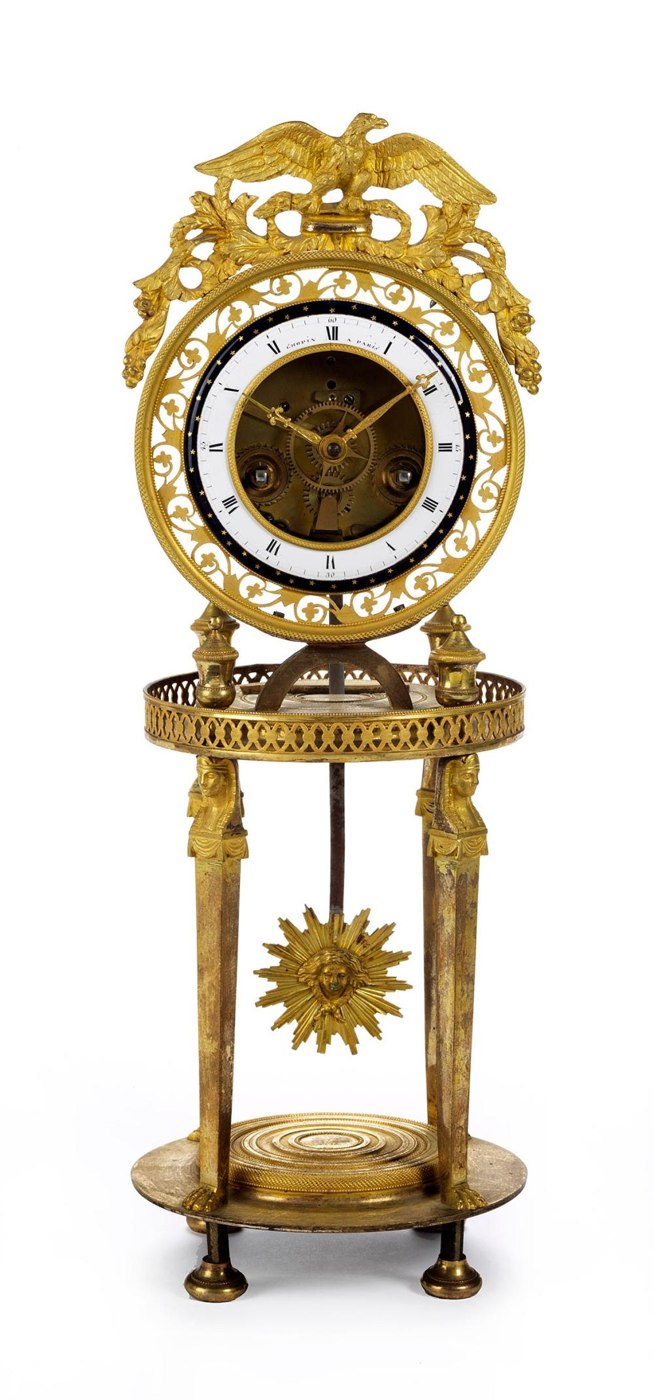
This is an Empire-period skeleton clock (Skelettpendule) measuring 40 cm in height, produced in Paris during the first quarter of the 19th century. Its structure follows a Tempietto form, resting on stepped, disc-shaped feet. The design incorporates classical elements, including a pierced gallery and a prominent eagle figure surmounting the dial. The dial features a white and dark blue enamel ring with gold star decoration, displaying black Roman hours, Arabic numerals for minutes, and index markers, all bordered by guilloché ornamentation. The movement includes a locking plate striking mechanism with a bell, capable of sounding the full and half hour, and features two winding points. The timepiece utilizes a sunburst pendulum with silk suspension and is equipped with gilded lily-style hands for the indication of hours and minutes. A key is provided with the lot.

Front view of the Empire-style skeleton clock showing the enamel dial, gilded lily-style hands, eagle ornament, and sunburst pendulum.
Front view of the Empire-style skeleton clock showing the enamel dial, gilded lily-style hands, eagle ornament, and sunburst pendulum. — Hampel Fine Art Auctions (via Invaluable). Rights pending — permission not yet requested. Original source

Catalogue identity

Source
www.invaluable.com
Category
Clock · Skeleton clock
Maker / attribution
Chopin
Reference
Not recorded
Catalogue / lot identifier
85
Source-reported date
circa early 19th century
Source-reported place
France

Source-reported attribution and specifications are not independent authentication. A listing does not establish present ownership, current display, availability or permission to reproduce.

Object description

Clockwork and Dial Construction

The timepiece is constructed as a skeleton clock in the Tempietto form, elevated on stepped, circular feet. The architecture features an 'à jour' worked gallery surrounding the mechanism. Above the dial, an eagle figure serves as the terminal ornament. The face consists of an enamel ring presented in white and dark blue, enriched with gold star motifs.

The time is indicated by gilded lily-shaped hands pointing to black Roman numerals for the hours and Arabic numerals for the minutes, with additional index markers. The outer edge of the dial area displays guilloché ornamentation. Visible behind the dial ring, the movement is supported by a frame, with two winding points for the internal gear train.

Evidence for this section
  • “Aufbau in Tempiettoform mit klassizistischen Elementen, à jour gearbeiteter Galerie und das Zifferblatt bekrönendem Adler.”
  • “Weiß und nachtblau emailliert mit Goldsterndekor; schwarze römische Stunden, arabische Minuten und Stabindizes.”
  • “vergoldete Lilienzeiger für Stunden und Minuten”

Movement and Pendulum

The movement is a striking type, specified as a locking plate striking mechanism. It allows the clock to strike on a bell for the full and half hours. The power is supplied through two winding apertures situated on the dial plate.

The clock utilizes a sunburst pendulum suspended by a silk cord, a common feature for clocks of this production era. The pendulum itself features a stylized human face at its center, surrounded by radiating rays. The auction description notes that while a key is provided, the clock has not been tested to confirm its current operational state.

Evidence for this section
  • “Schlossscheibenschlagwerk mit Schlag auf Glocke zur vollen und zur halben Stunde”
  • “zwei Aufzugsmöglichkeiten, ein Sonnenpendel mit Fadenaufhängung”
  • “nicht auf Funktionsfähigkeit getestet”

Signature and Chronology

The dial is signed "Chopin A Paris." Documentation indicates that the maker established his business in the Rue aux Ours, Paris, in 1806, later relocating to Rue Beaubourg in 1820, where operations continued until his death in 1867.

The manufacturing date of the object is attributed by the source to the first quarter of the 19th century. This placement aligns with the maker's early operational years in Paris.

Evidence for this section
  • “Zifferring signiert "Chopin A Paris".”
  • “Paris, erstes Viertel des 19. Jahrhunderts.”
  • “Chopin hat sein Uhrmachergeschäft 1806 in der Rue aux Ours in Paris gegründet”

Open research questions

  • Can specific archival records link this serial or style to Chopin's workshop output between 1806 and 1825?
  • Are there known examples of this specific Tempietto-form skeleton model in other collections or museum holdings?

Source evidence

Recorded claims and source quotations for Pariser Empire-Skelettpendule
FieldSource-reported valueSource quotation
MakerChopin“Zifferring signiert "Chopin A Paris”
Height40 cm“Höhe: 40 cm.”
Dial featuresWhite and dark blue enamel with gold stars“Weiß und nachtblau emailliert mit Goldsterndekor”
Strike mechanismLocking plate striking mechanism“Schlossscheibenschlagwerk”
SuspensionSilk suspension“Fadenaufhängung”
Design motifsEagle and Tempietto form“Aufbau in Tempiettoform mit klassizistischen Elementen, à jour gearbeiteter Galerie und das Zifferblatt bekrönendem Adler.”

Visible details

  • Gilded lily-style hour and minute hands
  • Sunburst pendulum with a central human face motif
  • Dial featuring Roman numerals for hours and Arabic numerals for minutes
  • Pierced 'à jour' gallery surrounding the dial mechanism

Research qualifications

  • The clock has not been tested for functional status
  • No verification provided for the specific manufacturing date within the first quarter of the 19th century

Photograph identity and source facts were screened before import; rights clearance remains pending.

Consulted source

Pariser Empire-Skelettpendule

Reviewed 2026-10-26 · Record e293fa92f3

Terms in this record

Glossary explanations for terms named in this object’s record.