
Skip to content
The Encyclopedia of Horology

Pocket watch · Quarter repeating pocket watch

Pair-case repeating watch by George Graham

Partially verified

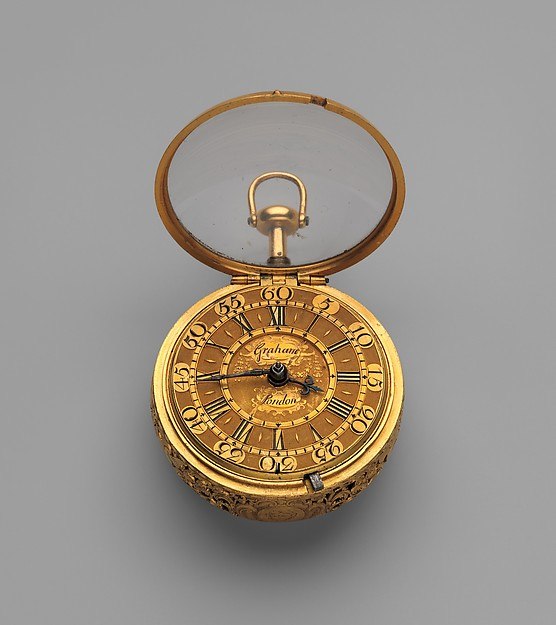
This pair-case watch with a quarter-repeating mechanism was made by the London-based clockmaker George Graham (1673–1751) and is dated 1719–20. The object, held by The Metropolitan Museum of Art (accession number 52.62a–d), features an inner and outer case constructed of gold. The dial is executed in champlevé gold, and the movement is constructed from gilded brass with components in partly blued steel. The diameter of the watch and case is 2 3/16 inches (5.6 cm). The watch is accompanied by two keys, with lengths of 1 1/16 inches (2.7 cm) and 1 inch (2.5 cm) respectively. The signature "Geo Graham, London" is engraved on the movement, which also bears the serial number 467. The watch face displays both Roman numerals for hours and Arabic numerals for the five-minute increments.

Detailed view of the watch dial, showing the champlevé gold surface and numerals, with the outer case visible beneath.
Detailed view of the watch dial, showing the champlevé gold surface and numerals, with the outer case visible beneath. — The Metropolitan Museum of Art — Gift of Captain Newton H. White Jr. U.S.N., 1952. Rights pending — permission not yet requested. Original source

Catalogue identity

Source
orbiscollectibles.com
Category
Pocket watch · Quarter repeating pocket watch
Maker / attribution
George Graham
Reference
Not recorded
Catalogue / lot identifier
52.62a–d
Source-reported date
1719–20
Source-reported place
Britain
Source-reported serial
467

Source-reported attribution and specifications are not independent authentication. A listing does not establish present ownership, current display, availability or permission to reproduce.

Object description

Case and Dial Construction

The watch is housed within a pair-case system, comprising an inner case and a protective outer case, both manufactured from gold. The dial is rendered in champlevé gold, a technique involving the removal of metal from the surface to create cells that are then worked, in this instance allowing for the display of both hour markers and peripheral minute divisions.

The dial configuration utilizes Roman numerals for the hours and Arabic numerals for five-minute intervals, providing a clear interface for the timekeeping function. A crystal is fitted to the bezel. The overall diameter of the watch and case measures 2 3/16 inches (5.6 cm).

Evidence for this section
  • “Outer and inner cases: gold; Dial: champlevé gold”
  • “Diameter (watch and case.62a, b): 2 3/16 in. (5.6 cm)”

Movement and Mechanism

The internal movement is constructed from gilded brass, which provides a durable frame for the various mechanical components. Elements of the movement, including the repeating mechanism, incorporate partly blued steel parts, a finishing method used to protect against oxidation and for visual differentiation of the parts.

The movement is signed "Geo Graham, London" and is stamped with the serial number 467. The accompanying keys for winding and setting are 1 1/16 inches and 1 inch in length.

Evidence for this section
  • “Movement: gilded brass and partly blued steel”

Provenance and Documentation

This watch is part of the collection of The Metropolitan Museum of Art, assigned accession number 52.62a–d. It was acquired as a gift from Captain Newton H. White Jr., U.S.N., in 1952. The museum provides the specific technical details regarding the materials and dimensions used to identify the piece.

The identification of the maker as George Graham is based on the signature on the movement and the museum's attribution. As with many horological objects from the early 18th century, the record relies on the specific physical evidence present on the item itself, corroborated by the institution’s cataloguing standards.

Evidence for this section
  • “The Metropolitan Museum of Art holds this object as 52.62a–d”
  • “Gift of Captain Newton H. White Jr. U.S.N., 1952”

Open research questions

  • What specific archival records, if any, survive to confirm the original commission or sale of this watch in 1719?
  • How does the serial number 467 correlate with the established production volume and chronology of George Graham's known output?

Source evidence

Recorded claims and source quotations for Pair-case repeating watch by George Graham
FieldSource-reported valueSource quotation
MakerGeorge Graham“George Graham (British, 1673–1751)”
Date1719–20“1719–20”
MaterialsGold, gilded brass, blued steel“Outer and inner cases: gold; Dial: champlevé gold; Movement: gilded brass and partly blued steel.”
Dimensions5.6 cm diameter“Diameter (watch and case.62a, b): 2 3/16 in. (5.6 cm)”
Museum Accession Number52.62a–d“52.62a–d”

Visible details

  • Champlevé gold dial with Roman and Arabic numerals
  • Movement signed "Geo Graham, London"
  • Pierced and engraved gold outer case
  • Internal serial number 467 visible on movement

Research qualifications

  • Wider type classification is subject to verification against specialist references
  • Historical context regarding the maker is based on general biographical records rather than object-specific documentation

Photograph identity and source facts were screened before import; rights clearance remains pending.

Consulted source

Pair-case watch with quarter repeating mechanism, George Graham, 1719–20

Reviewed 2026-11-02 · Record 3e3d482e77

Terms in this record

Glossary explanations for terms named in this object’s record.