
Skip to content
The Encyclopedia of Horology

Clock · Table orrery clock

Orrery clock with a glass celestial globe

Partially verified

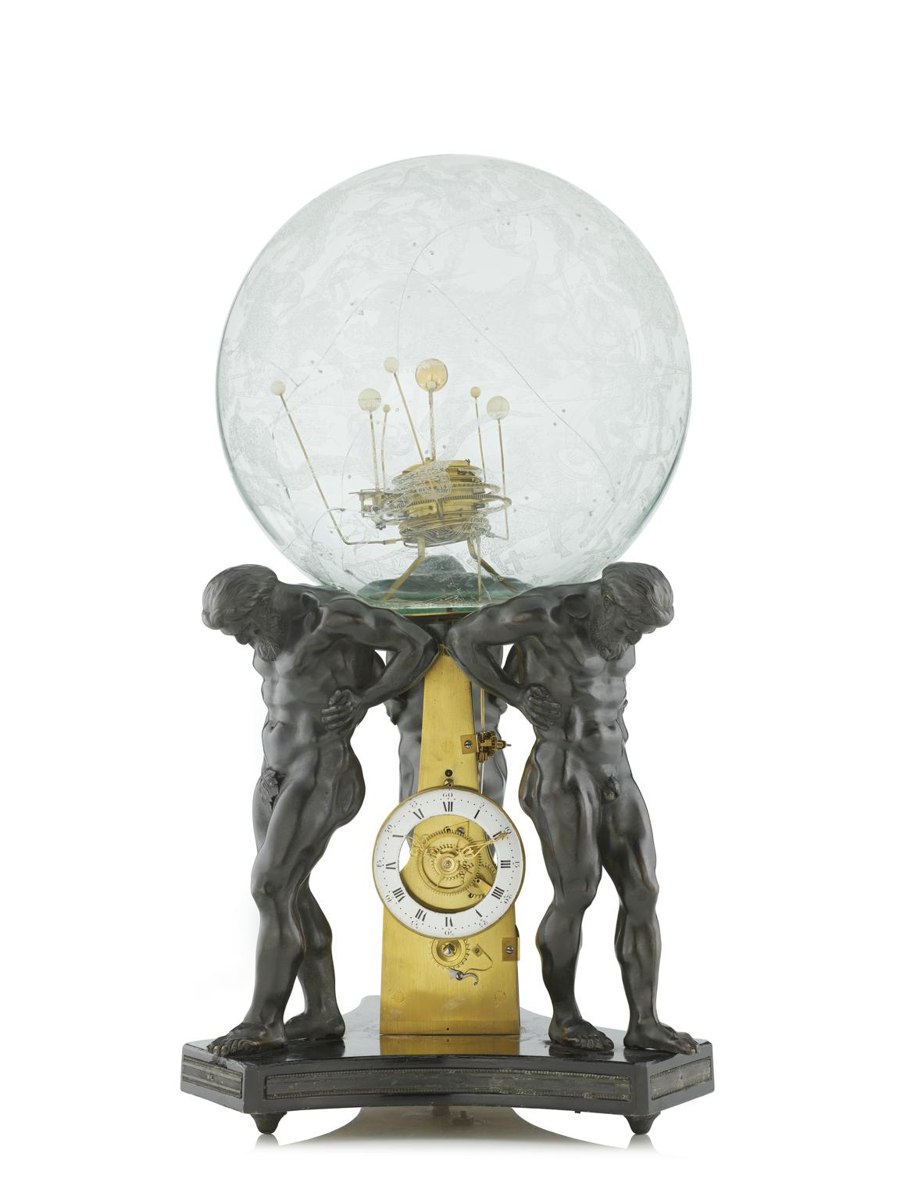
This French table clock dates to circa 1795 to 1805 and incorporates an orrery enclosed within a glass celestial globe engraved with constellations. The movement is mounted on a triangular base and flanked by three patinated bronze figures of Atlas who support the celestial sphere. A white enamel chapter ring displays the time while revealing the movement's gearing at the center. The source states the movement features an anchor escapement and a pendulum on a silk suspension, providing drive to the orrery mechanism above. Within the globe, the planetary gearing depicts the orbits of Mercury, Venus, Earth with its moon, Mars, Jupiter, and Saturn around the central sun.

Front view of the orrery clock showing the Atlas figures, dial, and glass celestial sphere containing planetary mechanism
Front view of the orrery clock showing the Atlas figures, dial, and glass celestial sphere containing planetary mechanism — Science Museum Group/The Clockmakers' Museum. Rights pending — permission not yet requested. Original source

Catalogue identity

Source
collection.sciencemuseumgroup.org.uk
Category
Clock · Table orrery clock
Maker / attribution
Not established
Reference
L2015-3451
Catalogue / lot identifier
Source URL identifies the listing
Source-reported date
1795-1805
Country
France

Source-reported attribution and specifications are not independent authentication. A listing does not establish present ownership, current display, availability or permission to reproduce.

Object description

Construction and Design

This table clock features a movement mounted on a triangular base and is surrounded by three bronze figures of Atlas. These figures support a glass celestial sphere which is engraved with constellations.

The orrery mechanism is housed inside the glass globe. It depicts the moon orbiting the Earth, as well as the orbits of Mercury, Venus, Earth, Mars, Jupiter, and Saturn around the sun.

Evidence for this section
  • “The clock movement is mounted on a triangular base, and surrounded by three bronze figures of Atlas. These hold up a glass celestial sphere engraved with the constellations.”
  • “The mechanism shows the movement of the moon around the earth, and Mercury, Venus, Earth, Mars, Jupiter and Saturn around the sun.”

Timekeeping and Mechanical Integration

The timekeeping display is characterized by an enamel chapter ring, with the center of the dial open to reveal the clock's movement.

The movement employs an anchor escapement and a pendulum with a silk suspension. This movement also provides the drive for the orrery mechanism located within the celestial globe.

Evidence for this section
  • “The dial consists of an enamel chapter ring, showing the movement through the centre.”
  • “The movement has an anchor escapement and pendulum with silk suspension. This drives the orrery mechanism, which is contained within the glass globe.”

Attribution and Record Information

The maker of the clock is recorded as unknown. While similar examples exist that have been attributed to the French clockmaker Antide Janvier, this attribution is not definitive for this object.

The object is associated with the Clockmakers' Museum (No. 567) and was purchased by the Worshipful Company of Clockmakers in 1879.

Evidence for this section
  • “unknown maker, France, c.1800”
  • “A handful of similar clocks are known to exist have been attributed to the French astronomical clockmaker Antide Janvier”
  • “Purchased by the Worshipful Company of Clockmakers in 1879. Clockmakers' Museum No. 567.”

Open research questions

  • Are there identifiable maker's marks or signatures on the movement or base that were not captured in the source description?
  • What are the specific technical provenance details for the 1879 purchase by the Worshipful Company of Clockmakers beyond the date?
  • Does the ivory component mentioned in the materials list correspond to a specific decorative or functional element of the clock?

Source evidence

Recorded claims and source quotations for Orrery clock with a glass celestial globe
FieldSource-reported valueSource quotation
Object NumberL2015-3451“Object Number: L2015-3451”
Date Range1795-1805“Made: 1795-1805 in France”
OriginFrance“unknown maker, France, c.1800”
EscapementAnchor escapement“The movement has an anchor escapement and pendulum with silk suspension.”
Sculptural SupportThree bronze figures of Atlas“surrounded by three bronze figures of Atlas. These hold up a glass celestial sphere engraved with the constellations.”
Museum Inventory NumberClockmakers' Museum No. 567“Clockmakers' Museum No. 567.”
MaterialsGlass, brass, bronze, steel, and ivory“Materials: glass , brass (copper, zinc alloy) , bronze (copper, tin alloy) , steel (metal) and ivory”

Visible details

  • Three dark patinated bronze male Atlas figures uphold a clear glass celestial sphere.
  • A central brass clock pillar features a white enamel ring with Roman numerals and an open gear-revealing center.
  • Planetary spheres mounted on radial arms are visible inside the glass sphere above brass gearing.

Research qualifications

  • Maker is officially recorded as unknown, though the source mentions similar clocks have been attributed to Antide Janvier.
  • Rear of movement, suspension, and escapement details are not visible in the front photograph.

Photograph identity and source facts were screened before import; rights clearance remains pending.

Consulted source

Orrery clock with a glass celestial globe | Science Museum Group Collection

Reviewed 2026-10-22 · Record 29c7ef60ee

Terms in this record

Glossary explanations for terms named in this object’s record.