
Skip to content
The Encyclopedia of Horology

Clock · Nursery clock

Nursery clock with terrier puppy motif

Partially verified

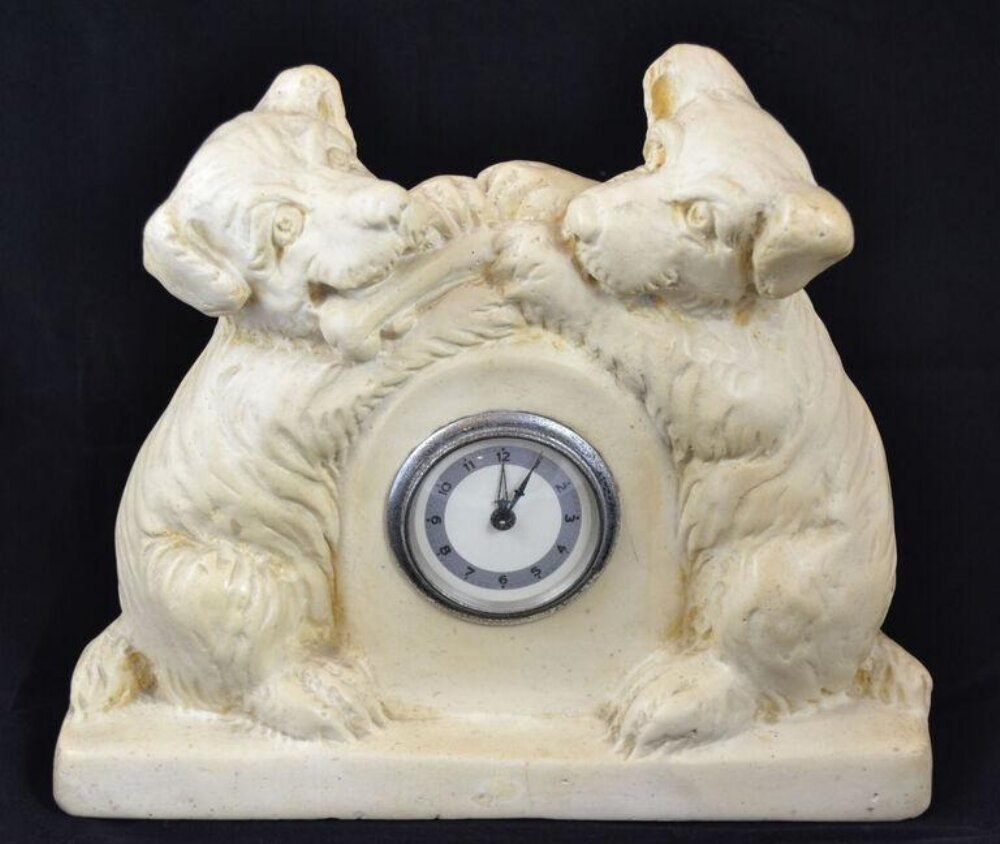
This nursery clock features a decorative surround cast in cream-tinted plaster, depicting two terrier puppies sharing a bone. The clock mechanism is mounted within this plaster slab, which measures 197 mm in height, 246 mm in width, and 79 mm in depth. The dial consists of a circular face with black Arabic numerals set upon a silvered ring, contrasted against a cream-colored ground. The dial is protected by glass and encased in a circular chrome-plated bezel. The time is indicated by a pierced triangular hour hand and an elongated lozenge-shaped minute hand. The rear of the object includes a winding key and a manual adjustment spindle for the hands. Produced in England between 1930 and 1959, the clock was gifted to the Museum of Childhood in 1986 by Mrs. Wright. The item is currently reported as non-operative with tarnished metal components.

View of the nursery clock featuring the cast plaster puppy motif and the circular dial.
View of the nursery clock featuring the cast plaster puppy motif and the circular dial. — V&A Museum. Rights pending — permission not yet requested. Original source

Catalogue identity

Source
collections.vam.ac.uk
Category
Clock · Nursery clock
Maker / attribution
Not established
Reference
Not recorded
Catalogue / lot identifier
MISC.791-1986
Source-reported date
1930-1959
Source-reported place
England

Source-reported attribution and specifications are not independent authentication. A listing does not establish present ownership, current display, availability or permission to reproduce.

Object description

Case and Dial Design

The clock is housed within a molded plaster surround designed for a nursery setting. The decorative base features two terrier puppies interacting with a bone, finished in a cream tint. This sculptural element serves as a frame for the functional timekeeping component.

The dial assembly consists of a circular face positioned centrally within the plaster slab. It features a silver-toned ring printed with black Arabic numerals against a cream-colored background. The dial is covered by a glass lens and held in place by a circular, chrome-plated metal bezel.

Evidence for this section
  • “The clock is set in a cream tinted plaster surround, moulded to show two terrier puppies with a bone”
  • “The clock is set into a cream slab supported by two terrier puppies with a bone”
  • “The clock face is glazed and is set in a circular chrome-plated border”

Movement and Handling

The clock is equipped with a mechanical movement requiring manual winding. A winding key is accessible at the back of the object, which serves as the primary power source for the clock. Adjacent to the winding mechanism, a spindle is provided to allow for the manual adjustment of the time.

The display is governed by a set of distinctively shaped hands. The hour hand is fashioned into a pierced triangular shape, while the minute hand is designed as an elongated lozenge. These components facilitate the intended function of the object as a timepiece.

Evidence for this section
  • “At the back of the clock is a key for winding the mechanism, and a spindle for adjusting the position of the hands.”
  • “it has a pierced triangular hour-hand and an elongated lozenge-shaped minute-hand.”

Provenance and Reported Condition

This clock was acquired by the Museum of Childhood following a donation from Mrs. Wright in 1986. The museum records an obscured or damaged mark at one end of the object, though its full content remains largely illegible, reading only as 'KAT______08'.

Upon accession, the museum noted the condition of the object as fair. Specifically, it was recorded that the metal components had begun to tarnish and that the internal clockwork was no longer functioning.

Evidence for this section
  • “Given to the MoC in 1986 by Mrs Wright”
  • “On entry its condition was noted as 'fair - metal tarnished. Clockwork non-operative.'”
  • “Mark at one end, damaged/obscured.”

Open research questions

  • Is the 'KAT______08' mark a manufacturing identifier or a retailer's inscription?
  • Can the specific production model of the internal clockwork be identified despite it being non-operative?

Source evidence

Recorded claims and source quotations for Nursery clock with terrier puppy motif
FieldSource-reported valueSource quotation
Accession numberMISC.791-1986“MISC.791-1986”
MaterialsPlaster, metal, and glass“Ceramic and metal, prob.British, 1930-59”
DonorMrs. Wright“Given to the MoC in 1986 by Mrs Wright”
ConditionMetal tarnished and clockwork non-operative“fair - metal tarnished. Clockwork non-operative.”
Dial featuresBlack Arabic numerals on a silver circle“inscribed with black Arabic numerals, on a silver circle against a cream ground”

Visible details

  • Plaster base cast as two puppies holding a bone
  • Circular dial with black Arabic numerals on silver ground
  • Chrome-plated clock bezel
  • Pierced triangular hour hand

Research qualifications

  • The clock mechanism is described as non-operative
  • Origin attributed to England is qualified as 'probably'
  • A mark at one end is damaged and obscured

Photograph identity and source facts were screened before import; rights clearance remains pending.

Consulted source

Clock, England, 1930-1959

Reviewed 2026-11-02 · Record 2a0dea0e10

Terms in this record

Glossary explanations for terms named in this object’s record.