
Skip to content
The Encyclopedia of Horology

Clock · Carriage clock

North German carriage clock

Partially verified

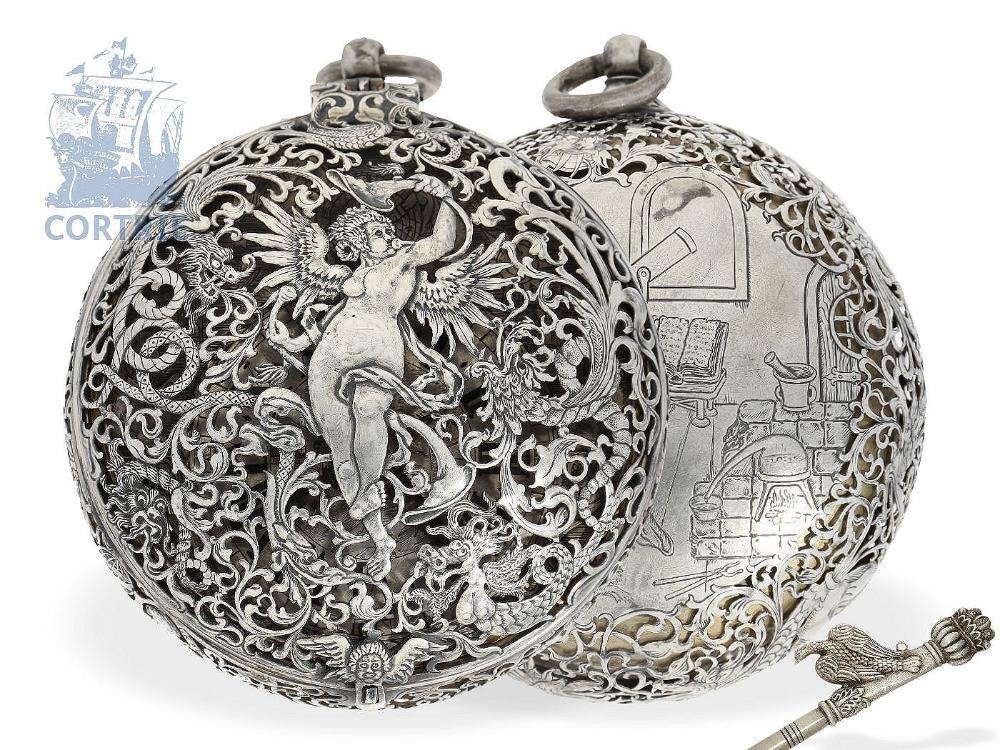
This North German carriage clock is attributed to the watchmaker Michael Pfündler and dated to approximately 1670. The object is constructed from silver and measures 11cm in diameter. The design features an intricate exterior, which includes highly detailed openwork filigree ornamentation depicting mythological or allegorical figures. The metalwork displays a contrasting scene on a solid panel, appearing to show a studio or laboratory setting with various tools. The overall structure is rounded, and the timepiece is accompanied by an ornate key. The provided documentation links the clockmaker to expeditions conducted in the 1630s, although the specific provenance of this object is described by the auction house as an attribution. Independent verification of the maker and the dating of this object remains required.

North German carriage clock, silver, with associated key, shown in two views to display the filigree work and engraved scene.
North German carriage clock, silver, with associated key, shown in two views to display the filigree work and engraved scene. — Cortrie Spezial Auktionen / Invaluable. Rights pending — permission not yet requested. Original source

Catalogue identity

Source
orbiscollectibles.com
Category
Clock · Carriage clock
Maker / attribution
Michael Pfündler
Reference
Not recorded
Catalogue / lot identifier
206729269
Source-reported date
c. 1670
Source-reported place
Germany

Source-reported attribution and specifications are not independent authentication. A listing does not establish present ownership, current display, availability or permission to reproduce.

Object description

Casing and Decorative Elements

The carriage clock is housed in a silver case characterized by elaborate openwork, commonly referred to as filigree. The visible surfaces show dense scrollwork and foliage motifs that provide a decorative shell over the inner movement components. A central figure, represented with wings, serves as a primary decorative focus on the exterior grill, surrounded by hybrid creatures.

Opposite the openwork panels, a solid silver section displays a detailed engraved scene. This imagery depicts a workroom containing what appear to be bellows, a small furnace or hearth, and various tools, suggesting a laboratory or watchmaker's workshop environment. The silver finish throughout appears consistent with the listed material description provided by the auction house.

Evidence for this section
  • “silver”

Maker and Attribution

The object is attributed to Michael Pfündler, a watchmaker identified in historical records related to expeditions from Hamburg to Moscow in the 1630s.

The source notes that while Pfündler was responsible for overseeing expeditions in his capacity as a watchmaker, the specific connection to this carriage clock remains an attribution. The listing qualifies the identification as probable and explicitly states that independent type authentication is required for confirmation of the maker and the object’s history.

Evidence for this section
  • “Michael Pfündler was responsible for overseeing the expedition in his capacity as a watchmaker.”
  • “independent type authentication remains research required.”

Documentation and Research Status

The record for this object is based on information provided by an auction house archive. The documentation specifies that the dimensions of 11cm and the attribution to the late 17th century are derived from the auction house's statements rather than independent academic assessment.

As of the present record, no formal catalogue references or accession numbers are available to verify the clock's provenance or its place within the broader output of the maker. The source emphasizes that the provided information should be regarded as an auction description, and further research is recommended to authenticate the type and period of the clock.

Evidence for this section
  • “Attribution and measurements are the auction house’s statements about the photographed example”
  • “No catalogue numbers recorded.”

Open research questions

  • What is the mechanical layout and movement type within the silver housing?
  • Are there known hallmarks on the silver casing that can confirm the place and date of manufacture?

Source evidence

Recorded claims and source quotations for North German carriage clock
FieldSource-reported valueSource quotation
Materialsilver“silver”
OriginNorth German“North German carriage clock”
Datec. 1670“c. 1670”
Lot ID206729269“206729269”

Visible details

  • The object features complex openwork silver casing with winged figure motifs.
  • The casing includes a solid silver section depicting an interior scene with a fireplace and laboratory instruments.
  • The item is supplied with a decorative winding key.
  • The form is spherical or semi-spherical in profile.

Research qualifications

  • The attribution to Michael Pfündler is stated as probable by the source.
  • The dating of circa 1670 for this specific example is not independently verified.

Photograph identity and source facts were screened before import; rights clearance remains pending.

Consulted source

North German carriage clock

Reviewed 2026-11-02 · Record ae6d63f1df

Terms in this record

Glossary explanations for terms named in this object’s record.