
Skip to content
The Encyclopedia of Horology

Tool · German nocturnal

Nocturnal

Partially verified

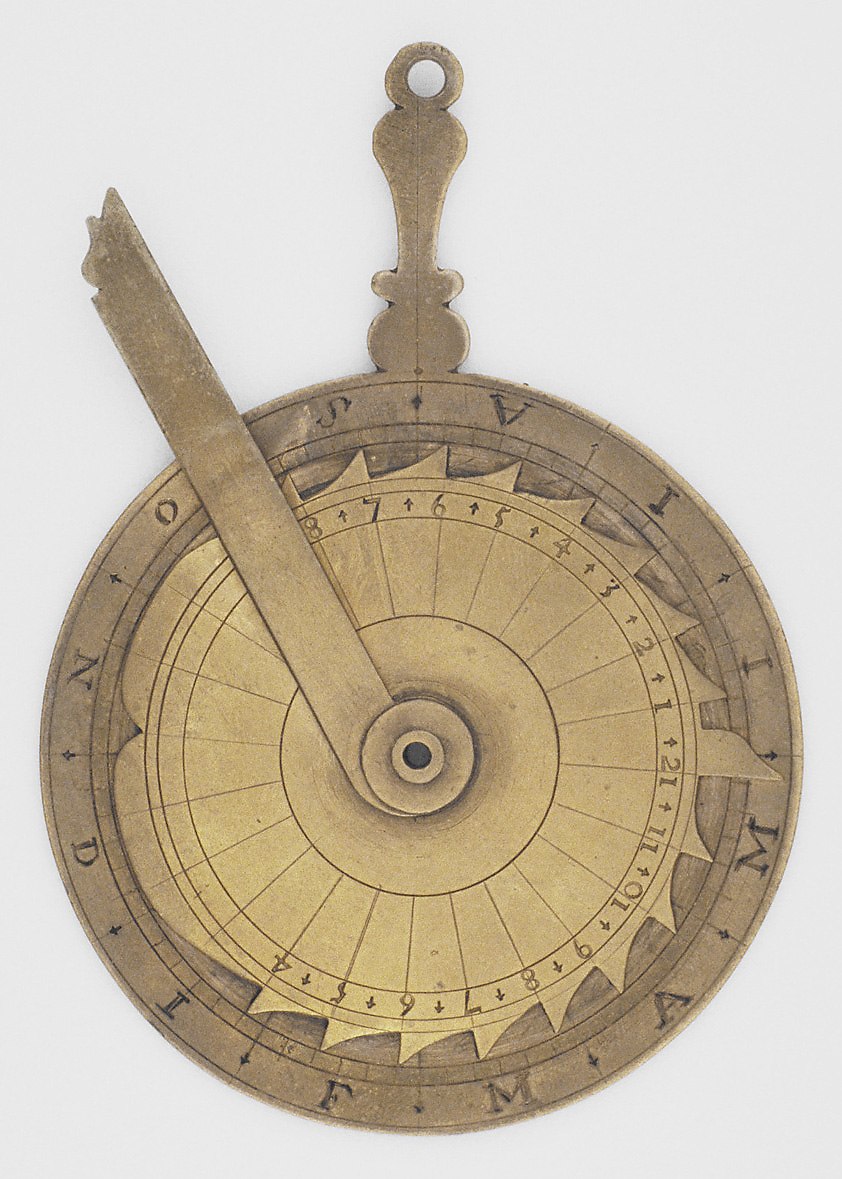
This brass nocturnal, inventory number 37450 in the Museum of the History of Science, Oxford, is a circular time-measuring instrument measuring 87mm in length. It features an unsigned, unadorned design with a shaped and pierced handle for suspension. The primary side consists of a base plate inscribed with a date scale, divided by month initials, and a rotating volvelle plate divided into 24 hours, marked with numerals 8 to 12 to 8. An index arm with a shaped tip is secured to the center by a pierced rivet. The reverse side includes an additional volvelle for calculating time in conjunction with a lunar sundial. The instrument lacks a maker's mark or date, and its attribution to the 16th century is considered speculative by the museum, noting it may date to the 17th century. It is constructed entirely of brass.

Brass nocturnal, inventory number 37450, Museum of the History of Science, Oxford.
Brass nocturnal, inventory number 37450, Museum of the History of Science, Oxford. — © Museum of the History of Science, Oxford. Rights pending — permission not yet requested. Original source

Catalogue identity

Source
www.mhs.ox.ac.uk
Category
Tool · German nocturnal
Maker / attribution
Not established
Reference
Not recorded
Catalogue / lot identifier
37450
Source-reported date
16th century? (possibly 17th century)
Source-reported place
Germany

Source-reported attribution and specifications are not independent authentication. A listing does not establish present ownership, current display, availability or permission to reproduce.

Object description

Construction and Design

The nocturnal is a brass instrument measuring 87mm in length, featuring a central, pierced rivet that supports the pivoting components. The design is utilitarian, characterized by a shaped and pierced handle for portability and hanging. The primary surface holds the nocturnal functionality, while the reverse side supports an auxiliary volvelle.

The primary plate is marked with a date scale containing initials for months, sub-divided into segments. The rotating volvelle plate displays a 24-hour cycle, using numerals from 8 to 12 and back to 8, with individual points marking the hour positions. Half-hour intervals are identified by arrows. An index arm featuring a distinct, shaped tip is attached to the central axis, facilitating the reading of time in relation to the stellar alignment indicated on the base plate.

Evidence for this section
  • “Brass; 87mm in length”
  • “The nocturnal side has a date scale on the base plate, with the months indicated by their initials and divided to 1/6.”
  • “An index arm with a shaped tip pivots on a central, pierced rivet.”

Functionality and Usage

The instrument functions primarily to determine time at night using stellar movement. The nocturnal dial is configured to be used with the star positions relative to the date scale. The secondary side provides an alternative method for nocturnal timekeeping, specifically intended for use with a lunar sundial.

The volvelle on the reverse of the plate requires the user to account for the shadow cast by the moon. By aligning this plate, the user can derive an approximate calculation of solar time, though the instrument cannot function independently for this specific lunar application.

Evidence for this section
  • “A volvelle on the reverse side of the nocturnal relates to an alternative way of finding the time at night, but must be used in conjunction with another instrument, namely a sundial where the shadow is cast by the moon.”
  • “The volvelle then allows an approximate calculation of the solar time”

Attribution and Status

The instrument is unsigned and bears no maker's mark or specific identifying features that would link it to a particular workshop or historical period. The museum catalogue identifies it as being of German origin, though this is based on broader historical classifications.

Dating the object is problematic, with the museum citing the 16th century as a speculative estimate. The entry notes that the simplicity of the design makes a 17th-century origin equally plausible. The lack of inscriptions or signatures leaves the precise temporal origin of the object open to interpretation.

Evidence for this section
  • “Unsigned”
  • “16th century ?; German”
  • “This is such a simple instrument, with no date or signature, that even a dating to the 16th century is speculative: it could be from the 17th century.”

Open research questions

  • Can stylistic analysis of the engraving on the volvelle scale provide a more precise dating than the 16th/17th-century window?
  • Are there specific, identifiable star indicators missing or implied by the nocturnal scale?

Source evidence

Recorded claims and source quotations for Nocturnal
FieldSource-reported valueSource quotation
Inventory number37450“Inventory number: 37450”
MaterialBrass“Brass; 87mm in length”
Attributed OriginGerman“16th century ?; German”
Length87mm“87mm in length”
Nocturnal Side ConfigurationDate scale with month initials“The nocturnal side has a date scale on the base plate, with the months indicated by their initials and divided to 1/6.”
Volvelle Side Configuration12-hour scale divided twice“On the volvelle side the base plate is divided into hours 1 to 12 twice.”

Visible details

  • Shaped and pierced suspension handle
  • Base plate with month initials on the perimeter
  • Rotating volvelle with 24-hour scale
  • Index arm with shaped, pierced tip

Research qualifications

  • Date is speculative and may be 16th or 17th century
  • No manufacturer signature or maker attribution
  • Requires external lunar sundial for full functionality of reverse side

Photograph identity and source facts were screened before import; rights clearance remains pending.

Consulted source

Nocturnal

Reviewed 2026-10-26 · Record cf44110805

Terms in this record

Glossary explanations for terms named in this object’s record.