
Skip to content
The Encyclopedia of Horology

Tool · German nocturnal and sundial

Nocturnal And Sundial by Ulrich Schniep

Partially verified

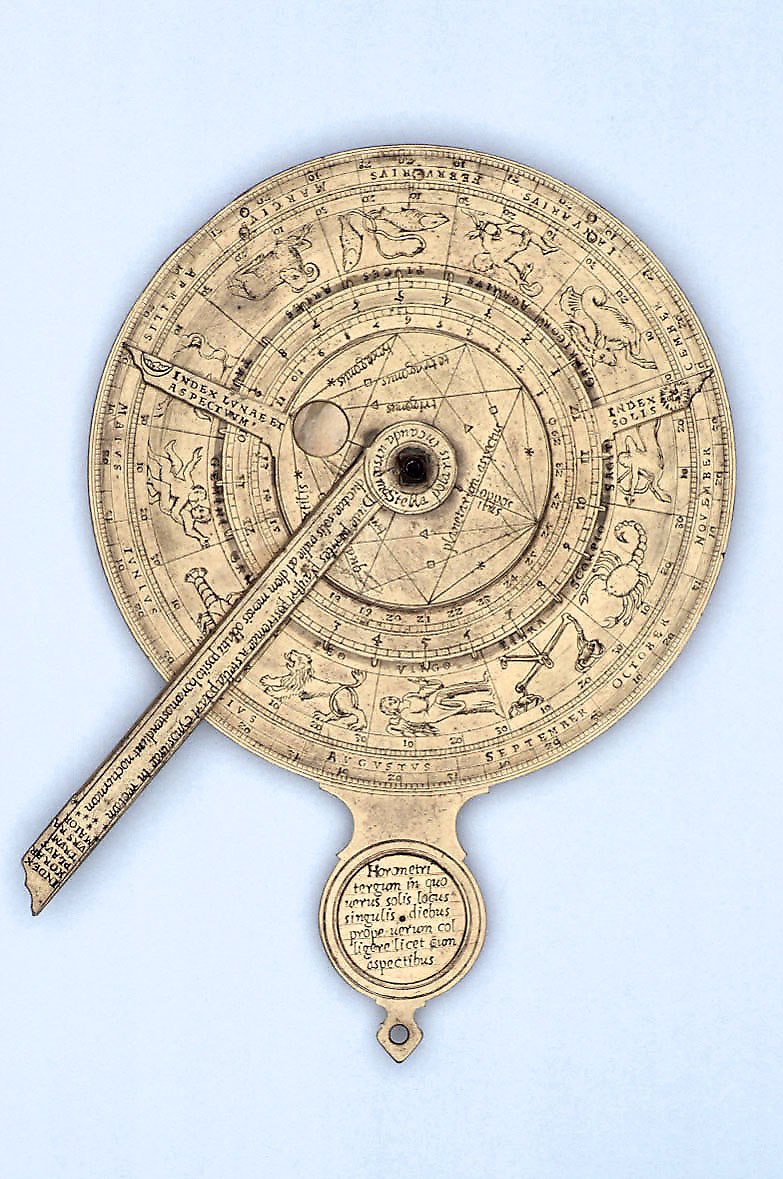
This 132 mm diameter gilt brass instrument, signed by Ulrich Schniep and dated 1581, functions as both a nocturnal and a sundial. The nocturnal side includes a base plate featuring a zodiacal calendar, representations of constellations, and two moving volvelle plates with pointers for the sun and moon, including scales for time and lunar age. An index arm is attached by a later screw and nut, lacking a central aperture for viewing the pole star. The reverse side features a Regiomontanus-type altitude dial, incorporating a triangular latitude grid, hour lines, solar declination scales, and a geometrical quadrant. The instrument is signed 'VDALRICVS SHNIEP MONACHY' and '15 VS 81'. It resembles a 1557 instrument by Caspar Vopel, and scholarly discussions exist regarding whether Schniep's work is a direct copy or if both instruments were derived from a common source.

Nocturnal side of the gilt brass instrument, displaying the calendar, volvelles, and the engraved central index arm.
Nocturnal side of the gilt brass instrument, displaying the calendar, volvelles, and the engraved central index arm. — Museum of the History of Science, Oxford. Rights pending — permission not yet requested. Original source

Catalogue identity

Source
www.mhs.ox.ac.uk
Category
Tool · German nocturnal and sundial
Maker / attribution
Ulrich Schniep
Reference
Not recorded
Catalogue / lot identifier
51384
Source-reported date
1581
Source-reported place
Munich

Source-reported attribution and specifications are not independent authentication. A listing does not establish present ownership, current display, availability or permission to reproduce.

Object description

Instrumental Construction

The nocturnal and sundial is constructed from gilt brass, measuring 132 mm in diameter. The nocturnal face serves as a multi-functional plate featuring a zodiacal calendar divided by month, day, and degree. It utilizes two volvelles; the first includes a sun index, time scale, and lunar age scale, while the second carries a lunar index and planetary aspect diagram.

The index arm extends beyond the base plate, lacking the central aperture for the pole star. The attachment mechanism includes a later screw and square nut. The reverse functions as a Regiomontanus-type altitude dial, incorporating sight vanes, a grid for latitude, and scales for solar declination, as well as quadrant scales for geometric measurement and shadow-square readings.

Evidence for this section
  • “Gilt brass; 132 mm in diameter”
  • “The index arm is attached by a later screw and square nut, and there is no central aperture for viewing the pole star.”
  • “The sundial side has a Regiomontanus-type altitude dial with sight vanes with double pin-holes”

Signatures and Inscriptions

The instrument is signed by Ulrich Schniep with the location and date inscribed as 'VDALRICVS SHNIEP MONACHY' and '15 VS 81'. Various instructional engravings in Latin adorn the handle and plates. These include descriptions of the nocturnal function on the back handle and labels for the latitude scale, shadow square, and general solar scales on the sundial side.

The central index arm on the nocturnal side is extensively engraved with instructions and the name of the constellation, Stella Polaris. These inscriptions clarify the use of the instrument for calculating the sun's position and the nocturnal hours based on the location of stars relative to the pole.

Evidence for this section
  • “Signed 'VDALRICVS SHNIEP MONACHY' and '15 VS 81'”
  • “The handle on this side is engraved, 'Horometri tergum in quo uerus solis locus singulis diebus prope uerum col ligere licet cum aspectibus'”
  • “engraved along the length of the arm is, 'Duae parites plaustri postremae A stella polari cynosurae in rectam ductae solis indie ad diem mensis oblatu positio horamostendunt nocturnam'”

Comparison and Attribution

The instrument is closely compared to a 1557 model by Caspar Vopel, also held by the Museum of the History of Science.

Scholarly assessment suggests that the Schniep instrument may be a copy of the Vopel version, though it is acknowledged that both could have been sourced from a common, unverified origin.

Evidence for this section
  • “This instrument is remarkably close to an instrument by Caspar Vopel dated 1557”
  • “It has been suggested that the instrument by Schniep is a copy of that by Vopel, but both could, of course, have been copied from some other source.”

Open research questions

  • What is the specific nature of the 'later' modification involving the screw and nut on the index arm?
  • Can chemical analysis of the gilding and brass alloy provide definitive data on the manufacturing period compared to the 1557 Vopel instrument?

Source evidence

Recorded claims and source quotations for Nocturnal And Sundial by Ulrich Schniep
FieldSource-reported valueSource quotation
MakerUlrich Schniep“Signed by Ulrich Schniep”
Date1581“Dated 1581”
Place of ManufactureMunich“Munich”
Dimensions132 mm in diameter“132 mm in diameter”
MaterialGilt brass“Gilt brass”
Inventory Number51384“Inventory number 51384”
InscriptionVDALRICVS SHNIEP MONACHY“Signed 'VDALRICVS SHNIEP MONACHY'”

Visible details

  • The index arm is secured by a later screw and square nut.
  • The noctural side features engraved constellations and zodiac signs on a calendar scale.
  • The instrument includes scales for a Regiomontanus-type altitude dial and a shadow-square.
  • The handle on the noctural side is engraved with a Latin inscription regarding the instrument's function.

Research qualifications

  • The plumb-line for the sundial side is missing.
  • The provenance or exact origin of the design remains speculative, with suggestions that it may be a copy of a 1557 Vopel instrument.

Photograph identity and source facts were screened before import; rights clearance remains pending.

Consulted source

Nocturnal And Sundial

Reviewed 2026-10-26 · Record 1931f58450

Terms in this record

Glossary explanations for terms named in this object’s record.