
Skip to content
The Encyclopedia of Horology

Tool · German nocturnal and sundial

Nocturnal and Regiomontanus-type sundial

Partially verified

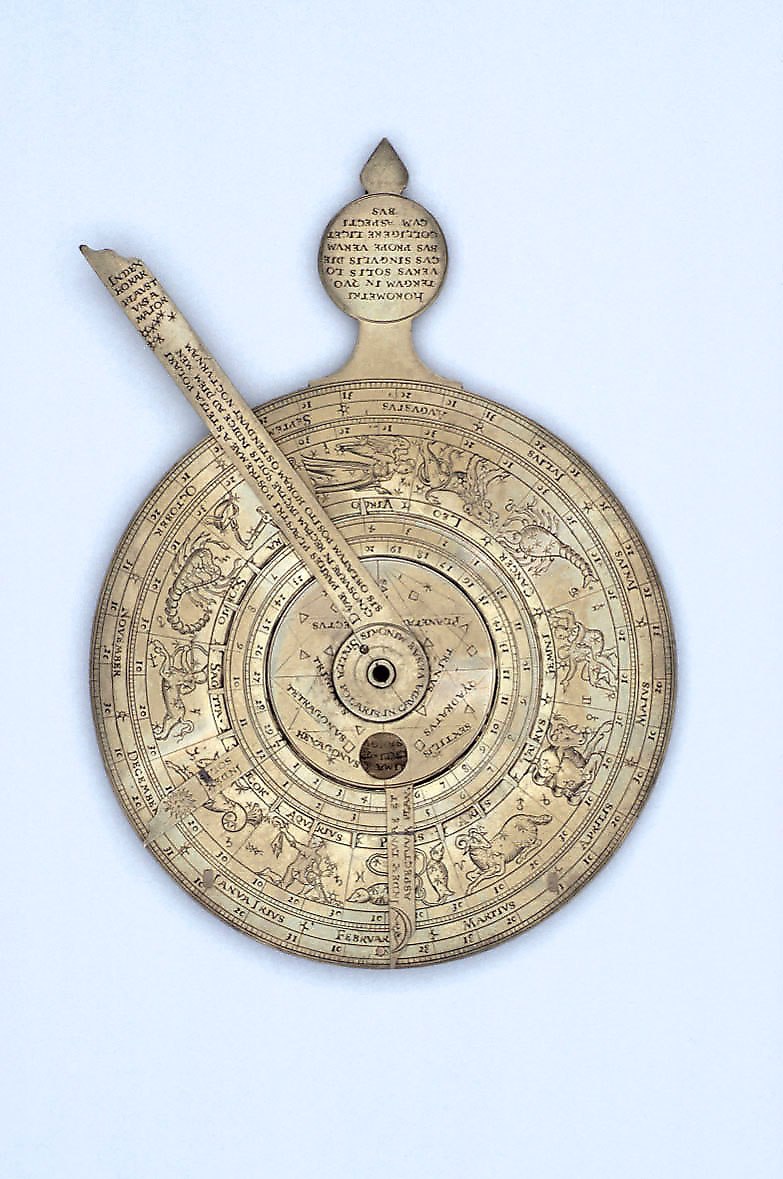
This brass nocturnal and sundial, measuring 130 mm in diameter, was made by Caspar Vopel in 1557. The instrument is dual-sided, featuring a nocturnal on one face and a Regiomontanus-type altitude sundial on the other. It includes a central index arm for sighting the pole star, engraved with Latin inscriptions regarding its usage. The reverse features an altitude dial with pinhole sight vanes and an articulated arm for suspending a plumb-line. The sundial incorporates a grid for latitude and zodiacal position, various hour scales, and peripheral scales for an astronomical quadrant and geometrical quadrant. The instrument is signed by the maker with the location Cologne.

Front side of the nocturnal and sundial instrument showing the central index arm and zodiacal calendar.
Front side of the nocturnal and sundial instrument showing the central index arm and zodiacal calendar. — Museum of the History of Science, Oxford. Rights pending — permission not yet requested. Original source

Catalogue identity

Source
www.mhs.ox.ac.uk
Category
Tool · German nocturnal and sundial
Maker / attribution
Caspar Vopel
Reference
Not recorded
Catalogue / lot identifier
33871
Source-reported date
1557
Source-reported place
Cologne

Source-reported attribution and specifications are not independent authentication. A listing does not establish present ownership, current display, availability or permission to reproduce.

Object description

Construction and Design

The instrument is a brass disc, 130 mm in diameter, comprising two distinct timekeeping faces. The primary assembly is held together by a central rivet that functions as an aperture for sighting the pole star. The nocturnal side is organized around a base plate containing a zodiacal calendar, which includes both the names of the months and engraved representations of the constellations. Two moving volvelle plates are mounted here, the outer carrying an index marked 'INDEX SOLIS' and the inner containing a lunar aspect diagram.

The sundial face is a Regiomontanus-type altitude dial. It is equipped with pinhole sight vanes and a three-element articulated arm designed to adjust the suspension point of a plumb-line, which is now missing. The dial face is complex, featuring a triangular grid for latitude and zodiacal position, multiple hour scales, and a solar declination scale.

Evidence for this section
  • “This instrument has the customary shape of a nocturnal , but in fact comprises several instruments.”
  • “The nocturnal side has a zodiacal calendar on the base plate”
  • “The sundial side has a Regiomontanus-type altitude dial with pinhole sight vanes and a three-element articulated arm”

Engravings and Markings

The instrument is densely engraved with Latin inscriptions, scales, and diagrams that facilitate its use. The nocturnal side contains hour markings on a time scale with points for dark-counting, as well as a lunar scale ranging from 0 to 29.5. The long central index arm, used for night time calculation, features an engraved diagram of Ursa Major and detailed instructions on its usage.

On the sundial side, the engraving includes designations for morning and afternoon hours, as well as specific markings for the midnight line and solar declination. The periphery of the disc hosts two distinct altitude scales: one for astronomical measurement and one for geometrical or shadow-square calculations. The maker's signature is located on the sundial face, specifying the location of Cologne and the year 1557.

Evidence for this section
  • “The time scale had hours 1 to 12 twice, divided to 1, subdivided to 15 minutes, numbered by 1 hour”
  • “Signed 'CASPAR VOPELI<US> MATHEM. COLONI. AGRIPPI. FACIEBAT 1557'”
  • “Around the edge of the sundial side are two altitude scales”
  • “The grid is marked on one side, 'ZODIACI LATITVDINVM SCALA'”

Provenance and Research

The object is held in the collection of the Museum of the History of Science, Oxford, and assigned the inventory number 33871.

Records indicate that a similar instrument, serving as a comparative reference, is held in the collection of the British Museum in London. The object's functionality relies on the use of both side-mounted handles, one of which includes a crest with three crowns and an inscription describing the instrument's capability to function at varying latitudes.

Evidence for this section
  • “Holding museum: Museum of the History of Science, Oxford”
  • “Inventory number: 33871”
  • “A similar instrument is to be found in the British Museum, London (Epact 53179).”

Open research questions

  • What is the specific functionality of the missing plumb-line weight in relation to the triangular grid?
  • How do the lunar phase diagram and inscriptions revealed by the piercing of the first volvelle interact with the astronomical calculations?

Source evidence

Recorded claims and source quotations for Nocturnal and Regiomontanus-type sundial
FieldSource-reported valueSource quotation
MakerCaspar Vopel“Signed by Caspar Vopel”
Date1557“Dated 1557; Cologne”
MaterialBrass“Brass; 130 mm in diameter”
Diameter130 mm“130 mm in diameter”
Inventory number33871“Inventory number: 33871”
Nocturnal side inscriptionEngraved along the nocturnal arm“DVAE PARITES PLAVSTRI POSTREMAE A STELLA POLARI CYNOSVRAE IN RECTAM DVCTAE SOLIS INDICE AD DIEM MENSIS OBLATVM POSITIO HORAM OSTENDVNT NOCTVRNAM”
Sundial side inscriptionSignature of maker“CASPAR VOPELI<US> MATHEM. COLONI. AGRIPPI. FACIEBAT 1557”

Visible details

  • Nocturnal side features engraved zodiac signs and month names on the base plate.
  • Sundial side includes a three-element articulated arm and a triangular grid.
  • Central index arm on the nocturnal side is marked for alignment with the constellation Ursa Major.
  • Peripheral scales include an astronomical quadrant and a geometrical quadrant on the sundial side.

Research qualifications

  • The plumb-line weight is missing from the sundial mechanism.
  • The exact nature of the lunar phase diagram and inscriptions obscured by the pierced volvelle is not fully described.

Photograph identity and source facts were screened before import; rights clearance remains pending.

Consulted source

Nocturnal And Sundial

Reviewed 2026-10-26 · Record b88c6cc107

Terms in this record

Glossary explanations for terms named in this object’s record.