
Skip to content
The Encyclopedia of Horology

Tool · French nocturnal and sundial

Nocturnal and Sundial

Partially verified

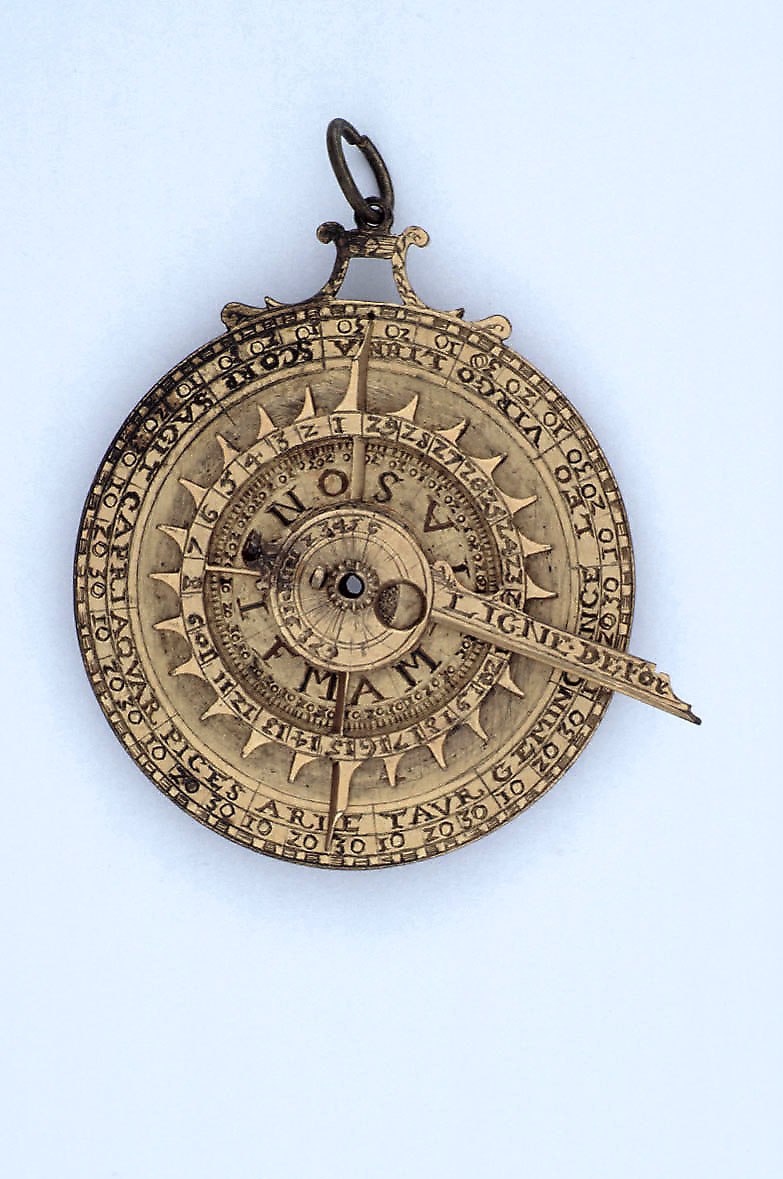
This compact horological instrument, crafted from gilt brass and measuring 57 mm in diameter, is a multifunctional device combining two sundials, a nocturnal, and a lunar volvelle. The object is unsigned and attributed to French origin around 1600. The nocturnal face features an outer zodiac scale and a moveable ring divided into 24 points to represent hours, designed for use in the dark. Beneath this ring is a date scale and a lunar volvelle with a scale from 1 to 29 for moon age. The disc is pierced to indicate lunar phases and includes an index arm marked 'LIGNE DE FOI'. The secondary side incorporates a vertical disc sundial with a folding gnomon, adjustable calendar scales, and two scales for reading ordinary and Italian hours. It is finished with a shaped, pierced suspension throne and a raised blank shield.

The obverse face of the nocturnal and sundial showing the central pierced disc, the lunar volvelle, and the index arm labeled 'LIGNE DE FOI'.
The obverse face of the nocturnal and sundial showing the central pierced disc, the lunar volvelle, and the index arm labeled 'LIGNE DE FOI'. — Museum of the History of Science, Oxford. Rights pending — permission not yet requested. Original source

Catalogue identity

Source
www.mhs.ox.ac.uk
Category
Tool · French nocturnal and sundial
Maker / attribution
Not established
Reference
Not recorded
Catalogue / lot identifier
45450
Source-reported date
circa 1600
Source-reported place
France

Source-reported attribution and specifications are not independent authentication. A listing does not establish present ownership, current display, availability or permission to reproduce.

Object description

Nocturnal and Lunar Functions

The nocturnal component is engineered for nighttime timekeeping without visual aid. It lacks numerical hour indicators, relying instead on 24 tactile points arranged around a movable ring. This allows users to count hours in darkness. An index arm labeled 'LIGNE DE FOI' serves as a guide for settings, extending towards the zodiac scale.

Integration with a lunar volvelle provides additional astronomical utility. This portion of the device includes a scale numbered 1 to 29 to track the moon's age. The disc is pierced to visually communicate lunar phases, and the internal date scale links the calendar to the zodiac signs, where the first point of Aries corresponds to 10 March.

Evidence for this section
  • “The nocturnal is unusual in not having an hour scale with any numbers, but only points”
  • “This face also incorporates a lunar volvelle, and the ring has a scale 1 to 29 for the age of the moon”
  • “The disc is pierced to show the phase of the moon, and has an extended index arm for the nocturnal, marked 'LIGNE? DE? FOI'”

Sundial Configuration

The device functions as a vertical disc sundial, featuring a pivoted index arm that supports a folding gnomon. To ensure precision, the user adjusts the gnomon based on a date scale marked with month initials, which is further divided into quarter-month segments. This enables the device to accommodate the changing position of the sun throughout the year.

Two distinct hour scales are provided on the opposite side of the vertical disc. One scale facilitates the reading of ordinary hours, while the other is calibrated for Italian hours. The ordinary hours are divided to the quarter, while the Italian hours are marked to the half-hour, supporting different regional timekeeping standards prevalent during the period.

Evidence for this section
  • “The sundial face has a vertical disc dial, with a pivoted index arm carrying a folding gnomon”
  • “There are two calendar scales marked with the initials for the months and divided to quarter months”
  • “on the opposite side of the disc scales for ordinary and Italian hours”

Physical Description and Suspension

The instrument is constructed from gilt brass, measuring 57 mm in diameter. Its overall design prioritizes portability and functionality, utilizing a shaped, pierced throne that serves as an attachment point for a suspension ring.

A raised, blank shield is integrated into the metalwork, offering a decorative element that remains unengraved. The overall assembly relies on traditional metal forming and piercing techniques to create the various overlapping scales and moveable parts required for the instrument's complex astronomical functions.

Evidence for this section
  • “Gilt brass; 57 mm in diameter”
  • “There is a shaped and pierced throne for a suspension ring, and a raised blank shield”

Open research questions

  • Are there known contemporary French makers who produced instruments with identical 'LIGNE DE FOI' index arm markings?
  • Does the nocturnal's point-based scale correspond to a specific localized tradition of night-time navigation?

Source evidence

Recorded claims and source quotations for Nocturnal and Sundial
FieldSource-reported valueSource quotation
MaterialGilt brass“Gilt brass”
Diameter57 mm“57 mm in diameter”
OriginFrench“French”
Datecirca 1600“circa 1600”
Condition detailRaised blank shield“a raised blank shield”
Nocturnal featureHour points for tactile use“not having an hour scale with any numbers, but only points - one for each hour - for feeling and counting in the dark”
Inventory Number45450“Inventory number 45450”

Visible details

  • Gilt brass construction
  • Pierced disc for moon phases
  • Shaped suspension throne
  • Folding sundial gnomon

Research qualifications

  • The provenance and exact maker remain unidentified beyond the attribution of French origin.
  • The 'LIGNE DE FOI' inscription is partially unclear in the source text transcription.

Photograph identity and source facts were screened before import; rights clearance remains pending.

Consulted source

Nocturnal And Sundial

Reviewed 2026-10-26 · Record 21cbb0461a

Terms in this record

Glossary explanations for terms named in this object’s record.

Other french nocturnal and sundial records