
Skip to content
The Encyclopedia of Horology

Tool · French nocturnal and sundial

Nocturnal and Sundial

Partially verified

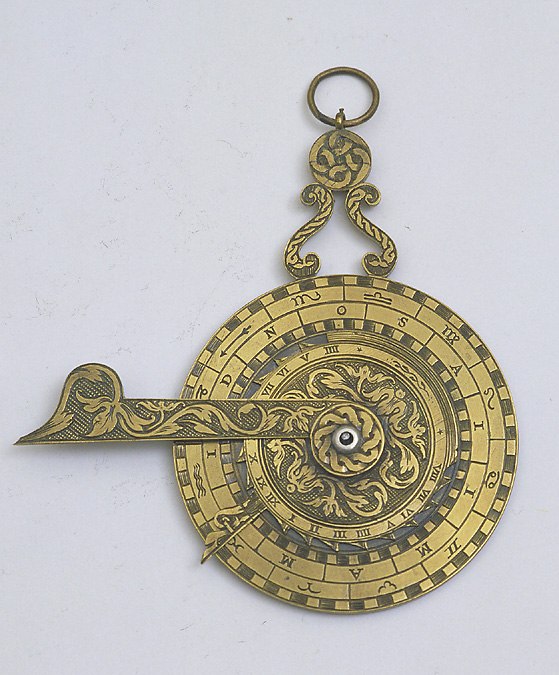
This combination instrument, dated 1554 and of French origin, measures 54 mm in diameter and is constructed from gilt brass. It integrates both a nocturnal and a sundial, consisting of two superimposed discs of varying diameters. The obverse features a central disc with an openwork scrolled mount and a suspension ring, with the body engraved as a zodiacal calendar. A toothed volvelle occupies the centre, decorated with symmetrical flowing leaf patterns. An ornate pointer is mounted above the discs, while a smaller pointer extends from the circumference of the smaller disc. The reverse is configured as a vertical plate dial, incorporating a folding pin-gnomon upon a rotatable plate, which is inscribed 'CIRCVLVS MERIDIANVS'. This instrument is currently held in the collection of the Istituto e Museo di Storia della Scienza in Florence.

The obverse of the 1554 nocturnal and sundial, showing the central volvelle and zodiacal calendar.
The obverse of the 1554 nocturnal and sundial, showing the central volvelle and zodiacal calendar. — Istituto e Museo di Storia della Scienza, Firenze. Rights pending — permission not yet requested. Original source

Catalogue identity

Source
www.mhs.ox.ac.uk
Category
Tool · French nocturnal and sundial
Maker / attribution
Not established
Reference
2501
Catalogue / lot identifier
2501
Source-reported date
1554
Source-reported place
France

Source-reported attribution and specifications are not independent authentication. A listing does not establish present ownership, current display, availability or permission to reproduce.

Object description

Construction and Obverse Design

The instrument is composed of two superimposed gilt brass discs of unequal diameter. The upper assembly features an openwork scrolled mount that incorporates a suspension ring. The main body of the instrument is engraved with a zodiacal calendar, where 0° Aries is positioned at 10.5 March. This scale reads to 5° increments and 5-day intervals in an anti-clockwise direction.

Centered within this arrangement is a toothed volvelle, which features teeth around two-thirds of its circumference. These are numbered IIII to XII and VIII. The central area of this volvelle is filled with symmetrical, flowing leaf decoration, providing both a functional interface and ornamental detailing.

Evidence for this section
  • “This instrument is made up of two superimposed discs of different diameters.”
  • “Central disc with openwork scrolled mount, cut from the same plate, carrying an eye for a suspension ring.”
  • “At the centre is a volvelle toothed around two thirds of its circumference, the teeth being numbered IIII to XII to VIII.”

Reverse Configuration

The reverse of the instrument functions as a vertical plate dial. It contains a folding pin-gnomon, which is positioned on a plate that can be rotated within the outer circumference. This outer region is inscribed with the Latin text 'CIRCVLVS [star] MERIDIANVS [star]' and features a latitude quadrant scale reading to 2° increments.

Adjacent to the pin-gnomon, a calendar scale is engraved. The hour markings on this side are arranged as I to VIII and IIII to XII, capable of indicating time to a 30-minute resolution. The remaining unoccupied space on the perimeter contains the date of manufacture.

Evidence for this section
  • “The reverse of the instrument is engraved with a vertical plate dial with folding pin-gnomon”
  • “engraved with a latitude quadrant reading to 2?. A calendar scale is engraved next to the pin-gnomon”
  • “The remaining free space in the circumference carries the date.”

Provenance and Documentation

This instrument is currently held in the permanent collection of the Istituto e Museo di Storia della Scienza in Florence. It is registered under the inventory number 2501.

The object is documented in the Epact catalogue, a resource regarding scientific instruments in Europe. Anthony J. Turner is cited in connection with the record details provided for this piece.

Evidence for this section
  • “Holding museum: Istituto e Museo di Storia della Scienza, Firenze”
  • “Inventory number: 2501”
  • “Anthony J. Turner”

Open research questions

  • What specific astronomical application do the anti-clockwise calendar scales serve?
  • Could the unsigned nature of the object be attributed to a specific French workshop of the mid-16th century?

Source evidence

Recorded claims and source quotations for Nocturnal and Sundial
FieldSource-reported valueSource quotation
Inventory number2501“Inventory no. 2501”
Date1554“Dated 1554”
OriginFrench“French”
MaterialGilt brass“Gilt brass”
Diameter54 mm“54 mm in diameter”
SignatureNone“Unsigned”

Visible details

  • Openwork scrolled suspension mount
  • Engraved zodiacal calendar on the obverse
  • Toothed volvelle with symmetrical leaf decoration
  • Folding pin-gnomon on the reverse side

Research qualifications

  • Unsigned object, authorship is not confirmed
  • Exact latitude capabilities are implied by the quadrant scale but not specified
  • Specific functional purpose of the anti-clockwise calendar engraving is not defined

Photograph identity and source facts were screened before import; rights clearance remains pending.

Consulted source

Nocturnal And Sundial

Reviewed 2026-10-26 · Record 8e18db0514

Terms in this record

Glossary explanations for terms named in this object’s record.

Other french nocturnal and sundial records