
Skip to content
The Encyclopedia of Horology

Clock · Religieuse pendulum clock

Nicolas Brodon Religieuse Pendulum Clock

Partially verified

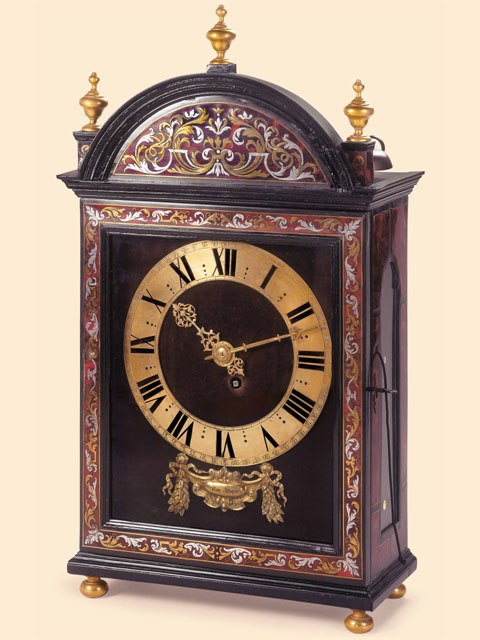
This early Religieuse pendulum clock was crafted by Nicolas Brodon in Paris, circa 1700. The clock features a rectangular case with a molded base and top, finished in an ebonized material and decorated with Boulle-style marquetry incorporating tortoiseshell, silver, and brass. The top is surmounted by a wooden arch with a molded edge and three gilt brass turned finials, supported by gilt brass bun feet. Access to the movement is provided by hinged front and back doors. The dial consists of a gilt brass ring with champlevé Roman numerals, inner quarter-hour divisions, and outer sixty-minute Arabic numerals, accompanied by elaborate gilt hands. Internally, a rectangular movement measuring 110 x 100 mm operates with a single going barrel for both the going and striking trains, a verge escapement, and a steel pendulum with silk suspension. It provides hour and half-hour striking with a pull quarter-repeating function.

A Nicolas Brodon Religieuse pendulum clock showing the gilt brass dial, Boulle-inlaid arch, and decorative finials.
A Nicolas Brodon Religieuse pendulum clock showing the gilt brass dial, Boulle-inlaid arch, and decorative finials. — Antiquorum. Rights pending — permission not yet requested. Original source

Catalogue identity

Source
catalog.antiquorum.swiss
Category
Clock · Religieuse pendulum clock
Maker / attribution
Nicolas Brodon
Reference
Not recorded
Catalogue / lot identifier
319
Source-reported date
circa 1700
Source-reported place
France

Source-reported attribution and specifications are not independent authentication. A listing does not establish present ownership, current display, availability or permission to reproduce.

Object description

Case Construction and Decor

The clock is housed in a rectangular case featuring an ebonized finish. The construction utilizes a molded base and top to define the silhouette, which is characterized by the use of Boulle-style marquetry. This decorative technique applies a combination of tortoiseshell, silver, and brass to the surface, particularly evident on the wooden arch.

The upper portion of the case is finished with a molded edge and accommodates three gilt brass turned finials. The clock rests on four gilt brass bun feet. Maintenance and access to the interior components are facilitated through hinged front and back doors.

Evidence for this section
  • “Rectangular with small molded base and top, the top withwooden arch inlaid with tortoise, silver, and brass with moldededge”
  • “three gilt brass turned finials, gilt brass bun feet, hingedfront and back door.”

Dial and Timekeeping Mechanics

The dial is formed from a gilt brass ring displaying champlevé Roman numerals. Time indicators are supplemented by inner divisions for quarter-hours and an outer track featuring Arabic numerals every five minutes. The hands are described as elaborate gilt pieces.

The movement, measuring 110 x 100 mm, utilizes a single going barrel to power both the going and striking trains. The escapement is a verge type, regulated by a steel pendulum with a small bob and a silk suspension system. A brass count wheel is positioned on the back plate of the movement.

Evidence for this section
  • “Gilt brass ring with champlevé Romannumerals, inner quarter-hour divisions and outer sixty-minuteradial Arabic figures.”
  • “single going barrel for both going and striking trains,verge escapement, steel pendulum with small bob, silk suspen-sion”

Auditory Functions and Condition

The mechanism includes an hour and half-hour striking system that functions in conjunction with a bell mounted on the top of the case. Additionally, the clock features a pull quarter-repeating function, which utilizes a configuration of three hammers striking against three distinct bells.

According to the auction house documentation, the clock is assigned a grade of AAA.

Evidence for this section
  • “striking on a bellmounted on the top of the case, pull repeating with three ham-mers on three bells.”
  • “Movement: 3* Good Overhaul recommended, at buyer's expense”

Open research questions

  • Does the current silk suspension appear to be contemporary or a later replacement?
  • Are there archival records identifying Nicolas Brodon's workshop activity in Paris during the period circa 1700?

Source evidence

Recorded claims and source quotations for Nicolas Brodon Religieuse Pendulum Clock
FieldSource-reported valueSource quotation
MakerNicolas Brodon“Nicolas Brodon A Paris”
Datecirca 1700“circa 1700”
Dimensions55 cm high, 29 cm wide“Dim. 55 cm high, 29 cm wide.”
Movement Dimensions110 x 100 mm“110 x100 mm”
EscapementVerge escapement“verge escapement”
SuspensionSilk suspension“silk suspen-sion”
SignaturesSigned on dial and movement“Signed on dial and movement.”

Visible details

  • Gilt brass bun feet supporting the rectangular case.
  • Boulle marquetry inlay visible on the arch and case frame.
  • Three gilt brass finials crowning the wooden arch.
  • Gilt brass dial with champlevé Roman numerals.

Research qualifications

  • The auction description recommends an overhaul for the movement.
  • The exact extent of original versus replaced inlay components is not explicitly documented.

Photograph identity and source facts were screened before import; rights clearance remains pending.

Terms in this record

Glossary explanations for terms named in this object’s record.