
Skip to content
The Encyclopedia of Horology

Component · Center wheel and safety pinion assembly

National Watch Company center wheel and Merritt Burt patent safety pinion

Partially verified

This component assembly consists of a brass center wheel and a steel safety pinion mechanism based on Merritt Burt's 1864 patent design, produced for the National Watch Company. Built with a threaded center arbor, the arrangement secures a hollow center pinion in place using an adjustable threaded nut. The safety design was intended to allow the nut to unscrew and the pinion to rotate freely if a mainspring broke, absorbing shock and preserving gear teeth. The National Watch Company fitted these assemblies to production movements from approximately 1867 until around 1871, when the design was superseded.

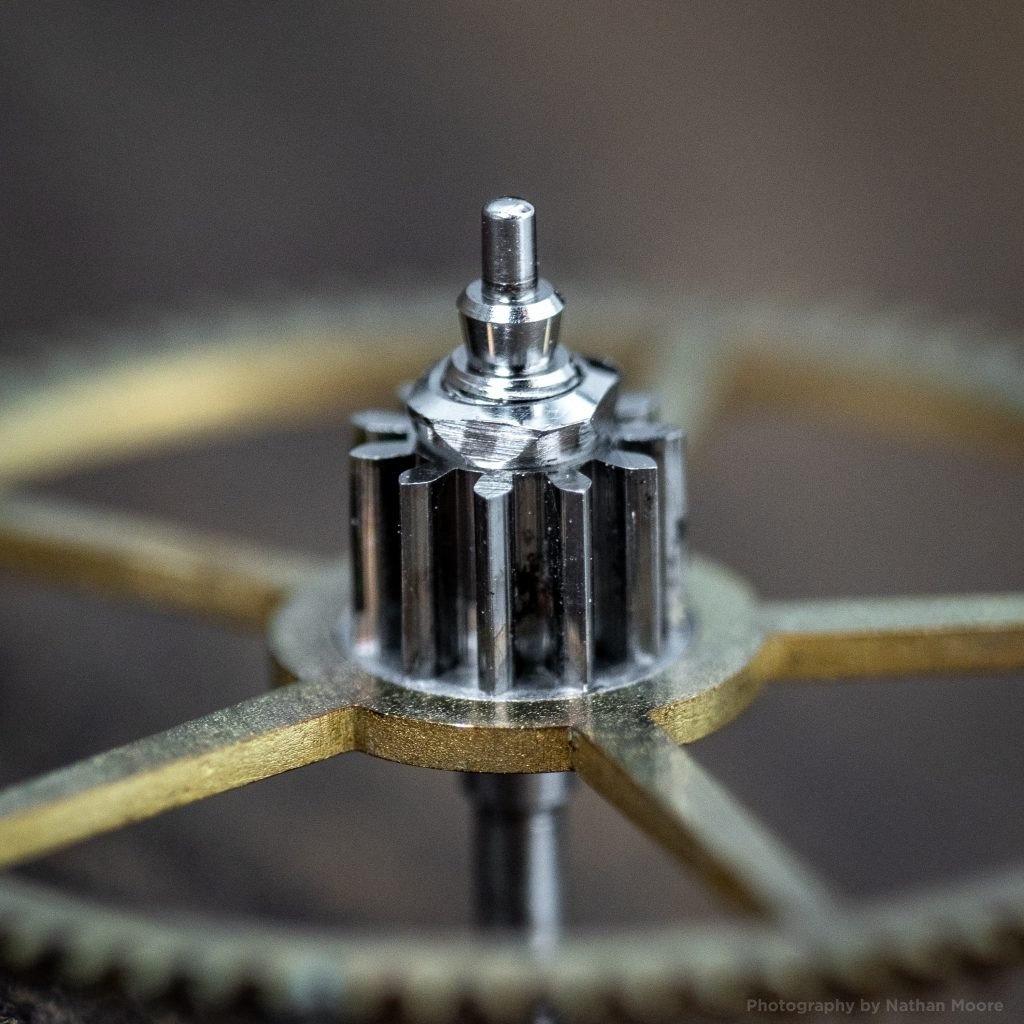
Macro photograph of assembled center wheel and Burt patent safety pinion with threaded nut installed
Macro photograph of assembled center wheel and Burt patent safety pinion with threaded nut installed — Nathan Moore. Rights pending — permission not yet requested. Original source

Catalogue identity

Source
blog.pocketwatchdatabase.com
Category
Component · Center wheel and safety pinion assembly
Maker / attribution
National Watch Company
Reference
Not recorded
Catalogue / lot identifier
Source URL identifies the listing
Source-reported date
c. 1867–1871
Country
United States

Source-reported attribution and specifications are not independent authentication. A listing does not establish present ownership, current display, availability or permission to reproduce.

Object description

Visual Morphology and Assembly

The component assembly presents a toothed steel pinion mounted on a central steel arbor positioned above a spoked brass wheel. The central arbor extends upward past the assembly with a stepped pivot tip.

A small polygonal faceted nut is tightened directly against the upper face of the center pinion leaves. The source contrasts this ungrooved appearance with later Charles S. Moseley pinions that incorporated visible grooves on top of the leaves.

Evidence for this section
  • “Macro view showing the toothed steel pinion mounted on the central steel arbor above a spoked brass wheel.”
  • “A small polygonal faceted nut is tightened directly against the upper face of the center pinion leaves.”
  • “The central arbor extends upward past the nut with a stepped pivot tip.”
  • “If grooves are visible on top of the center pinion, the design should properly be attributed to Moseley instead of Burt. If no grooves are visible, it is likely Burt’s patent pinion.”

Patent Mechanism and Function

The assembly embodies Merritt Burt's design patented on September 13, 1864, which was created to protect delicate watch parts from the shock resulting from a broken mainspring. Burt's construction utilized a threaded arbor on the center wheel to tighten a nut atop a hollowed center pinion, which would otherwise rotate freely on the shaft.

When the nut was substantially tightened, the pinion was secured for regular operation. Upon mainspring rupture, reverse force delivered from the barrel to the center pinion created friction against the nut, unscrewing it immediately and allowing the pinion to rotate freely around the arbor until the force was spent.

Evidence for this section
  • “On September 13, 1864, Merritt Burt was granted the first patent for a safety pinion design in the United States.”
  • “The primary objective of a safety pinion is to save the delicate watch parts from the sudden and destructive force that occurs when a mainspring breaks.”
  • “Merritt Burt’s design consisted of a threaded arbor on the center wheel to allow the tightening of a nut on top of a hollowed center pinion. Without the nut in place, the center pinion could rotate freely around the arbor. However, when the nut was substantially tightened, the pinion was secured for standard operation.”
  • “As a result, the friction between the pinion and the nut would immediately unscrew the nut, allowing the pinion to spin freely on the arbor until the force was entirely expended.”

Production Era and Design Obsolescence

Adopted shortly after the National Watch Company was organized, Burt's design was fitted to watches sold from the company's 1867 market debut until approximately 1871. In addition to shock absorption, Burt designed the pinion to slip if wound too tightly, but this balance proved problematic because loose nuts caused slipping while over-tight nuts risked broken pinion teeth.

Around 1871, Elgin replaced Burt's configuration with an improved design by Charles S. Moseley. Moseley's modification introduced grooves on top of the pinion leaves to generate greater friction between the nut and the pinion.

Evidence for this section
  • “Burt’s safety pinion design was adopted by the National Watch Company (Elgin) shortly after the company was organized and included in watches sold from the company’s market introduction in 1867 until approximately 1871.”
  • “One key aspect of Burt’s design that differs from other safety pinions in development at the time is that the pinion was intentionally constructed to not only save the train from sudden shock but also relieve excessive pressure if the watch was wound too tightly.”
  • “If it remained too loose, the pinion would prematurely slip while the watch was being wound. If it was installed too tight, the pinion teeth would frequently break before the force could unscrew the nut during a mainspring event.”
  • “Elgin replaced Burt’s design with an improved design by Charles S. Moseley around 1871. Moseley’s design added several grooves that provided more friction between the nut and the pinion.”

Open research questions

  • What specific National Watch Company grade and movement serial number was this center wheel assembly originally removed from?
  • Does this individual assembly show physical evidence or wear indicating whether an optional spring washer was ever present between the nut and pinion?

Source evidence

Recorded claims and source quotations for National Watch Company center wheel and Merritt Burt patent safety pinion
FieldSource-reported valueSource quotation
PatenteeMerritt Burt“On September 13, 1864, Merritt Burt was granted the first patent for a safety pinion design in the United States.”
ManufacturerNational Watch Company (Elgin)“Burt’s safety pinion design was adopted by the National Watch Company (Elgin) shortly after the company was organized”
Production erac. 1867 to c. 1871“included in watches sold from the company’s market introduction in 1867 until approximately 1871.”
Mechanical constructionThreaded arbor with securing nut and hollow pinion“Merritt Burt’s design consisted of a threaded arbor on the center wheel to allow the tightening of a nut on top of a hollowed center pinion.”
Original patent numberU.S. Patent #44161“Merritt Burt, U.S. Patent #44161”
Reissued patent dateMarch 6, 1866“Burt received a reissued patent on March 6, 1866 , which further illustrated this washer”
Top plate markingBurt's Patent (on early B.W. Raymond watches)“Early B.W. Raymond watches fitted with Burt’s Safety Pinion are marked “Burt’s Patent” on the top plate, directly under the regulator arm.”

Visible details

  • Macro view showing the toothed steel pinion mounted on the central steel arbor above a spoked brass wheel.
  • A small polygonal faceted nut is tightened directly against the upper face of the center pinion leaves.
  • The central arbor extends upward past the nut with a stepped pivot tip.

Research qualifications

  • The specific parent movement serial number and grade from which this center wheel was removed are not stated.
  • The component is shown detached from its watch movement; presence of an optional spring washer is not indicated on this example.

Photograph identity and source facts were screened before import; rights clearance remains pending.

Terms in this record

Glossary explanations for terms named in this object’s record.