
Skip to content
The Encyclopedia of Horology

Clock · Purse watch

Movado Ermeto Calendarmeto Triple Calendar Moonphase purse watch

Partially verified

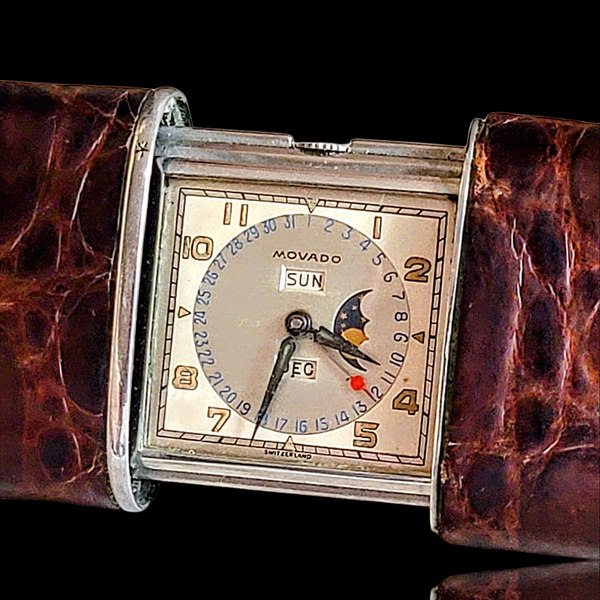
This Movado Ermeto Calendarmeto purse watch is dated by the source to circa 1940 and features a sliding travel case covered in dark brown crocodile leather. Opening and closing the two sliding covers winds the center-mounted mechanism via interior rails, alongside standard crown winding. The square dial features Arabic numerals, an inner date ring indicated by a pointer hand, apertures for day and month, and a moonphase display. The source reports that the case incorporates a folding rear stand allowing it to function as a desk or nightstand clock, measuring 76 mm wide by 36 mm tall when opened.

Front view of the opened Movado Ermeto Calendarmeto purse watch showing dial and calendar indications
Front view of the opened Movado Ermeto Calendarmeto purse watch showing dial and calendar indications — Secondhand Horology. Rights pending — permission not yet requested. Original source

Catalogue identity

Source
secondhandhorology.com
Category
Clock · Purse watch
Maker / attribution
Movado
Reference
Not recorded
Catalogue / lot identifier
WA-2028
Source-reported date
circa 1940
Country
Switzerland

Source-reported attribution and specifications are not independent authentication. A listing does not establish present ownership, current display, availability or permission to reproduce.

Object description

Object Identity and Configuration

This timepiece is identified as a Movado Ermeto Calendarmeto, a variant of the Ermeto line produced between the 1920s and 1960s. The source provides an approximate production date of 1940. The unit is described by the source as the second-largest sub-model in the series, with physical dimensions of 76 mm wide and 36 mm tall when the sliding case is fully extended.

The exterior features a covering of dark brown crocodile leather, which the source identifies as the original material. The design incorporates a pop-out rear stand, intended by the design to allow it to function as a desk or nightstand clock.

Evidence for this section
  • “This particular model is called the Movado Ermeto Calendarmeto.”
  • “The approximate date of production is 1940.”
  • “This version is the second largest version, measuring 76mm wide, by 36mm tall when open.”
  • “The case is adorned in it’s original, rich dark brown crocodile leather”
  • “It features a pop-out stand that allow it to be used as a desk or nightstand clock.”

Dial and Complications

The square metal dial is signed 'MOVADO' and marked 'SWITZERLAND' at the base. It features luminescent-style outlined Arabic numerals with arrow indices at the cardinal positions.

Calendar complications include apertures for the day and month, positioned above and below center, respectively, and a moonphase crescent on the right. A concentric track numbered 1 through 31 tracks the date, indicated by a red-tipped pointer hand.

Evidence for this section
  • “Square metal dial signed 'MOVADO' and marked 'SWITZERLAND' at the base.”
  • “Luminescent-style outlined Arabic numerals with arrow indices at the cardinals.”
  • “Central display includes an aperture for the day above center, month below center, and a moonphase crescent at right.”
  • “Concentric date track numbered 1 through 31 indicated by a red-tipped pointer hand.”

Mechanical Operation

The Ermeto utilizes a sliding travel case to drive the winding mechanism. Two internal opposing rails engage the center-mounted crown during the opening and closing movement. The source claims that six cycles are sufficient to provide 24 hours of operation, in addition to standard manual crown winding.

The movement caliber remains unrecorded in the source. The source reports that timekeeping, calendar advancements (day, date, and month), and moonphase functions are currently operational.

Evidence for this section
  • “There are two opposing rails, that when the case is opened and closed, spin the center mounted crown.”
  • “It is reported that it takes just SIX opening and closings of the case to wind the watch enough for 24 hours of operation.”
  • “All functions work…timekeeping, day advance, date advance, month advance, and moonphase advance”

Open research questions

  • What is the specific movement caliber used in the Movado Ermeto Calendarmeto?
  • Are there internal case hallmarks present to verify the circa 1940 production date?
  • What are the specific metallurgical or manufacturing specifications for the Ermeto rails?

Source evidence

Recorded claims and source quotations for Movado Ermeto Calendarmeto Triple Calendar Moonphase purse watch
FieldSource-reported valueSource quotation
Model NameMovado Ermeto Calendarmeto“This particular model is called the Movado Ermeto Calendarmeto.”
ComplicationsTriple calendar and moonphase“It also features a triple calendar (Day, Date, and Month) AND Moonphase.”
Winding MechanismSliding case action and crown winding“There are two opposing rails, that when the case is opened and closed, spin the center mounted crown.”
Open Dimensions76 mm wide by 36 mm tall“measuring 76mm wide, by 36mm tall when open.”
Covering MaterialDark brown crocodile leather“The case is adorned in it’s original, rich dark brown crocodile leather”
Stand FeaturePop-out folding stand“It features a pop-out stand that allow it to be used as a desk or nightstand clock.”
Winding MethodCrown and sliding case“It can be wound through the crown, of course, but is also would by the simple act of opening and closing the case.”
Stand FunctionalityIntegrated folding support“It features a pop-out stand that allow it to be used as a desk or nightstand clock.”

Visible details

  • Square metal dial signed 'MOVADO' and marked 'SWITZERLAND' at the base.
  • Dark brown textured crocodile leather covering on sliding shutters.
  • Central display includes an aperture for the day above center, month below center, and a moonphase crescent at right.
  • Concentric date track numbered 1 through 31 indicated by a red-tipped pointer hand.
  • Luminescent-style outlined Arabic numerals with arrow indices at the cardinals.

Research qualifications

  • Movement caliber and interior case hallmarks are not shown or recorded in the text.
  • Circa 1940 production date is source-estimated.

Photograph identity and source facts were screened before import; rights clearance remains pending.

Terms in this record

Glossary explanations for terms named in this object’s record.