
Case and Dial Design
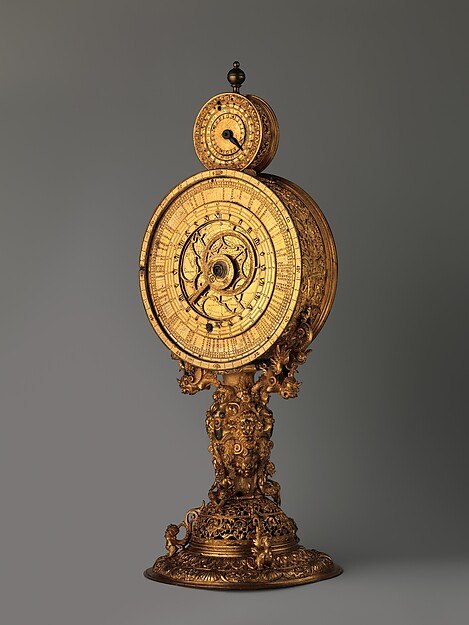
The clock is configured as a mirror clock, a form historically referred to as a monstrance clock. The structure rests on an openwork foot and is supported by a hollow stem featuring grotesque ornamentation. These decorations consist of satyrs, masks, and hybrid creatures rendered in high relief. The design elements on the base are compared to drinking vessel designs from 1551.
The dial includes a central astrolabe with a rete and a reversible tympan calibrated for 40 and 50 degrees latitude. A concentric revolving calendar ring tracks the months, days, and liturgical information. The outer chapter ring provides hour indication (I–XII) and incorporates touch pins intended for operation in low-light conditions.
Evidence for this section
- “The hollow stem of the case is covered with a distinctive variety of ornament called grotesque”
- “The tympan for the Museum’s clock is reversible and can be used for 40 degrees latitude on one side and 50 degrees latitude on the other”
- “The numerals on the hour chapter are augmented by touch pins for using the clock in darkness.”