
Skip to content
The Encyclopedia of Horology

Tool · Quadrant

Medieval Astrolabe Quadrant

Partially verified

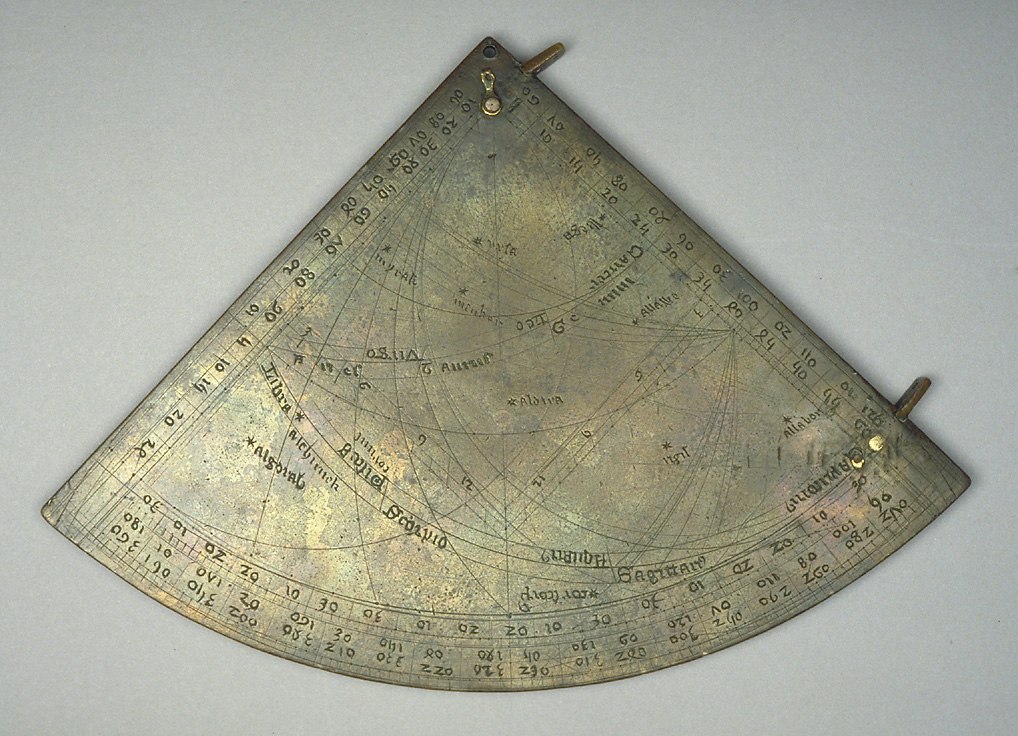
This brass astrolabe quadrant, measuring 136 mm in radius, is one of seven such instruments recorded from the medieval period. It features a design that combines the functionalities of an astrolabe with those of a quadrant. The instrument is unsigned, with an unknown origin, and remains undated. The brass plate has side lengths of 135 mm and 136 mm, with two fixed sights on one side and a hole indicating the former position of a plumb bob. The front contains complex scales for sines, cosines, declination, latitude, zodiacal signs, and unequal hour lines, alongside a shadow square and the positions of twelve identified stars. On the back, the instrument features two volvelles with indices, accompanied by zodiacal, Julian calendar, and solar cycle scales. The lunar volvelle is unfinished, rendering its associated calendrical scales non-functional.

The front of the brass astrolabe quadrant, showing the shadow square, star positions, and various astronomical scales.
The front of the brass astrolabe quadrant, showing the shadow square, star positions, and various astronomical scales. — British Museum, London. Rights pending — permission not yet requested. Original source

Catalogue identity

Source
www.mhs.ox.ac.uk
Category
Tool · Quadrant
Maker / attribution
Not established
Reference
PCII
Catalogue / lot identifier
MLA 1995,4-3.1
Source-reported date
Undated
Source-reported place
Not established

Source-reported attribution and specifications are not independent authentication. A listing does not establish present ownership, current display, availability or permission to reproduce.

Object description

Construction and Design

The quadrant is constructed from a brass plate measuring 136 mm in radius, with side lengths of 135 mm and 136 mm. Two sights are fixed to one side of the instrument, and a hole is present where a plumb bob was formerly attached. The surface displays various astronomical markings, including a shadow square with a base of 12, unequal hour lines, and two arcs depicting the ecliptic, which are divided into the 12 signs of the zodiac.

The front face contains detailed linear and circular scales. On the right-hand side, scales serve to determine sine and cosine values, while the left-hand side includes scales for declination and latitude. A double scale on the circular border provides 360 degrees of measurement. The engraving is described as lacking precision, and the lunar volvelle on the reverse remains unfinished, which prevents the use of the calendrical scales on the back.

Evidence for this section
  • “This brass instrument has sides with a length of 135 mm and 136 mm respectively with two sights fixed to one side.”
  • “the engraving is often not very precise.”
  • “The lunar volvelle has been left unfinished and the calendrical scales on the back of the quadrant are therefore useless.”

Astronomical and Calendrical Features

The instrument incorporates diverse data for astronomical calculation. The front face lists twelve stars by name, including Alchimek, Aldira, and Wega. The zodiacal signs are represented through a dedicated scale and the ecliptic arcs. Several horizon lines are present, though the specific latitudes are not labelled.

The back of the quadrant features two volvelles, each equipped with an index. These are associated with three circular scales: a zodiacal scale, a Julian calendar scale, and a solar cycle scale numbered 1 to 28. The first point of Aries is marked, though the divisions are noted as not being clearly defined.

Evidence for this section
  • “The position of 12 stars are indicated and their names given as follows: 'Alchimek, Aldira, Algorab, Allabor, Allawe, cor scorpius, coruus, menkar, myrak, rigil, ursa, Wega'.”
  • “On the back are two volvelles with an index surrounded by three circular scales.”

Historical Context and Identification

This object is catalogued as one of only seven medieval astrolabe quadrants currently recorded. The design has been associated by some with Profatius (1236?-1305), although it is noted that features found on the instrument were also present on earlier Islamic devices. The quadrant was purchased from Christie's in 1995 and is sometimes referred to as 'PCII' in academic literature, such as in the work of E. Dekker.

The instrument is currently held by the British Museum in London under the registration number MLA 1995,4-3.1. It is currently undated, and the origin remains unknown, despite its role in scientific and educational research as a representative of medieval instrument-making techniques.

Evidence for this section
  • “This is one of only seven astrolabe quadrants - an instrument which combines the features of an astrolabe with those of a quadrant - so far recorded from the medieval period.”
  • “For other related astrolabe quadrants see E. Dekker, "An Unrecorded Medieval Astrolabe Quadrant from c. 1300", Annals of Science , 52 (1995), pp. 1-47, where this quadrant is named 'PCII'.”

Open research questions

  • What is the specific provenance of the instrument prior to its 1995 sale at Christie's?
  • Can metallurgical analysis clarify the region of origin, given the lack of historical records?

Source evidence

Recorded claims and source quotations for Medieval Astrolabe Quadrant
FieldSource-reported valueSource quotation
Inventory numberMLA 1995,4-3.1“Registration no. MLA 1995,4-3.1”
MaterialBrass“Brass; 136 mm in radius”
Dimensions136 mm radius“136 mm in radius”
Star markingsTwelve stars indicated“The position of 12 stars are indicated and their names given as follows: 'Alchimek, Aldira, Algorab, Allabor, Allawe, cor scorpius, coruus, menkar, myrak, rigil, ursa, Wega'”
ProvenancePurchased from Christie's in 1995“The instrument was purchased from Christie's in 1995.”

Visible details

  • Features two fixed sights located on one side of the brass frame.
  • Engraved with twelve specific star names, including 'Alchimek', 'Aldira', and 'Wega'.
  • Equipped with a shadow square to the base 12 on the front face.
  • Includes two volvelles with indices on the reverse side.

Research qualifications

  • The provenance and specific date of manufacture remain unknown, though some research associates it with the approximate period of c. 1300.
  • The attribution of the instrument's design to Profatius is noted as a general historical perspective rather than a confirmed fact.

Photograph identity and source facts were screened before import; rights clearance remains pending.

Consulted source

Quadrant

Reviewed 2026-10-26 · Record 1da9644290

Terms in this record

Glossary explanations for terms named in this object’s record.

Other quadrant records