
Skip to content
The Encyclopedia of Horology

Tool · Quadrant

Quadrant

Partially verified

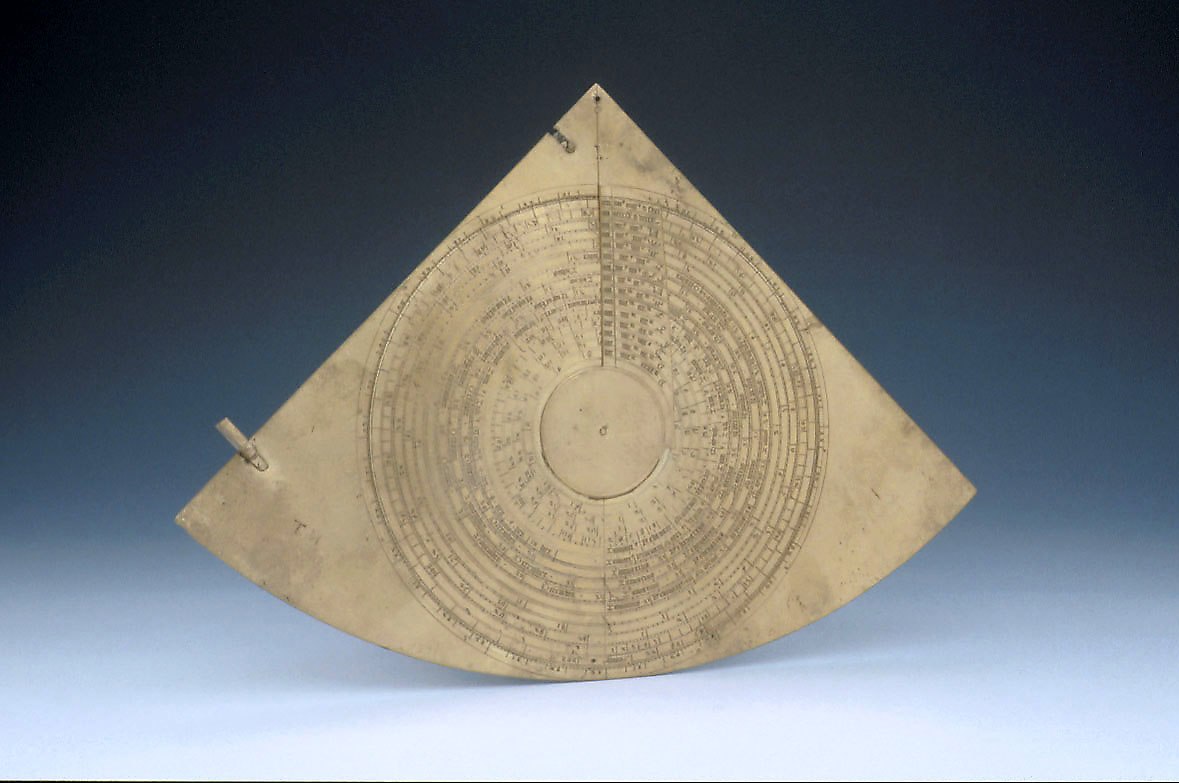
This late 15th-century brass quadrant, measuring 228 mm in radius, functions as both an observational and astrological instrument. The object is composed of two brass plates held by small rivets. The front side features a sinecal quadrant with edges graduated 0 to 60 and a limb marked 0 to 360, alongside indicators for zodiacal signs and astrological houses. A ring near the apex was intended for a plumb bob, which is now missing. The reverse side houses a rotating volvelle with a brass arm. The plate beneath the volvelle is engraved with 15 concentric circles containing various astronomical and calendar scales. The brass arm features inscriptions corresponding to these scales, relating to planetary movements such as trepidation, medius motus, and medium argumentum. John's College, Oxford.

Front view of the brass quadrant showing the volvelle, concentric scales, and brass arm.
Front view of the brass quadrant showing the volvelle, concentric scales, and brass arm. — Museum of the History of Science, Oxford. Rights pending — permission not yet requested. Original source

Catalogue identity

Source
www.mhs.ox.ac.uk
Category
Tool · Quadrant
Maker / attribution
Not established
Reference
Not recorded
Catalogue / lot identifier
16856
Source-reported date
late 15th century
Source-reported place
Not established

Source-reported attribution and specifications are not independent authentication. A listing does not establish present ownership, current display, availability or permission to reproduce.

Object description

Construction and Front Face

The quadrant is constructed from two brass plates secured by small rivets. The front face is designed for observational and calculations purposes, featuring a sinecal quadrant. The square edges are marked from 0 to 60, while the limb is graduated between 0 and 360 across two sectors.

Between these sectors are two additional sections inscribed with the names of the zodiacal signs and numbered from 1 to 12 in Gothic numbers, which identify the astrological houses. A small ring is located near the apex for mounting a plumb bob, though the bob itself is missing, and one of the instrument's sights is also absent.

Evidence for this section
  • “The quadrant is made of two brass plates held together by small rivets.”
  • “One sight is missing.”
  • “The front of the instrument has a sinecal quadrant, marked along the square edges [0] to 60 by 1, numbered by 5, twice in two directions.”

Volvelle and Astronomical Scales

The reverse side of the instrument consists of a rotating volvelle equipped with a brass arm. The main plate beneath the arm displays two concentric circles divided into 12 parts for calendar use, as well as 15 concentric circles engraved with various mathematical and astronomical data, including numerical sequences and the days of the months.

The brass arm contains inscriptions that identify the purpose of the underlying scales, including references to precession, trepidation, and the medius motus and medium argumentum of various planets, including the sun, moon, and visible planets like Saturn and Jupiter. These values provided the necessary data for astrological predictions.

Evidence for this section
  • “The back of the quadrant has a rotating volvelle with brass arm.”
  • “The brass arm bears the indication of the use of the scales: corresponding to the circles on the brass plate, are engraved: 'an mo aug z stel'”
  • “They indicate respectively the precession, the trepidation, the medius motus of Saturn, the lunar node, Jupiter, Mars, and the Sun - Mercury - Venus, the medium argumentum for the year for Saturn, Jupiter, Mars, Venus and Mercury, and the medius motus, medium argumentum and medium centrum for the moon.”

Provenance and Markings

Engraved on the back of the instrument are the initials 'T [N]', which are attributed to a former owner. Additionally, the name 'Pointer' appears faintly on this side. This refers to the collector who ultimately bequeathed the quadrant to St. John's College, Oxford.

The instrument is currently held by the Museum of the History of Science in Oxford, and it has been documented in the research of R. T. Gunther regarding early science in Oxford.

Evidence for this section
  • “On this side of the quadrant are also engraved the initials 'T [N]', probably of an owner, and, very faintly, 'Pointer', the collector who bequeathed it to St. John's College, Oxford.”
  • “See R. T. Gunther, Early Science in Oxford , (14 vols, Oxford, 1923-45).”

Open research questions

  • What specific individual does the 'T [N]' monogram represent?
  • Are there similar quadrant designs from the same period that confirm the function of the missing sight?

Source evidence

Recorded claims and source quotations for Quadrant
FieldSource-reported valueSource quotation
Inventory number16856“Inventory number: 16856”
MaterialBrass“Brass; 228 mm in radius”
Radius228 mm“228 mm in radius”
DatingLate 15th century“Late 15th century ?”
ComponentsTwo brass plates“The quadrant is made of two brass plates held together by small rivets.”
ProvenanceSt. John's College, Oxford“'Pointer', the collector who bequeathed it to St. John's College, Oxford.”

Visible details

  • Missing plumb bob
  • Missing one sight
  • Initials 'T [N]' engraved on back

Research qualifications

  • Late 15th-century dating is tentative
  • Origin is unknown

Photograph identity and source facts were screened before import; rights clearance remains pending.

Consulted source

Quadrant

Reviewed 2026-10-26 · Record d4ca88e65e

Terms in this record

Glossary explanations for terms named in this object’s record.

Other quadrant records