
Construction and Design
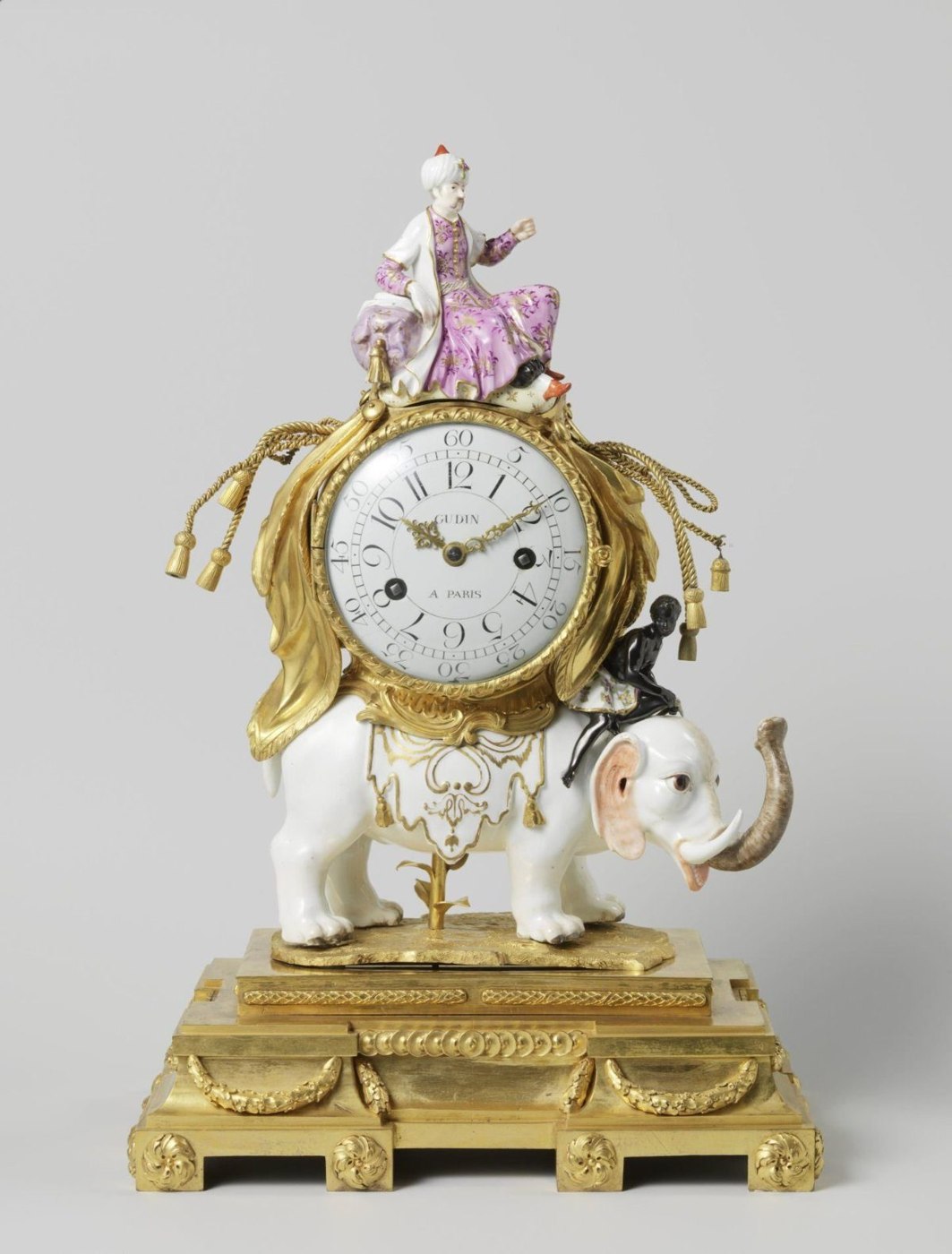
The clock is composed of a movement housed behind an enamel dial, mounted between decorative porcelain elements. The primary structural component is a polychrome porcelain elephant, which serves as a pedestal for the clock housing. A detachable porcelain figure of a sultan sits on the upper portion of the clock, while a smaller black figure is perched on the neck of the elephant. The assembly is secured to a rectangular base crafted from gilded bronze, which is decorated with relief ornamentation including garlands, rosettes, and representations of coins.
The assembly of these disparate elements was initiated by a Parisian marchand-mercier. The porcelain figures originated from the Meissener Porzellan Manufaktur. While the porcelain figures are dated to approximately 1753, the gilded bronze mountings were added shortly thereafter, in a style described as neoclassic. The total height of the object is 52.5 cm, with a width of 34.6 cm and a depth of 23.5 cm.
Evidence for this section
- “De porseleinen figuren uit Meissen zijn op aansporing van een Parijse handelaar in luxegoederen, een marchand-mercier, verwerkt in een klok, vermoedelijk omstreeks 1755.”
- “Korte tijd later is het geheel geplaatst op een verguld bronzen voet in neoclassicistische stijl.”
- “Klok die wordt gedragen door een olifant van polychroom porselein.”