
Skip to content
The Encyclopedia of Horology

Clock · Mantel clock

Mantel clock (pendule de cheminée)

Partially verified

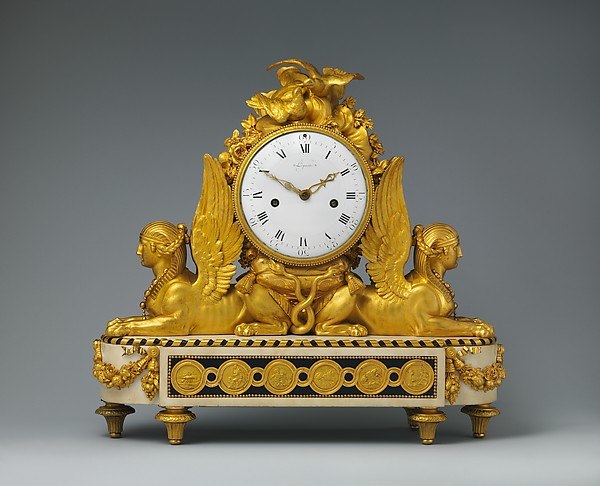
This mantel clock (pendule de cheminée), dated circa 1783, is part of the collection at The Metropolitan Museum of Art (accession number 1972.284.16). The piece is attributed to the French designer François Joseph Belanger (1744–1818). The clock measures 21 by 21 1/2 by 6 1/4 inches overall. Its construction utilizes a combination of materials, specifically gilt bronze, marble, and painted metal. The timekeeping mechanism is composed of brass and steel, housed within a frame that features an enamel dial. The aesthetic design is defined by the inclusion of sphinx figures, which are noted as a primary subject tag in the museum's documentation. The base and decorative elements incorporate further gilt bronze detailing, contributing to the clock's documented overall dimensions and form as a period horological object held in a public institution.

Front view of the mantel clock showing the sphinx ornaments and enamel dial.
Front view of the mantel clock showing the sphinx ornaments and enamel dial. — The Metropolitan Museum of Art, New York. Rights pending — permission not yet requested. Original source

Catalogue identity

Source
orbiscollectibles.com
Category
Clock · Mantel clock
Maker / attribution
François Joseph Belanger
Reference
Not recorded
Catalogue / lot identifier
1972.284.16
Source-reported date
ca. 1783
Source-reported place
France

Source-reported attribution and specifications are not independent authentication. A listing does not establish present ownership, current display, availability or permission to reproduce.

Object description

Design and Materials

The mantel clock is constructed using a variety of materials including gilt bronze, marble, and painted metal. The visual composition is centered on a circular enamel dial set within a structure adorned with sphinx figures. The clock sits on a rectangular base decorated with a series of six circular reliefs, which are set against a darker, contrasting background. Additional floral and foliate motifs in gilt bronze decorate the upper portion and corners of the clock case.

The sphinx motifs specifically serve as a thematic subject tag for the piece within the museum's documentation, linking the horological function to the broader ornamental design of the object.

Evidence for this section
  • “Gilt bronze, marble, and painted metal; enamel dial; brass and steel movement”
  • “Subject tags assigned by the museum: Sphinx.”

Horological Components

The clock face is an enamel dial, which exhibits Roman numerals for the hour markers and incorporates smaller Arabic numerals for the minutes, facilitating time reading. The movement is accessed via two winding holes positioned on the dial, which suggests a standard configuration for this type of mantel clock from the late 18th century.

The stability of the object is ensured by four feet placed at the corners of the base, allowing it to function as a shelf or mantel piece.

Evidence for this section
  • “brass and steel movement”
  • “enamel dial; brass and steel movement”

Provenance and Documentation

This clock is officially catalogued as part of The Metropolitan Museum of Art's European Sculpture and Decorative Arts department collection. It was assigned the accession number 1972.284.16. The museum's record provides the attribution to the French designer François Joseph Belanger, who was active in Paris during the late 18th century.

The documentation provided by the museum serves as the primary source for the technical and historical details of the piece. The museum notes that the clock represents a specific object within their collection, and ongoing research is requested to verify the extent to which this clock corresponds to broader maker typologies or serial productions associated with Belanger.

Evidence for this section
  • “The museum records the medium as Gilt bronze, marble, and painted metal; enamel dial; brass and steel movement”
  • “It is attributed to François Joseph Belanger (French, Paris 1744–1818 Paris).”

Open research questions

  • Does archival evidence verify François Joseph Belanger’s involvement in the design of this specific clock?
  • Are there similar mantel clocks with identical sphinx-based case designs recorded in other public or private collections?

Source evidence

Recorded claims and source quotations for Mantel clock (pendule de cheminée)
FieldSource-reported valueSource quotation
MakerFrançois Joseph Belanger“attributed to François Joseph Belanger”
Dateca. 1783“ca. 1783”
MediumGilt bronze, marble, and painted metal; enamel dial; brass and steel movement“Gilt bronze, marble, and painted metal; enamel dial; brass and steel movement”
Dimensions21 × 21 1/2 × 6 1/4 in. (53.3 × 54.6 × 15.9 cm)“Overall: 21 × 21 1/2 × 6 1/4 in. (53.3 × 54.6 × 15.9 cm)”
Accession number1972.284.16“1972.284.16”
InstitutionThe Metropolitan Museum of Art“The Metropolitan Museum of Art, New York”

Visible details

  • The dial features Roman numerals for the hours and Arabic numerals for the minutes.
  • The clock case is supported by four feet and incorporates two flanking sphinx figures with wings.
  • The central base features a series of six circular relief panels mounted on a dark background.

Research qualifications

  • The exact extent to which this object represents a broader collectible type remains to be independently verified.
  • Attribution to François Joseph Belanger is provided as an expert association rather than a maker's mark.

Photograph identity and source facts were screened before import; rights clearance remains pending.

Consulted source

Mantel clock (pendule de cheminée), ca. 1783

Reviewed 2026-11-02 · Record fcbfa0db55

Terms in this record

Glossary explanations for terms named in this object’s record.