
Skip to content
The Encyclopedia of Horology

Clock · Bracket clock

Louis XIV-style bracket clock with matching bracket

Partially verified

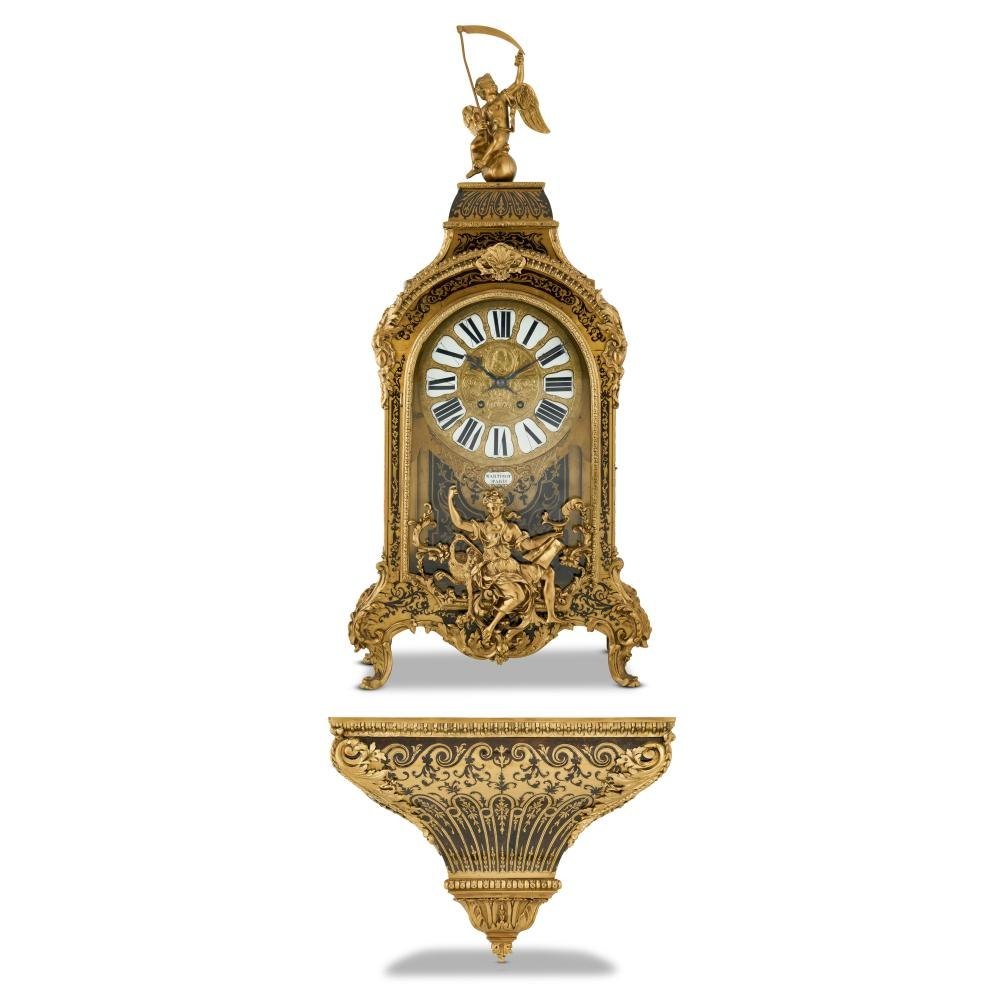
This early 20th-century bracket clock and matching wall bracket are designed in the Louis XIV style, in the manner of the French clockmaker Jerôme Martinot. The clock features an upright, glazed case constructed in the Boulle manner, characterized by an intricate inlay of cut brass against a ground of simulated tortoiseshell. The exterior is adorned with extensive gilt bronze mounts, including a winged putto figure holding a scythe at the crest and an allegorical female figure positioned on the front panel. The dial displays enamelled Roman numerals set on a brass ground, featuring a central portrait of the Sun King. Below the dial, the clock is inscribed with the signature 'MARTINOT Á PARIS'. Internally, the timepiece is powered by an eight-day countwheel movement that strikes on a bell. The complete assembly includes a winding key.

Front view of the Louis XIV-style bracket clock, including the matching wall bracket.
Front view of the Louis XIV-style bracket clock, including the matching wall bracket. — Auction house “Leonard Joel”, via Invaluable. Rights pending — permission not yet requested. Original source

Catalogue identity

Source
orbiscollectibles.com
Category
Clock · Bracket clock
Maker / attribution
Jerôme Martinot
Reference
Not recorded
Catalogue / lot identifier
Source URL identifies the listing
Source-reported date
Early 20th century
Source-reported place
France

Source-reported attribution and specifications are not independent authentication. A listing does not establish present ownership, current display, availability or permission to reproduce.

Object description

Case and Ornamentation

The clock and its accompanying wall bracket are executed in the Louis XIV style using the Boulle technique. The case is constructed from a simulated tortoiseshell ground, inlaid with detailed patterns of cut brass. The structure is supported by gilt bronze mounts, which provide the framework for the decorative elements.

The ornamentation includes figurative bronze elements. A winged putto, shown holding a scythe, serves as the finial at the top of the clock. On the main body of the case, an allegorical female figure is mounted centrally. The decorative program is completed by the matching bracket, which continues the Boulle-style brass inlay motif.

Evidence for this section
  • “The clock features an upright glazed case crafted in the Boulle manner, showcasing an intricate inlay of cut brass set against a simulated tortoiseshell ground.”
  • “The piece is lavishly decorated with gilt bronze mounts, including an allegorical female figure mounted on the front and a winged putto holding a scythe positioned atop the clock.”

Dial and Signature

The dial of the clock consists of a brass base featuring applied enamelled Roman numerals. At the center of the dial is a portrait depicted as the Sun King.

The inscription 'MARTINOT Á PARIS' is located below the dial, directly referencing the French clockmaker Jerôme Martinot, though the object is described as being in his manner rather than a production of his specific workshop.

Evidence for this section
  • “The dial incorporates enamelled Roman numerals on a brass ground, centered with a portrait identified as the Sun King, with the signature 'MARTINOT Á PARIS' inscribed below.”

Movement and Technical Details

The internal mechanism is an eight-day movement utilizing a countwheel system. The clock is designed to strike the hour on an internal bell.

The overall assembly includes the clock and the matching bracket, with a winding key provided. The dimensions of the clock stand at 88cm in height, while the bracket adds to the overall display height when mounted.

Evidence for this section
  • “Technically, the timepiece is powered by an eight-day countwheel movement that strikes on a bell.”
  • “A winding key is included with the assembly.”

Open research questions

  • What is the specific composition of the 'simulated' tortoiseshell material used in this early 20th-century construction?
  • Can the foundry responsible for the bronze mounts be identified through casting marks or secondary style analysis?

Source evidence

Recorded claims and source quotations for Louis XIV-style bracket clock with matching bracket
FieldSource-reported valueSource quotation
DateEarly 20th century“early 20th-century bracket clock”
MakerJerôme Martinot“in the manner of Jerôme Martinot”
Clock Dimensions88cm H x 39cm W x 14cm D“The clock measures 88cm in height, 39cm in width, and 14cm in depth”
Bracket Dimensions29cm H x 41cm W x 18cm D“the conforming bracket measures 29cm high, 41cm wide, and 18cm deep”
MovementEight-day countwheel“powered by an eight-day countwheel movement”
MaterialsGilt bronze, brass, simulated tortoiseshell, enamel“Gilt bronze, brass, simulated tortoiseshell, enamel”
SignatureMARTINOT Á PARIS“signature 'MARTINOT Á PARIS' inscribed below”

Visible details

  • Winged putto with scythe on crest
  • Allegorical female figure on front
  • Enamelled Roman numerals on dial
  • Simulated tortoiseshell and brass inlay

Research qualifications

  • 'In the manner of' implies this is not an authentic 17th/18th-century piece by Martinot
  • Dating to the early 20th century is based on the source description

Photograph identity and source facts were screened before import; rights clearance remains pending.

Terms in this record

Glossary explanations for terms named in this object’s record.