
Skip to content
The Encyclopedia of Horology

Clock · Bracket clock

Louis XIV clock attributed to Bernard I Van Risamburgh

Partially verified

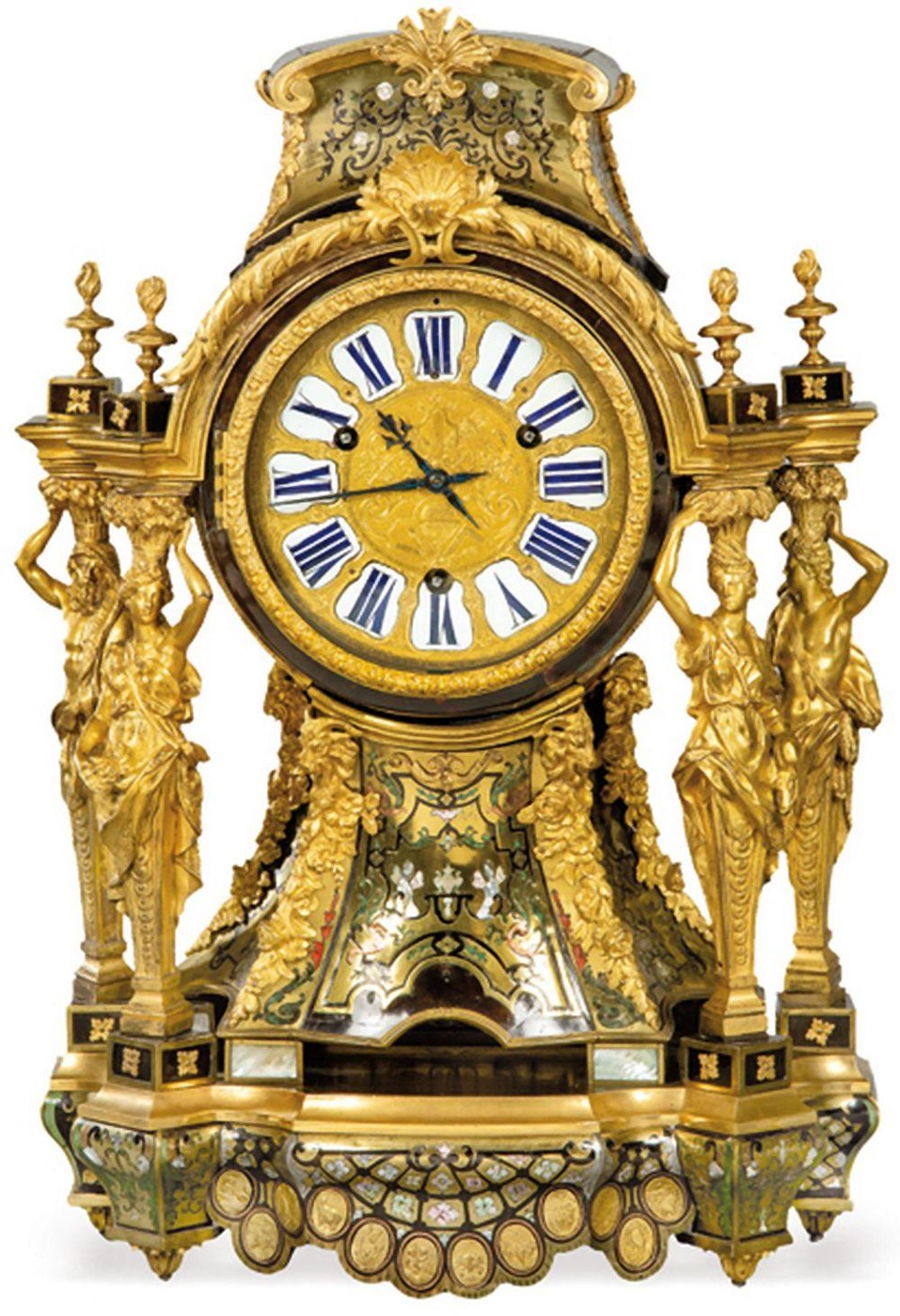
This Louis XIV bracket clock is attributed to the cabinetmaker Bernard I Van Risamburgh (BVRB I) and features a movement signed by the clockmaker Chabrolle of Paris. The case is constructed from stained oak and ebony veneer, incorporating elaborate Boulle marquetry composed of tortoiseshell, brass, stained horn, and mother-of-pearl. The exterior is highly decorative, featuring chased and gilt bronze mounts. The clock is topped by a shell motif framed by foliage scrolls. The circular dial displays enameled Roman numerals and is flanked by four caryatid-shaped supports representing the four seasons, each surmounted by a fire pot. The base is decorated with foliage patterns in the style of Bérain, floral motifs, and inlaid medallions depicting the signs of the Zodiac. It rests on supports featuring ram's head appliqués and falling rose motifs. The lower plate includes an intertwined monogram 'MB'.

Frontal view of the Louis XIV bracket clock showing the dial, gilt bronze caryatid figures, and the marquetry base with Zodiac medallions.
Frontal view of the Louis XIV bracket clock showing the dial, gilt bronze caryatid figures, and the marquetry base with Zodiac medallions. — Subastas Segre (via Invaluable). Rights pending — permission not yet requested. Original source

Catalogue identity

Source
www.invaluable.com
Category
Clock · Bracket clock
Maker / attribution
Bernard I Van Risamburgh (attributed); Chabrolle (movement)
Reference
Not recorded
Catalogue / lot identifier
1282
Source-reported date
early 18th century
Source-reported place
France

Source-reported attribution and specifications are not independent authentication. A listing does not establish present ownership, current display, availability or permission to reproduce.

Object description

Case Construction and Ornamentation

The case of this Louis XIV clock reflects the traditional aesthetic of the period, employing a complex material palette. It is built upon a substrate of stained oak and ebony veneer, which serves as the foundation for an elaborate Boulle marquetry. This intricate veneer work utilizes a combination of tortoiseshell, brass, stained horn, and mother-of-pearl to create decorative patterns, particularly on the lower section of the base.

The visual profile is defined by extensive chased and gilt bronze mounts. These include decorative applications of ram's heads, falling roses, and a Bérain-style foliage motif at the center. The crest of the clock is adorned with a large shell motif flanked by foliage scrolls, while the mid-section features four distinct caryatid figures representing the four seasons, each supporting a fire pot atop its head.

Evidence for this section
  • “In stained oak and ebony veneer, Boulle marquetry of tortoiseshell, brass, stained horn, and mother-of-pearl, and ornamentation of chased and gilt bronze”
  • “flanked by four caryatid-shaped supports embodying the four seasons topped by fire pots”
  • “centered with a Bérain-style foliage decoration, the base decorated with flowers and inlaid with medallions representing the signs of the Zodiac”

Dial and Movement

The dial is circular and composed of individual enamel cartouches displaying Roman numerals. These numerals are executed in a blue enamel, contrasting with the metallic face. The movement is attributed to the clockmaker Chabrolle, who was active in Paris. The signature is placed directly on the movement.

The movement's precise mechanics are housed within the elaborate case, which serves as both a housing for the timekeeping mechanism and an independent display piece. The lower plate of the mechanism between the clock feet bears an intertwined monogram consisting of the letters 'MB', which serves as an additional identifier on the internal components.

Evidence for this section
  • “the circular dial with enameled Roman numerals”
  • “the movement signed 'Chabrolle à Paris'”
  • “the lower plate between both feet bears the inscription of the intertwined monogram 'MB'”

Attribution and Comparative History

The clock is attributed to the cabinetmaker Bernard I Van Risamburgh, commonly known by the acronym BVRB I.

While the clock is attributed to his workshop, the auction description notes that similar examples exist, including one previously sold at Christie's in November 2020.

Evidence for this section
  • “Louis XIV clock attributed to Bernard I Van Risamburgh (BVRB I)”
  • “A clock similar to this one was sold at Christie's Paris on November 24, 2020, lot 85.”
  • “After his death in 1738, his workshop, famous for its marquetry clocks, continued to influence furniture design during the early years of Louis XV's reign.”

Open research questions

  • What is the definitive identity of the individual or entity represented by the 'MB' monogram found on the movement plate?
  • Are there existing workshop records or specific comparative studies that confirm the attribution of this specific clock to the hand of Bernard I Van Risamburgh?

Source evidence

Recorded claims and source quotations for Louis XIV clock attributed to Bernard I Van Risamburgh
FieldSource-reported valueSource quotation
MaterialStained oak, ebony veneer, Boulle marquetry of tortoiseshell, brass, stained horn, and mother-of-pearl, chased and gilt bronze“In stained oak and ebony veneer, Boulle marquetry of tortoiseshell, brass, stained horn, and mother-of-pearl, and ornamentation of chased and gilt bronze”
Dimensions70 x 22 x 45 cm“Measurements: 70 x 22 x 45 cm”
Movement signatureChabrolle à Paris“the movement signed 'Chabrolle à Paris'”
Base detailsBérain-style foliage, flower decorations and Zodiac medallions“centered with a Bérain-style foliage decoration, the base decorated with flowers and inlaid with medallions representing the signs of the Zodiac”
Figural elementsFour caryatid-shaped supports embodying the four seasons“flanked by four caryatid-shaped supports embodying the four seasons topped by fire pots”
MonogramMB“the lower plate between both feet bears the inscription of the intertwined monogram 'MB'”

Visible details

  • Four caryatid-shaped figures flanking the central dial
  • Twelve white enamel cartouches with blue Roman numerals
  • Inlaid Zodiac medallions along the bottom section of the base
  • Integrated gilt bronze foliage and shell ornament at the clock's crest

Research qualifications

  • Attribution to Bernard I Van Risamburgh remains a historical attribution rather than a documented certainty
  • The significance and specific history of the 'MB' monogram are not fully identified in the source description

Photograph identity and source facts were screened before import; rights clearance remains pending.

Terms in this record

Glossary explanations for terms named in this object’s record.