
Skip to content
The Encyclopedia of Horology

Clock · Longcase clock

Longcase clock by Jan Hermelinck

Partially verified

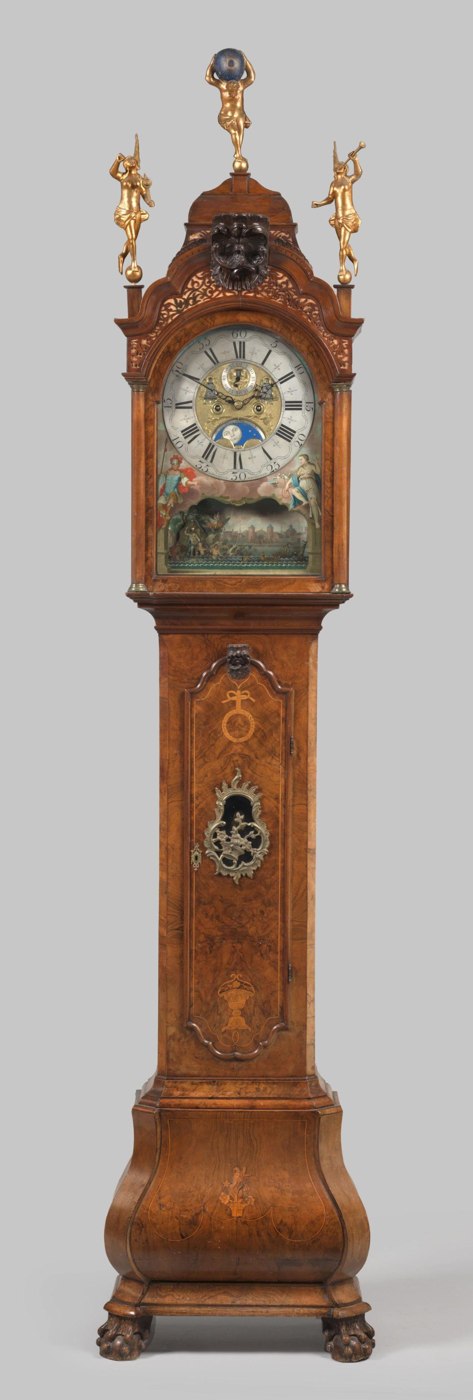
This longcase clock, dating between 1750 and 1799, is the work of Amsterdam-based clockmaker Jan Hermelinck. The construction consists of an oak case veneered in walnut, featuring a distinctive S-shaped base supported by claw feet. The clock stands at 285 cm in height. The front door of the case is shaped with scalloped edges and includes a central aperture with copper fittings, displaying marquetry imagery of a vase and a ribbon-tied wreath. The hood is topped with a rocaille-decorated crest, flanked by gilded figures of Fame and Atlas. The dial is signed "Jan Hermelink Amsterdam" and is further enriched with a painted scene beneath it depicting mythological figures. This piece was acquired by the Rijksmuseum in 1948 as a gift from Mrs. Z. Beversen-Siemons, Soestdijk.

Full view of the longcase clock by Jan Hermelinck, showing the walnut-veneered case, gilded crest figures, and painted dial area.
Full view of the longcase clock by Jan Hermelinck, showing the walnut-veneered case, gilded crest figures, and painted dial area. — Rijksmuseum. Rights pending — permission not yet requested. Original source

Catalogue identity

Source
www.rijksmuseum.nl
Category
Clock · Longcase clock
Maker / attribution
Jan Hermelinck
Reference
BK-16099
Catalogue / lot identifier
BK-16099
Source-reported date
ca. 1750 - voor 1799
Source-reported place
Netherlands

Source-reported attribution and specifications are not independent authentication. A listing does not establish present ownership, current display, availability or permission to reproduce.

Object description

Case and Exterior Design

The longcase clock features a structural core of oak, finished with walnut veneer. The base is notably S-shaped and rests on four claw-style feet. A central feature of the waist is the scalloped door, which incorporates a decorated window with copper fittings. This panel displays lighter wood marquetry depicting a ribbon-bound vase and wreath motif.

The hood section mirrors the case's scalloped aesthetic and is capped with a crest featuring rocaille ornamentation. The upper corners are supported by Tuscan-style columns. Three gilded figures finish the top, comprising two representations of Fame and one central figure of Atlas carrying the world.

Evidence for this section
  • “Staande klok in eiken kast belijmd met notenhout.”
  • “De boven en onder uitgeschulpte kastdeur heeft een ruitje met koperen beslagstuk en toont een vaas en strik met krans in marqueterie in lichtere houtsoort.”
  • “De kap heeft een uitgeschulpte kaplijst met kuifstuk met rocailles; op de hoeken Toscaanse zuilen.”
  • “Drie vergulde figuren, twee van de Faam en Atlas, bekronen de kap.”

Dial and Dial-Area Decoration

The dial acts as the primary focal point for the clock's timekeeping and decorative display. It bears the signature of the maker, documented as "Jan Hermelink Amsterdam" in the museum records. This specific spelling differs slightly from the catalogued name "Jan Hermelinck."

Positioned immediately beneath the main dial face is an additional artistic panel. This area contains hand-painted elements, which include mythological subjects and various figures. This scene is integrated into the clock's front aesthetic, positioned below the dial chapter ring.

Evidence for this section
  • “signatuur, wijzerplaat: ‘Jan Hermelink Amsterdam’”
  • “Onder de wijzerplaat zijn een mythologische voorstelling en figuren geschilderd.”

Provenance and Acquisition

The clock entered the collection of the Rijksmuseum in 1948. It was acquired as a formal donation from Mrs. Z. Beversen-Siemons of Soestdijk. The object is registered within the museum system under the number BK-16099.

The provenance is limited to the donor information provided upon acquisition. There is no listed documentation regarding the ownership history prior to 1948 or any specific information regarding its manufacture location beyond the attribution to the Amsterdam-based maker.

Evidence for this section
  • “Schenking van mevrouw Z. Beversen-Siemons, Soestdijk”
  • “schenking 1948”
  • “Objectnummer BK-16099”

Open research questions

  • What is the reason for the discrepancy between the dial signature spelling 'Hermelink' and the recorded maker 'Hermelinck'?
  • Does the movement contain additional indicators for the moon phase or calendar features beyond the visual elements on the dial?

Source evidence

Recorded claims and source quotations for Longcase clock by Jan Hermelinck
FieldSource-reported valueSource quotation
MakerJan Hermelinck“uurwerkmaker: Jan Hermelinck, Amsterdam”
Dateca. 1750 - voor 1799“ca. 1750 - voor 1799”
Object NumberBK-16099“Objectnummer BK-16099”
Case materialsOak case veneered with walnut“Staande klok in eiken kast belijmd met notenhout.”
SignatureJan Hermelink Amsterdam“signatuur, wijzerplaat: ‘Jan Hermelink Amsterdam’”
Height285 cm“hoogte 285 cm”
ProvenanceSchenking van mevrouw Z. Beversen-Siemons, Soestdijk“Schenking van mevrouw Z. Beversen-Siemons, Soestdijk”

Visible details

  • Hood features a central figure of Atlas and two side figures of Fame
  • Dial includes a moon phase or calendar disc and Roman numerals
  • Central waist door contains a metal escutcheon plate with ornate cut-outs
  • Base displays light wood marquetry inlay on the walnut veneer

Research qualifications

  • The date range is broad, spanning nearly half a century
  • The signature spelling 'Hermelink' on the dial varies from the maker's recorded name 'Hermelinck'
  • The exact technical configuration of the movement is not detailed

Photograph identity and source facts were screened before import; rights clearance remains pending.

Consulted source

Longcase clock, Jan Hermelinck Amsterdam

Reviewed 2026-11-02 · Record c3df84eb65

Terms in this record

Glossary explanations for terms named in this object’s record.