
Skip to content
The Encyclopedia of Horology

Clock · Skeleton clock

Late-Victorian English Skeleton Clock

Partially verified

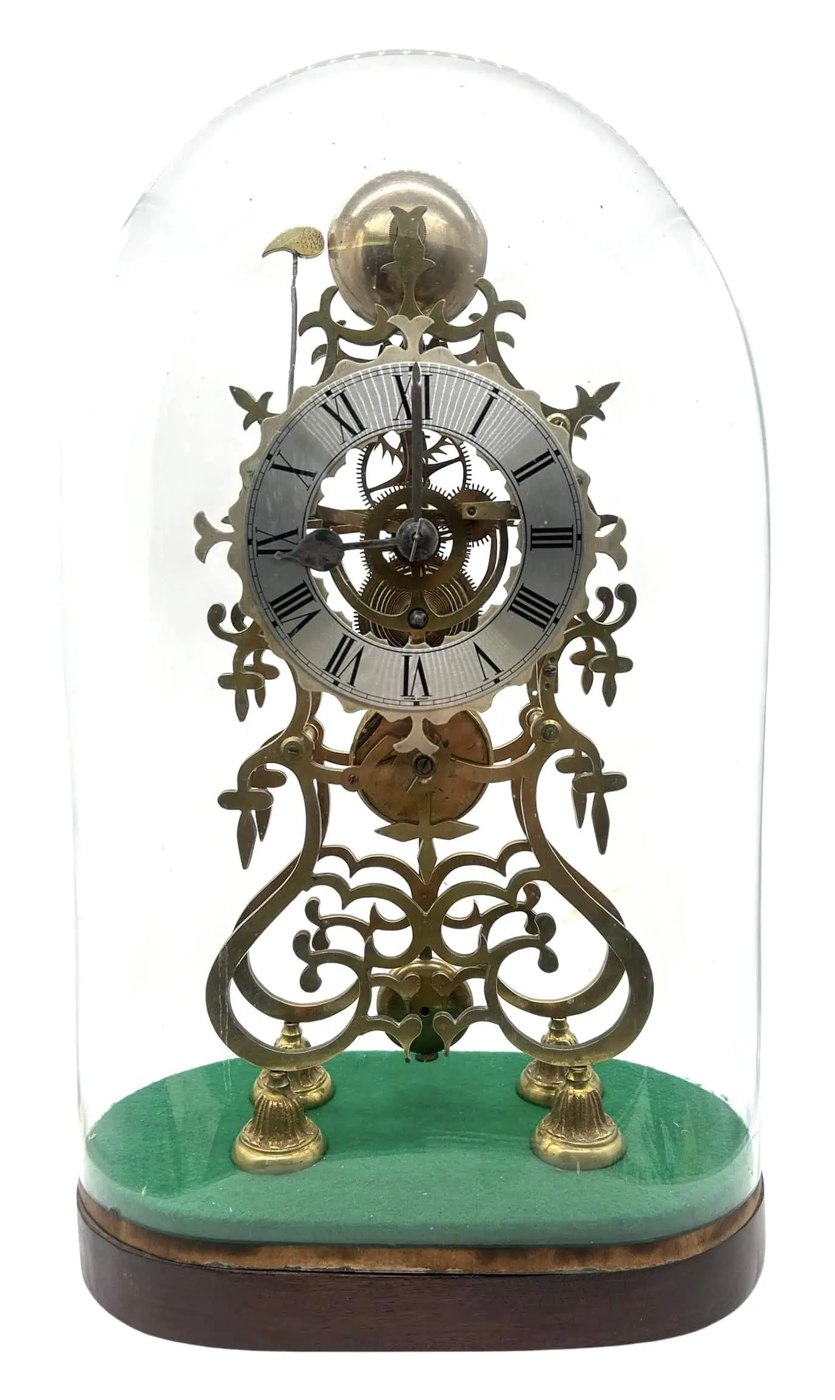
This late-Victorian skeleton clock is an 8-day timepiece of English origin, manufactured circa 1880. The mechanism is mounted within a frame of cut-out brass plates, designed to display the movement and wheelwork. It is powered by an 8-day single-chain fusee movement regulated by an anchor recoil escapement. The dial consists of a fretted, silvered skeletonised chapter ring featuring Roman numerals. The clock is housed under a protective glass dome and stands on a mahogany plinth base. Measuring 50cm in height, 50cm in width, and 30cm in depth, the piece exhibits an authentic patina on the brass elements. The auction description notes that the steel hands and the chapter ring are replacements. The clock is reported by the seller to be in working order and maintaining reliable time, with sound fusee chain and spring tension.

Front view of the 8-day fusee skeleton clock under its glass dome, showing the fretted brass frame and silvered chapter ring.
Front view of the 8-day fusee skeleton clock under its glass dome, showing the fretted brass frame and silvered chapter ring. — Vintage Clocks UK. Rights pending — permission not yet requested. Original source

Catalogue identity

Source
vintageclocks.uk
Category
Clock · Skeleton clock
Maker / attribution
Not established
Reference
Not recorded
Catalogue / lot identifier
JN151
Source-reported date
circa 1880
Source-reported place
England
Source-reported serial
JN151

Source-reported attribution and specifications are not independent authentication. A listing does not establish present ownership, current display, availability or permission to reproduce.

Object description

Movement and Escapement

The clock is built around an 8-day duration single-chain fusee movement. This mechanical system is designed to provide consistent power to the gear train.

The auction description confirms that the movement is in working order and capable of keeping reliable time. The internal components, including the fusee chain and spring tension, are reported to be sound, supporting the clock's ongoing operation within its open frame construction.

Evidence for this section
  • “Driven by a high-quality 8-day single-chain fusee movement”
  • “Escapement:Anchor recoil escapement.”
  • “The Movement:In working order, keeping reliable time.”

Case and Dial

The clock features a skeletonised aesthetic, utilizing a frame made of cut-out brass plates. This structural design exposes the internal wheelwork of the timepiece to view from all angles through the protective glass dome. The clock is mounted on a mahogany plinth base which supports the brass structure.

The dial is presented as a silvered chapter ring with Roman numerals. According to the provided information, the chapter ring and the steel hands are replacements for the original components. The brass frame itself is noted as having an authentic patina, with the silvered dial described as remaining crisp and legible.

Evidence for this section
  • “features finely cut-out brass plates that beautifully expose the intricate wheelwork”
  • “Dial:Fretted, silvered skeletonised chapter ring Roman numerals replaced”
  • “Hands: – steel hands Replaced”
  • “The brass plates possess a beautiful, authentic patina.”

Condition and Maintenance

The seller reports that the clock is currently functional and maintains accurate time. The integrity of the power delivery system, specifically the fusee chain and the spring tension, is confirmed as being in good working order. There is no damage reported to the brass structure or the glass housing.

For transportation purposes, the auction description provides instructions regarding the secure handling of the object.

Evidence for this section
  • “The Movement:In working order, keeping reliable time. The fusee chain and spring tension are sound.”
  • “The clock will be meticulously packed, ensuring the pendulum, weights, and dome are separated and protected safely for transit.”

Open research questions

  • Is there any maker signature on the back plate or base that was not captured in the provided photographs?
  • What is the specific history of the clock's restoration, particularly concerning the replacement of the hands and chapter ring?

Source evidence

Recorded claims and source quotations for Late-Victorian English Skeleton Clock
FieldSource-reported valueSource quotation
OriginEngland“Origin:England / British horology.”
Datecirca 1880“Period:Late Victorian, circa 1880.”
Movement8-day single-chain fusee“8-day single-chain fusee timepiece movement.”
EscapementAnchor recoil“Escapement:Anchor recoil escapement.”
Dimensions50cm x 50cm x 30cm“Measures 50cm high, 50cm wide, 30cm deep”
SerialJN151“SKU: JN151”

Visible details

  • Fretted brass frame with ornamental cut-out detailing
  • Silvered chapter ring with black Roman numerals
  • Single-chain fusee movement construction
  • Mahogany plinth base and protective glass dome

Research qualifications

  • The source notes the hands and chapter ring are replacements.
  • The source provides no specific maker attribution beyond 'English' origin.

Photograph identity and source facts were screened before import; rights clearance remains pending.

Consulted source

Fine Late-Victorian English 8-Day Fusee Skeleton Clock (Circa 1880)

Reviewed 2026-11-02 · Record 2853423567

Terms in this record

Glossary explanations for terms named in this object’s record.